Lim Hee-Sook, Kim Hee-Seon, Kim Jin Kuk, Park Mooyong, Choi Soo Jeong
Department of Food Sciences & Nutrition, Yeonsung University, Anyang 14011, Korea.
Department of Food Sciences & Nutrition, Soonchunhyang University, Asan 31538, Korea.
Clin Nutr Res. 2019 Jan 29;8(1):28-35. doi: 10.7762/cnr.2019.8.1.28. eCollection 2019 Jan.
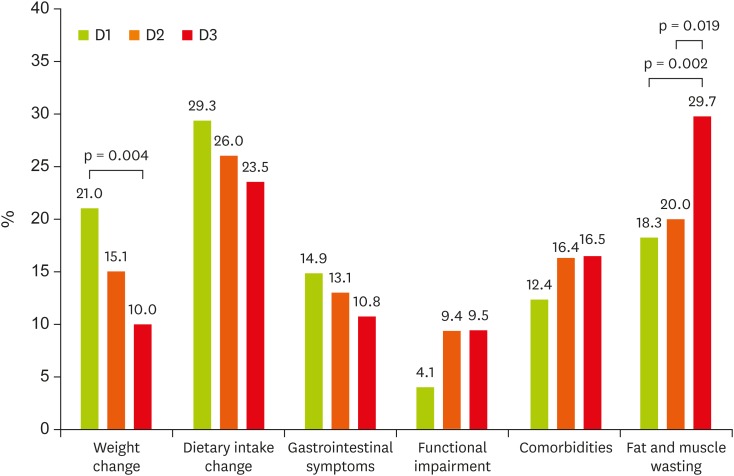
As the incidence of chronic diseases such as diabetes and hypertension increases, complications such as decreased renal function are also increasing in many patients. Nutritional management in hemodialysis patients is a very important factor for prognosis and quality of life. The purpose of this study was to investigate the differences in nutritional status and dietary management according to hemodialysis duration. A total of 145 patients were divided into 4 groups according to hemodialysis duration: less 1 year (D1), 1-5 years (D2), and above 5 years (D3). The rates of protein-energy wasting were 31.1% in D1 group, 49.5% in D2 group, and 47.6% in D3 group. However, there was no significant difference between the 3 groups. Nutrient intake analysis showed that protein, iron, and vitamin C were significantly lower in the D3 group than in the D1 group. Protein intake in all 3 groups was insufficient compared to the recommended dietary amount for dialysis patients. The most difficult aspect in dietary management was cooking with low sodium. In the D3 group, which had the longest duration of dialysis, the practice of diet therapy and self-perceived need for nutrition education was lowest. Observations of nutritional status are necessary to maintain the health status of dialysis patients. In addition, education plans should be prepared to mediate the nutrient intakes and identify the patient's difficulties and provide practical help.
随着糖尿病和高血压等慢性病的发病率上升,许多患者肾功能下降等并发症也在增加。血液透析患者的营养管理是影响预后和生活质量的一个非常重要的因素。本研究的目的是调查根据血液透析时长的营养状况和饮食管理的差异。总共145名患者根据血液透析时长被分为4组:少于1年(D1)、1至5年(D2)、5年以上(D3)。D1组的蛋白质能量消耗率为31.1%,D2组为49.5%,D3组为47.6%。然而,这3组之间没有显著差异。营养摄入分析表明,D3组的蛋白质、铁和维生素C显著低于D1组。与透析患者的推荐饮食量相比,所有3组的蛋白质摄入量都不足。饮食管理中最困难的方面是低钠烹饪。在透析时间最长的D3组中,饮食疗法的实践和自我感知的营养教育需求最低。观察营养状况对于维持透析患者的健康状况是必要的。此外,应该制定教育计划来调节营养摄入,识别患者的困难并提供实际帮助。