Department of Urology, Institute of Urology, West China Hospital, Sichuan University, 37# Guoxuexiang Street, Chengdu, 610041, People's Republic of China.
World J Surg Oncol. 2019 Feb 12;17(1):30. doi: 10.1186/s12957-018-1555-7.
Oncostatin M receptor (OSMR) represents a part of the interleukin-six (IL6) cytokine group that was discovered recently to be closely associated with cell's growth and differentiation, inflammation, and enhancement of metastatic capacity. A comprehensive study suggests a close relationship between OSMR and papillary thyroid cancer, colorectal cancer, breast cancer, and other tumors. However, the relationship between OSMR and bladder cancer has yet to be determined.
Three hundred six patients (including 142 patients with muscle-invasive bladder cancer and 164 patients with non-muscle-invasive bladder cancer) as well as 459 normal controls were included in this study. Two tag SNPs of OSMR, rs2278329, and rs2292016 were genotyped by TaqMan® SNP Genotyping Assay method and then the associations with bladder cancer were analyzed, as well as risk factors and prognosis.
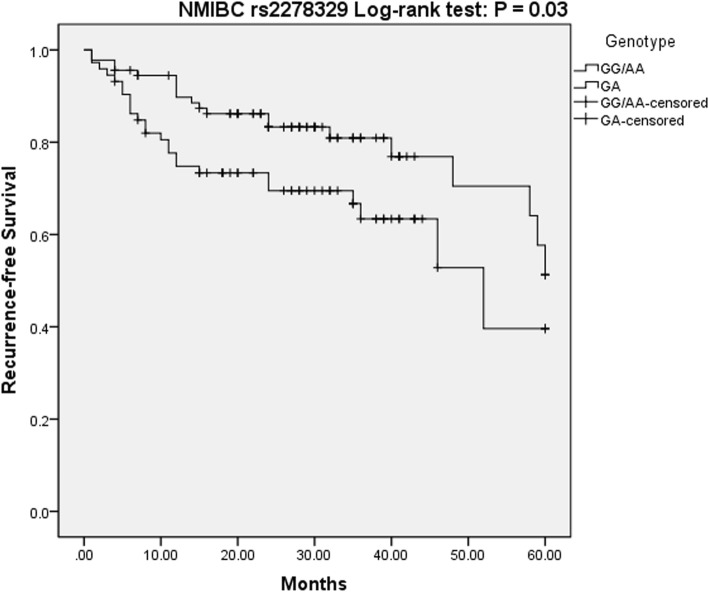
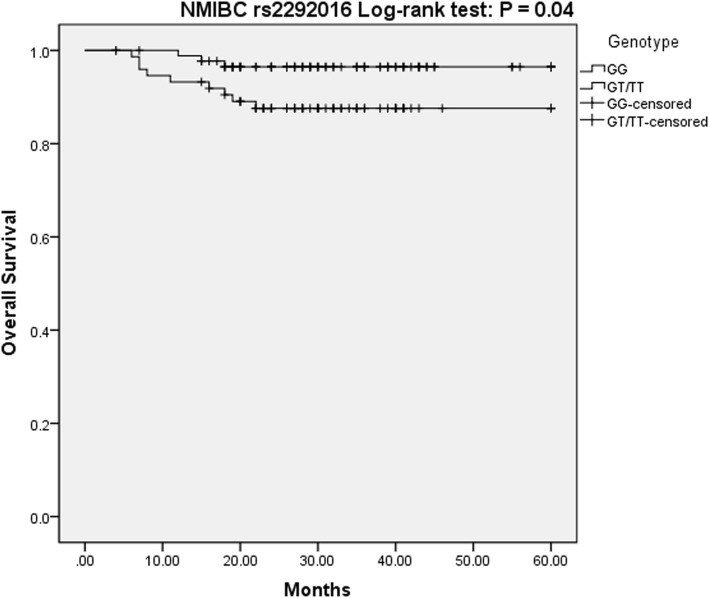
Patients with bladder cancer and controls did not differ significantly in terms of genotype frequencies and allele frequency distribution of rs2278329 (P = 0.77, OR = 0.97) and rs2292016 (P = 0.39, OR = 1.20) respectively. For rs2278329, no differences were found in terms of risk factors in stratified analyses. However, rs2292016 was associated with recurrence and tumor grade. GT/TT was found to increase the risk of relapse compared to the patients without allele T (GG genotype) (P = 0.016, OR = 1.878, 95% CI = 1.12-3.14) with the T allele of rs2292016 being a risk factor for recurrence (P = 0.032, OR = 0.67, 95% CI = 0.47-0.97). Besides, patients with GT genotype often present with high-grade bladder cancer (P = 0.003, OR = 2.33, 95% CI = 1.32-4.17). Multiple Cox regression analysis showed that rs2278329 and rs2292016 were related to the recurrence-free survival and overall survival in non muscle invasive bladder cancer (NMIBC) patients. For rs2278329, GA genotype could affect recurrence-free survival (P = 0.01, OR = 2.16, 95% CI = 1.17-3.98). For rs2292016, TT/GT genotype had a lower risk of death compared with GG homozygote genotype, and T was a protective factor for overall survival in bladder cancer (P = 0.029, OR = 0.22, 95% CI = 0.06-0.86).
OSMR genotype frequencies were found to be associated with higher recurrence in bladder cancer, and it may serve as a biomarker candidate gene to predict prognosis of this disease. Further validation of OSMR as biomarker is required.
孤啡肽受休(OSMR)是最近发现的白介素-6(IL6)细胞因子家族的一部分,与细胞的生长和分化、炎症以及增强转移能力密切相关。一项综合研究表明,OSMR 与甲状腺乳头癌、结直肠癌、乳腺癌和其他肿瘤密切相关。然而,OSMR 与膀胱癌之间的关系尚待确定。
本研究纳入了 306 例患者(包括 142 例肌层浸润性膀胱癌患者和 164 例非肌层浸润性膀胱癌患者)和 459 例正常对照。采用 TaqMan® SNP 基因分型检测法对 OSMR 的两个标签 SNP(rs2278329 和 rs2292016)进行基因分型,并分析与膀胱癌的相关性,以及风险因素和预后。
膀胱癌患者和对照组在 rs2278329(P=0.77,OR=0.97)和 rs2292016(P=0.39,OR=1.20)的基因型频率和等位基因频率分布方面无显著差异。在分层分析中,rs2278329 的风险因素无差异。然而,rs2292016 与复发和肿瘤分级有关。与没有等位基因 T(GG 基因型)的患者相比,GT/TT 增加了复发的风险(P=0.016,OR=1.878,95%CI=1.12-3.14),携带 rs2292016 的 T 等位基因是复发的风险因素(P=0.032,OR=0.67,95%CI=0.47-0.97)。此外,GT 基因型的患者常伴有高级别膀胱癌(P=0.003,OR=2.33,95%CI=1.32-4.17)。多 Cox 回归分析显示,rs2278329 和 rs2292016 与非肌层浸润性膀胱癌(NMIBC)患者的无复发生存和总生存有关。对于 rs2278329,GA 基因型可能影响无复发生存(P=0.01,OR=2.16,95%CI=1.17-3.98)。对于 rs2292016,与 GG 纯合子相比,TT/GT 基因型的死亡风险较低,T 是膀胱癌总生存的保护因素(P=0.029,OR=0.22,95%CI=0.06-0.86)。
OSMR 基因型频率与膀胱癌的高复发率有关,它可能成为预测膀胱癌预后的候选基因标志物。需要进一步验证 OSMR 作为生物标志物的作用。