School of Pharmaceutical Sciences, Shandong University, 44 Wenhua Xi Road, Jinan, 250012, Shandong, China.
Department of Clinical Laboratory, The Second Hospital of Shandong University, 247 Beiyuan Street, Tianqiao District, Jinan, 250033, Shandong, China.
J Exp Clin Cancer Res. 2019 Feb 13;38(1):76. doi: 10.1186/s13046-019-1069-3.
S-phase kinase-associated protein 2 (SKP2) is an oncogene and cell cycle regulator that specifically recognizes phosphorylated cell cycle regulator proteins and mediates their ubiquitination. Programmed cell death protein 4 (PDCD4) is a tumor suppressor gene that plays a role in cell apoptosis and DNA-damage response via interacting with eukaryotic initiation factor-4A (eIF4A) and P53. Previous research showed SKP2 may interact with PDCD4, however the relationship between SKP2 and PDCD4 is unclear.
To validate the interaction between SKP2 and PDCD4, mass spectrometric analysis and reciprocal co-immunoprecipitation (Co-IP) experiments were performed. SKP2 stably overexpressed or knockdown breast cancer cell lines were established and western blot was used to detect proteins changes before and after radiation. In vitro and in vivo experiments were performed to verify whether SKP2 inhibits cell apoptosis and promotes DNA-damage response via PDCD4 suppression. SMIP004 was used to test the effect of radiotherapy combined with SKP2 inhibitor.
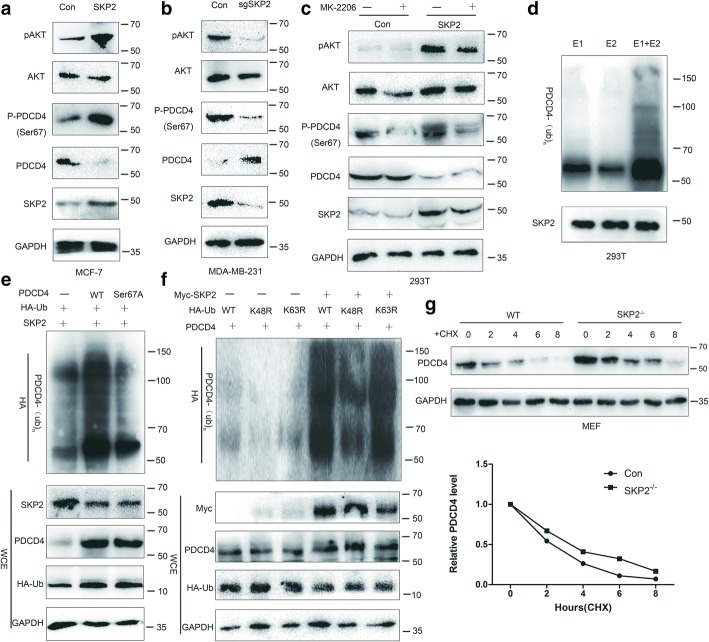
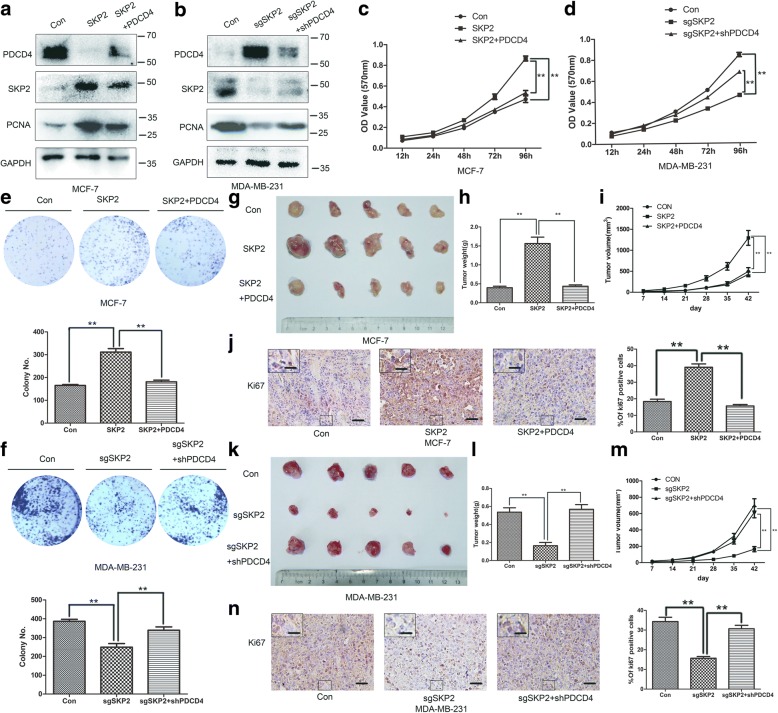
We found that SKP2 remarkably promoted PDCD4 phosphorylation, ubiquitination and degradation. SKP2 promoted cell proliferation, inhibited cell apoptosis and enhanced the response to DNA-damage via PDCD4 suppression in breast cancer. SKP2 and PDCD4 showed negative correlation in human breast cancer tissues. Radiotherapy combine with SKP2 inhibitor SMIP004 showed significant inhibitory effects on breast cancer cells in vitro and in vivo.
We identify PDCD4 as an important ubiquitination substrate of SKP2. SKP2 promotes breast cancer tumorigenesis and radiation tolerance via PDCD4 degradation. Radiotherapy combine with SKP2-targeted adjuvant therapy may improve breast cancer patient survival in clinical medicine.
S 期激酶相关蛋白 2(SKP2)是一种癌基因和细胞周期调节剂,它特异性地识别磷酸化的细胞周期调节剂蛋白,并介导其泛素化。程序性细胞死亡蛋白 4(PDCD4)是一种肿瘤抑制基因,通过与真核起始因子 4A(eIF4A)和 P53 相互作用,在细胞凋亡和 DNA 损伤反应中发挥作用。先前的研究表明,SKP2 可能与 PDCD4 相互作用,但 SKP2 和 PDCD4 之间的关系尚不清楚。
为了验证 SKP2 和 PDCD4 之间的相互作用,进行了质谱分析和相互免疫沉淀(Co-IP)实验。建立了 SKP2 稳定过表达或敲低的乳腺癌细胞系,并通过 Western blot 检测辐射前后蛋白质的变化。进行了体外和体内实验,以验证 SKP2 是否通过抑制 PDCD4 抑制细胞凋亡和促进 DNA 损伤反应。使用 SMIP004 测试放疗联合 SKP2 抑制剂的效果。
我们发现 SKP2 显著促进了 PDCD4 的磷酸化、泛素化和降解。SKP2 通过抑制 PDCD4 促进乳腺癌细胞增殖、抑制细胞凋亡并增强对 DNA 损伤的反应。SKP2 和 PDCD4 在人乳腺癌组织中呈负相关。放疗联合 SKP2 抑制剂 SMIP004 对体外和体内乳腺癌细胞显示出显著的抑制作用。
我们确定 PDCD4 是 SKP2 的一个重要泛素化底物。SKP2 通过 PDCD4 降解促进乳腺癌的发生和辐射耐受。放疗联合 SKP2 靶向辅助治疗可能改善乳腺癌患者的临床生存。