The University of Western Australia, Telethon Kids Institute, Nedlands, Western Australia, Australia.
Centre for Child Health Research, The University of Western Australia, Crawley, Western Australia, Australia.
J Epidemiol Community Health. 2019 May;73(5):427-434. doi: 10.1136/jech-2018-211323. Epub 2019 Feb 13.
Literacy is championed as a pathway out of poverty, yet it is vulnerable to the risk circumstances it seeks to mitigate. This study explored the developmental circumstances that gave rise to stark inequalities in reading achievement in Australian children across 6 years of school.
We used data from : the Longitudinal Study of Australian Children linked to Australia's National Assessment Program-Literacy and Numeracy across school years 3, 5, 7 and 9. Latent class analysis and growth curve modelling (n=4983) were used to identify risk profiles for reading achievement for children (ages 8.2-15.2).
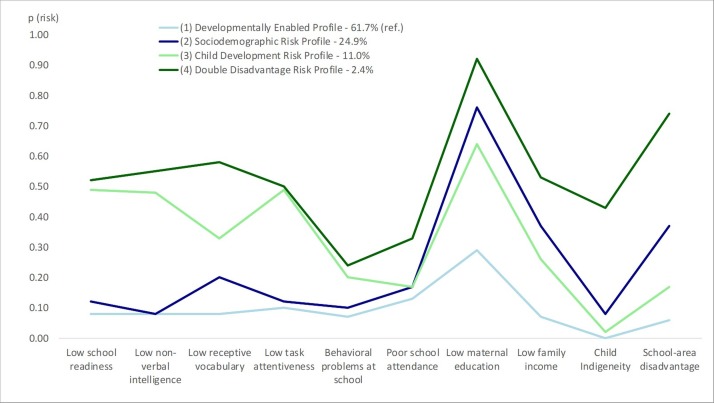
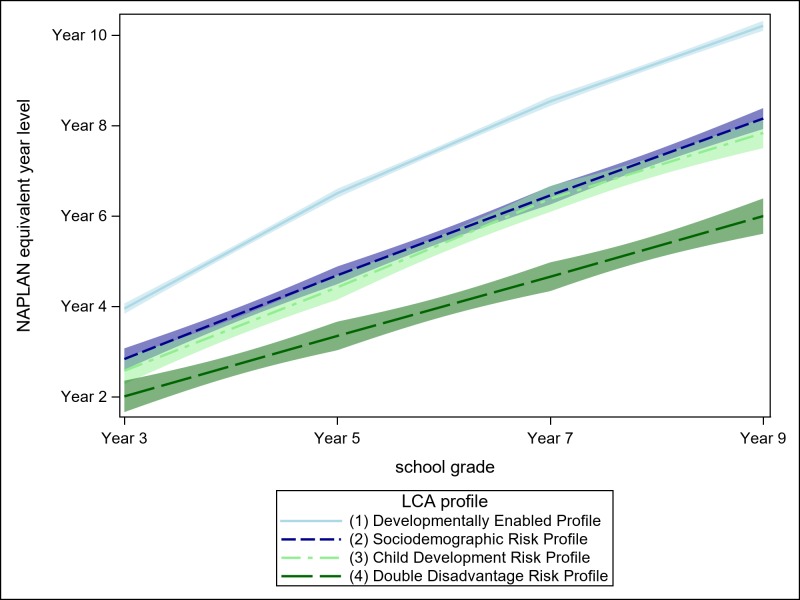
Four distinct profiles were identified: developmentally enabled profile (62% of children); sociodemographic risk profile (25% of children); child development risk profile (11% of children); and sociodemographic and child development (double disadvantage) risk profile (2% of children). Children with a developmentally enabled profile achieved the expected rate of growth of 1.0 year per year of school across years 3, 5, 7 and 9. By comparison, children with sociodemographic and/or child development risk profiles started behind their developmentally enabled peers, and lost ground over time.
Across 6 years of school, multiple risk-exposed children lagged behind low risk-exposed children in the order of years of lost gains in reading achievement. The results point to the complex contexts of educational disadvantage and the need for cross-cutting social, health and education policies and coordinated multiagency intervention efforts to break the cycle of educational disadvantage.
扫盲被视为摆脱贫困的途径,但它容易受到自身试图缓解的风险环境的影响。本研究探讨了在澳大利亚儿童接受 6 年学校教育的过程中,导致阅读成绩明显不平等的发展环境。
我们使用了来自纵向澳大利亚儿童研究的数据,该研究与澳大利亚学校 3、5、7 和 9 年级的国家评估计划-读写和计算能力相联系。潜在类别分析和增长曲线模型(n=4983)用于确定儿童阅读成绩的风险概况(年龄 8.2-15.2 岁)。
确定了四个不同的概况:发展能力赋予概况(62%的儿童);社会人口风险概况(25%的儿童);儿童发展风险概况(11%的儿童);社会人口和儿童发展(双重劣势)风险概况(2%的儿童)。具有发展能力赋予概况的儿童在 3、5、7 和 9 年期间,每年的阅读成绩增长预期为 1.0 年。相比之下,具有社会人口和/或儿童发展风险概况的儿童落后于发展能力赋予的同龄人,并随着时间的推移失去优势。
在 6 年的学校教育中,具有多种风险暴露的儿童在阅读成绩方面落后于低风险暴露的儿童,损失的年数超过了收益。研究结果表明了教育劣势的复杂背景,需要跨部门的社会、卫生和教育政策以及协调的多机构干预措施,以打破教育劣势的循环。