Centre for Big Data Research in Health, University of New South Wales, Sydney, Australia.
National Centre for Epidemiology and Population Health, Australian National University, Canberra, Australia.
PLoS Med. 2018 Apr 24;15(4):e1002558. doi: 10.1371/journal.pmed.1002558. eCollection 2018 Apr.
In recent decades, there has been a shift to later childbearing in high-income countries. There is limited large-scale evidence of the relationship between maternal age and child outcomes beyond the perinatal period. The objective of this study is to quantify a child's risk of developmental vulnerability at age five, according to their mother's age at childbirth.
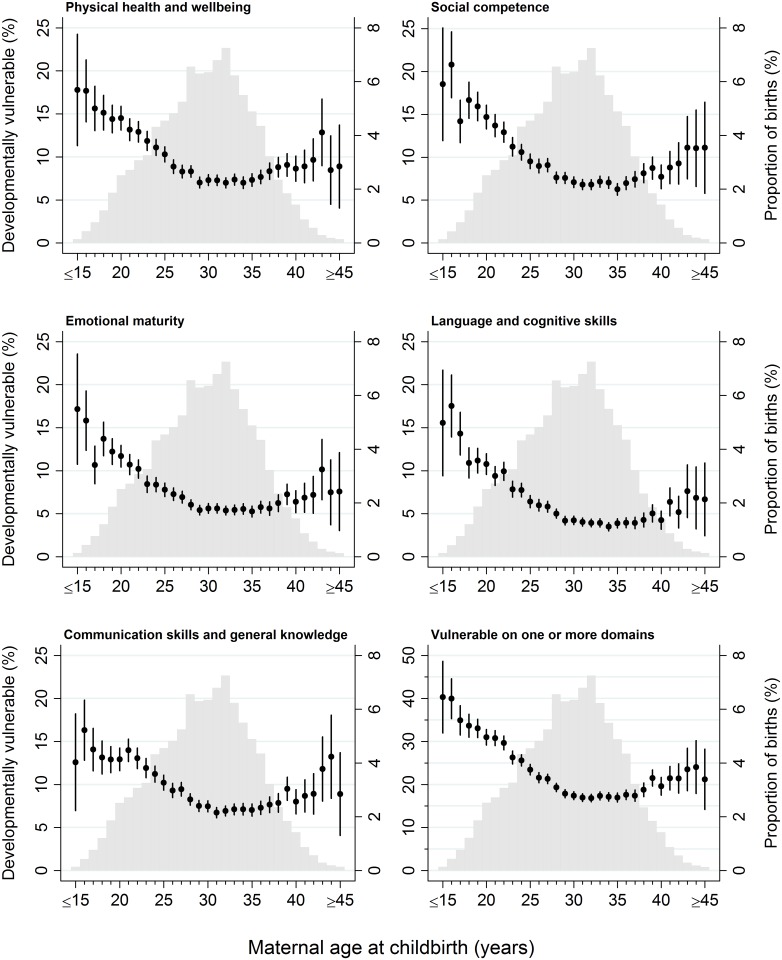
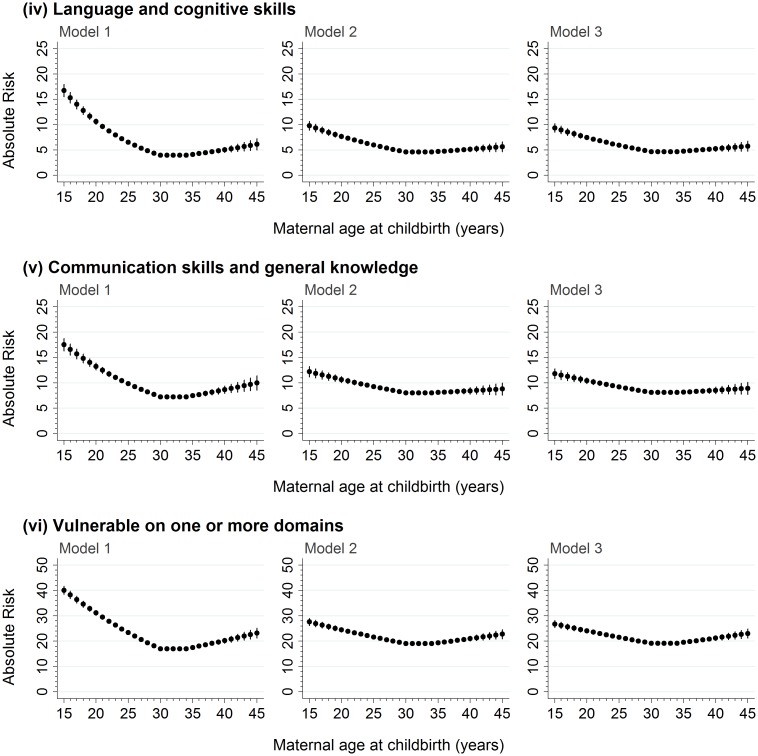
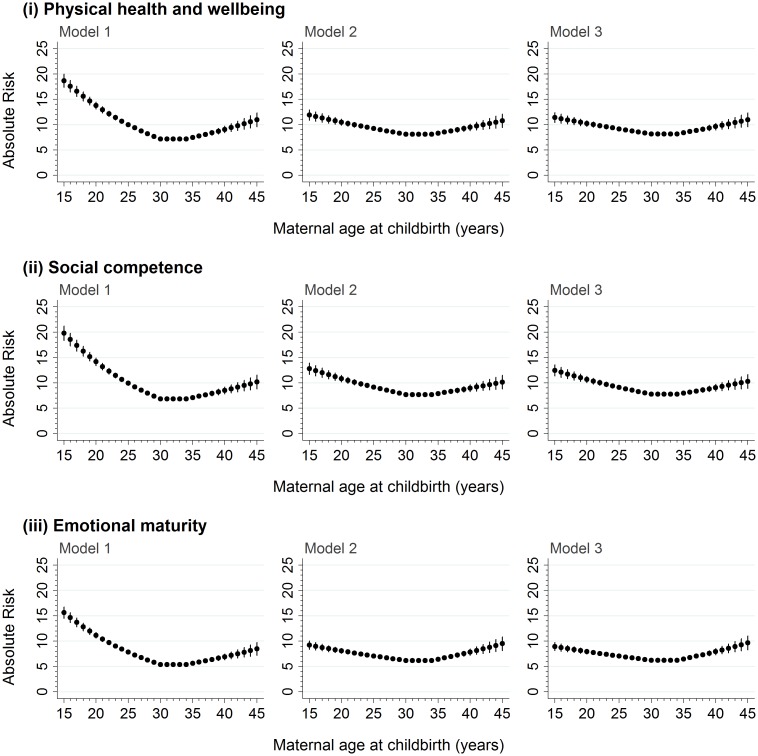
Linkage of population-level perinatal, hospital, and birth registration datasets to data from the Australian Early Development Census (AEDC) and school enrolments in Australia's most populous state, New South Wales (NSW), enabled us to follow a cohort of 99,530 children from birth to their first year of school in 2009 or 2012. The study outcome was teacher-reported child development on five domains measured by the AEDC, including physical health and well-being, emotional maturity, social competence, language and cognitive skills, and communication skills and general knowledge. Developmental vulnerability was defined as domain scores below the 2009 AEDC 10th percentile cut point. The mean maternal age at childbirth was 29.6 years (standard deviation [SD], 5.7), with 4,382 children (4.4%) born to mothers aged <20 years and 20,026 children (20.1%) born to mothers aged ≥35 years. The proportion vulnerable on ≥1 domains was 21% overall and followed a reverse J-shaped distribution according to maternal age: it was highest in children born to mothers aged ≤15 years, at 40% (95% CI, 32-49), and was lowest in children born to mothers aged between 30 years and ≤35 years, at 17%-18%. For maternal ages 36 years to ≥45 years, the proportion vulnerable on ≥1 domains increased to 17%-24%. Adjustment for sociodemographic characteristics significantly attenuated vulnerability risk in children born to younger mothers, while adjustment for potentially modifiable factors, such as antenatal visits, had little additional impact across all ages. Although the multi-agency linkage yielded a broad range of sociodemographic, perinatal, health, and developmental variables at the child's birth and school entry, the study was necessarily limited to variables available in the source data, which were mostly recorded for administrative purposes.
Increasing maternal age was associated with a lesser risk of developmental vulnerability for children born to mothers aged 15 years to about 30 years. In contrast, increasing maternal age beyond 35 years was generally associated with increasing vulnerability, broadly equivalent to the risk for children born to mothers in their early twenties, which is highly relevant in the international context of later childbearing. That socioeconomic disadvantage explained approximately half of the increased risk of developmental vulnerability associated with younger motherhood suggests there may be scope to improve population-level child development through policies and programs that support disadvantaged mothers and children.
近几十年来,高收入国家的生育年龄呈后移趋势。关于产妇年龄与围产期后儿童结局之间的关系,目前仅有少量大规模证据。本研究旨在根据产妇分娩年龄,量化儿童在 5 岁时出现发育脆弱的风险。
通过对人群水平的围产期、医院和出生登记数据集进行链接,结合澳大利亚早期发展普查(AEDC)和新南威尔士州(澳大利亚人口最多的州)的学校入学数据,我们能够对 99530 名儿童进行随访,这些儿童从出生到 2009 年或 2012 年开始上小学。本研究的结局是教师报告的儿童在五个领域的发展情况,包括身体健康和幸福感、情绪成熟度、社会能力、语言和认知技能以及沟通技能和一般知识。发育脆弱性被定义为低于 2009 年 AEDC 第 10 百分位截断点的域评分。产妇的平均分娩年龄为 29.6 岁(标准差[SD],5.7),4382 名(4.4%)儿童的母亲年龄<20 岁,20026 名(20.1%)儿童的母亲年龄≥35 岁。整体上有 21%的儿童在≥1个领域存在脆弱性,且根据产妇年龄呈反向 J 形分布:≤15 岁母亲所生孩子的脆弱性最高,为 40%(95%CI,32-49),而 30 岁至≤35 岁母亲所生孩子的脆弱性最低,为 17%-18%。对于 36 岁至≥45 岁的产妇年龄,在≥1个领域存在脆弱性的比例增加到 17%-24%。调整社会人口统计学特征后,显著降低了年轻母亲所生孩子的脆弱性风险,而调整产前检查等潜在可改变因素对所有年龄的影响很小。尽管多机构链接在儿童出生和入学时提供了广泛的社会人口统计学、围产期、健康和发育变量,但该研究必然受到源数据中可用变量的限制,这些变量主要是为了管理目的而记录的。
产妇年龄增加与 15 岁至 30 岁母亲所生孩子的发育脆弱性风险降低相关。相比之下,产妇年龄超过 35 岁通常与脆弱性增加相关,大致相当于 20 岁出头母亲所生孩子的风险,这在晚育的国际背景下具有重要意义。社会经济劣势解释了大约一半与年轻母亲有关的发育脆弱性风险增加,这表明通过支持弱势母亲和儿童的政策和方案,可能有改善人口水平儿童发育的空间。