Department of Gastrointestinal Oncology, Peking University Cancer Hospital & Institute, Beijing, 100142, China.
Department of Pathology, Key laboratory of Carcinogenesis and Translational Research (Ministry of Education/Beijing), Peking University Cancer Hospital & Institute, Beijing, 100142, China.
Cell Death Dis. 2019 Feb 13;10(2):139. doi: 10.1038/s41419-019-1314-x.
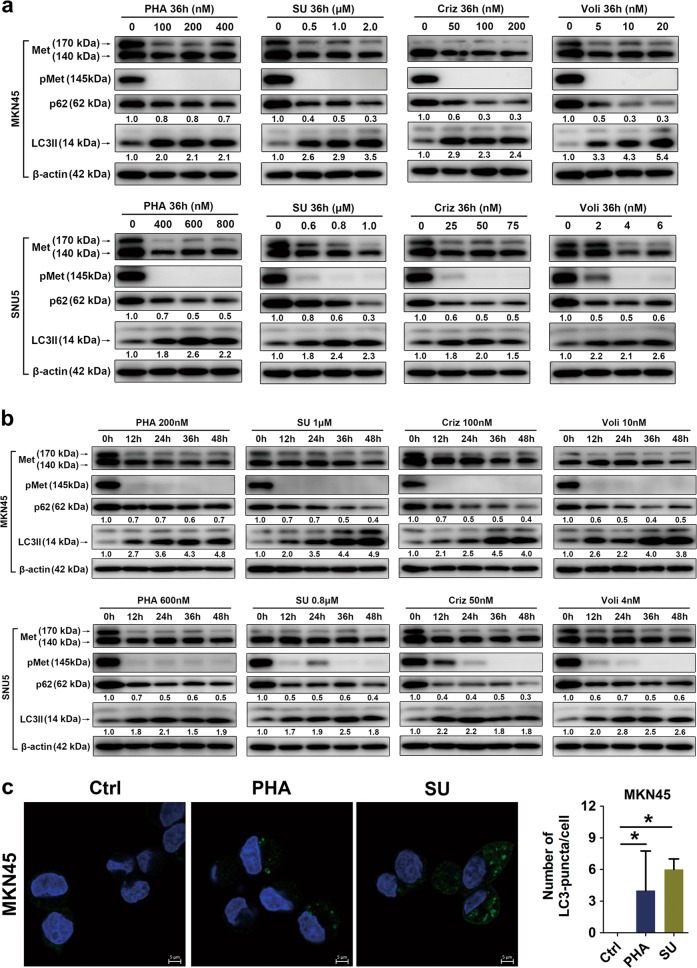
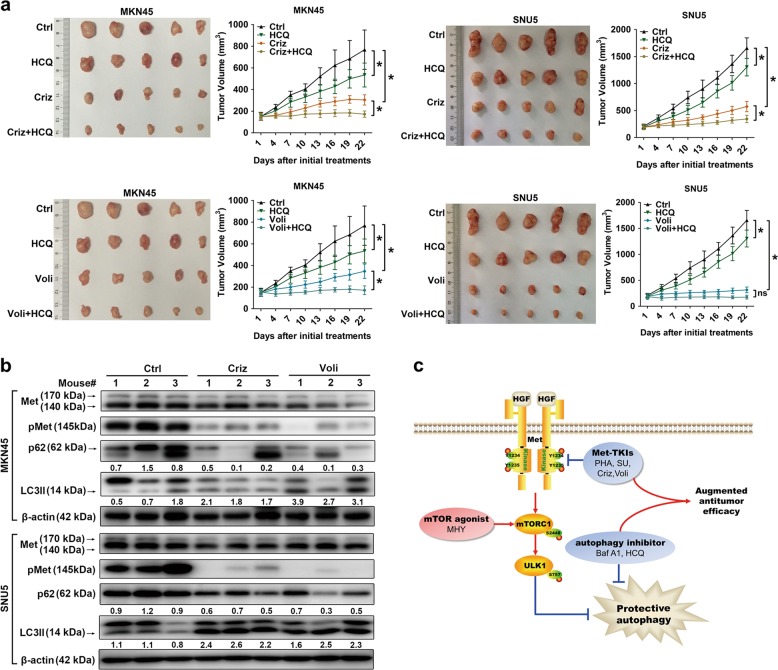
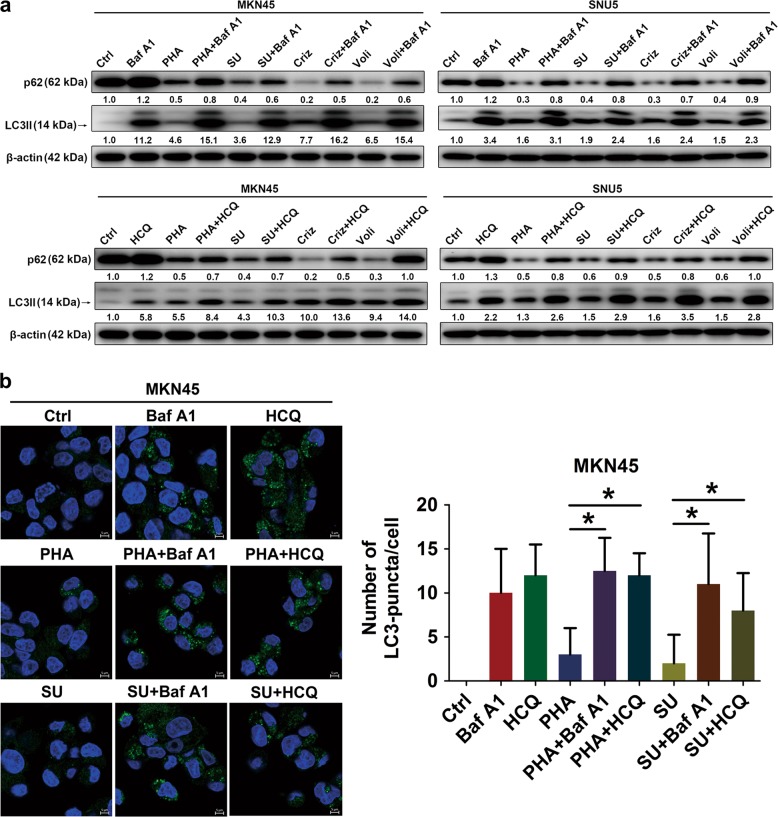
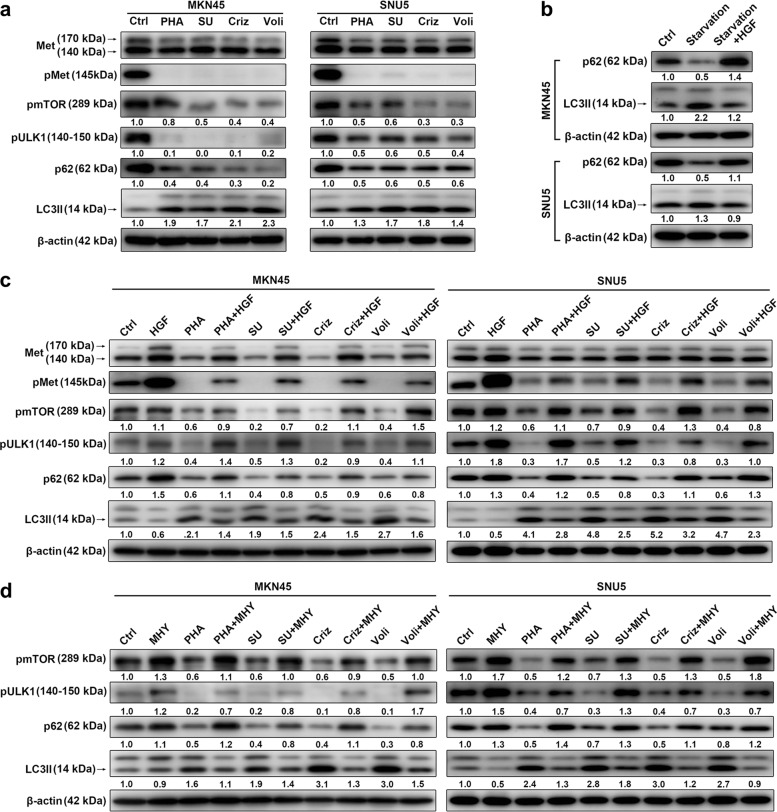
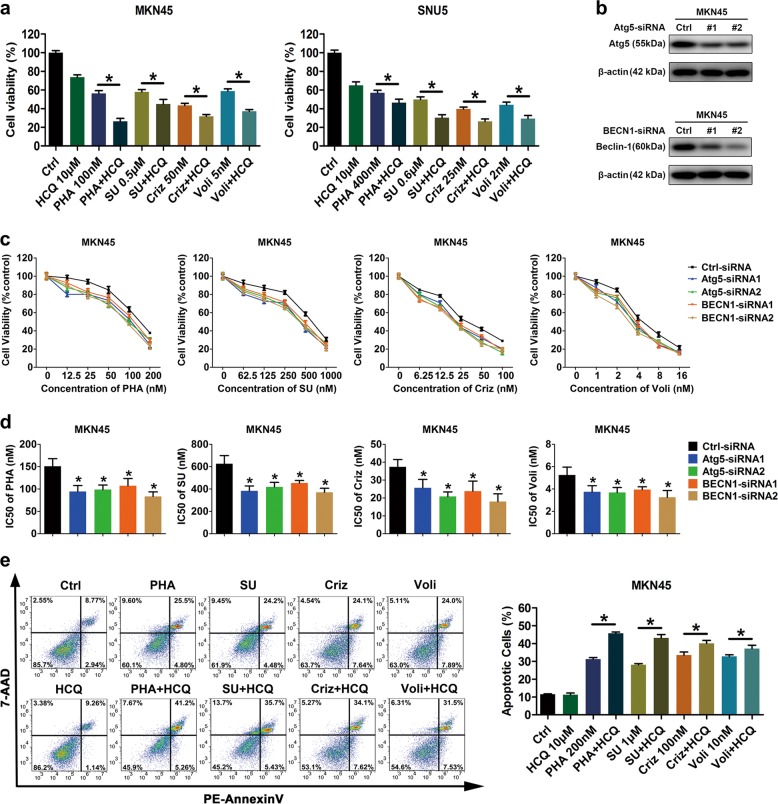
Met tyrosine kinase inhibitors (Met-TKIs) subjected to ongoing clinical trials are a promising option for Met-amplified gastric cancer (GC), but how to optimize their antitumor activity especially with combination schemes remains unclear. Since autophagy is known to be initiated by Met-TKIs, we investigated its underlying mechanisms and therapeutic potentials of Met-TKIs combined with autophagy inhibitors against Met-amplified GC. As expected, four Met-TKIs induced autophagy in Met-amplified GC cells marked by p62 degradation, LC3-II accumulation and increased LC3-positive puncta. Autophagy flux activation by Met-TKIs was further validated with combined lysosomal inhibitors, bafilomycin A1 (Baf A1) and hydroxychloroquine (HCQ). Molecular investigations reveal that autophagy induction along with mTOR and ULK1 de-phosphorylation upon Met-TKI treatment could be relieved by hepatocyte growth factor (HGF) and mTOR agonist MHY1485 (MHY), suggesting that autophagy was initiated by Met-TKIs via Met/mTOR/ULK1 cascade. Intriguingly, Met-TKIs further suppressed cell survival and tumor growth in the presence of autophagy blockade in Met-amplified GC preclinical models. Thus, these findings indicate Met/mTOR/ULK1 cascade responsible for Met-TKI-mediated autophagy and Met-TKIs combined with autophagy inhibitors as a promising choice to treat Met-amplified GC.
正在进行临床试验的针对 MET 酪氨酸激酶抑制剂(Met-TKIs)是 MET 扩增型胃癌(GC)的有前途的选择,但如何优化其抗肿瘤活性,特别是联合方案,目前仍不清楚。由于自噬是由 Met-TKIs 引发的,我们研究了 Met-TKIs 联合自噬抑制剂对 MET 扩增型 GC 的潜在机制和治疗潜力。正如预期的那样,四种 Met-TKIs 在 MET 扩增型 GC 细胞中诱导自噬,标志为 p62 降解、LC3-II 积累和 LC3 阳性斑点增加。用联合溶酶体抑制剂巴弗洛霉素 A1(Baf A1)和羟氯喹(HCQ)进一步验证了 Met-TKIs 对自噬流的激活作用。分子研究表明,Met-TKI 处理后,自噬诱导以及 mTOR 和 ULK1 的去磷酸化可以被肝细胞生长因子(HGF)和 mTOR 激动剂 MHY1485(MHY)缓解,这表明自噬是由 Met-TKIs 通过 MET/mTOR/ULK1 级联引发的。有趣的是,在 MET 扩增型 GC 临床前模型中,自噬阻断的情况下,Met-TKIs 进一步抑制了细胞存活和肿瘤生长。因此,这些发现表明,MET/mTOR/ULK1 级联反应负责 Met-TKI 介导的自噬,Met-TKIs 联合自噬抑制剂是治疗 MET 扩增型 GC 的一种有前途的选择。