Helmholtz Zentrum München-German Research Center for Environmental Health, Institute of Epidemiology, Neuherberg, Germany.
Ludwig-Maximilians-Universität München, IBE-Chair of Epidemiology, Munich, Germany.
Sci Rep. 2019 Feb 13;9(1):1946. doi: 10.1038/s41598-019-38531-9.
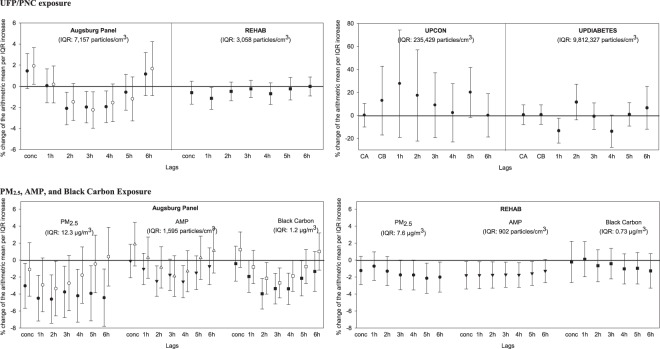
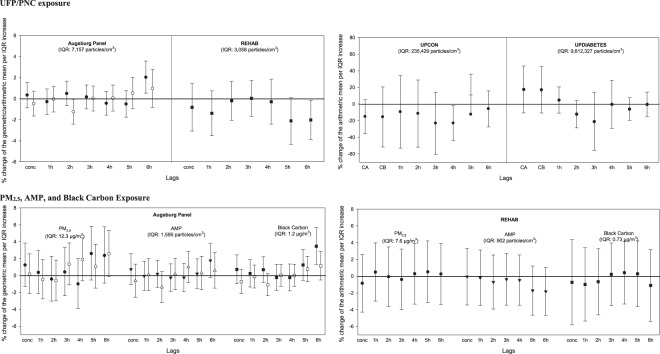
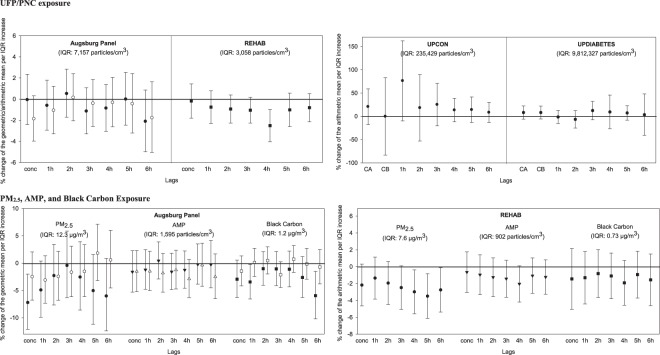
Previous studies have reported increased risks of myocardial infarction in association with elevated ambient particulate matter (PM) in the previous hour(s). However, whether PM can trigger mechanisms that act on this time scale is still unclear. We hypothesized that increases in PM are associated with rapid changes in measures of heart rate variability and repolarization. We used data from panel studies in Augsburg, Germany, and Rochester, New York, USA, and two controlled human exposure studies in Rochester. Data included ECG recordings from all four studies, controlled exposures to (concentrated) ultrafine particles (UFP; particles with an aerodynamic diameter <100 nm) and ambient concentrations of UFP and fine PM (PM, aerodynamic diameter <2.5 μm). Factor analysis identified three representative ECG parameters: standard deviation of NN-intervals (SDNN), root mean square of successive differences (RMSSD), and T-wave complexity. Associations between air pollutants and ECG parameters in the concurrent and previous six hours were estimated using additive mixed models adjusting for long- and short-term time trends, meteorology, and study visit number. We found decreases in SDNN in relation to increased exposures to UFP in the previous five hours in both of the panel studies (e.g. Augsburg study, lag 3 hours: -2.26%, 95% confidence interval [CI]: -3.98% to -0.53%; Rochester panel study, lag 1 hour: -2.69%; 95% CI: -5.13% to -0.26%) and one of the two controlled human exposure studies (1-hour lag: -13.22%; 95% CI: -24.11% to -2.33%). Similarly, we observed consistent decreases in SDNN and RMSSD in association with elevated PM concentrations in the preceding six hours in both panel studies. We did not find consistent associations between particle metrics and T-wave complexity. This study provided consistent evidence that recent exposures to UFP and PM can induce acute pathophysiological responses.
先前的研究报告指出,在过去的一个小时内,环境中细颗粒物(PM)浓度升高与心肌梗死风险增加有关。然而,PM 是否能引发作用于这个时间尺度的机制尚不清楚。我们假设 PM 浓度的增加与心率变异性和复极的快速变化有关。我们使用了来自德国奥格斯堡和美国纽约罗彻斯特的四项面板研究的数据,以及罗彻斯特的两项人体受控暴露研究的数据。这些数据包括来自所有四项研究的心电图记录、对(浓缩)超细颗粒(空气动力学直径<100nm 的颗粒)和环境中超细颗粒和细颗粒物(PM,空气动力学直径<2.5μm)浓度的受控暴露。因子分析确定了三个有代表性的心电图参数:NN 间期标准差(SDNN)、连续差值的均方根(RMSSD)和 T 波复杂度。使用附加混合模型,根据长期和短期时间趋势、气象和研究访问次数,对污染物与心电图参数之间的关系进行了估计。我们发现,在这两项面板研究中,与过去五个小时内的 UFP 暴露增加相关的 SDNN 降低(例如,奥格斯堡研究,滞后 3 小时:-2.26%,95%置信区间[CI]:-3.98%至-0.53%;罗彻斯特面板研究,滞后 1 小时:-2.69%;95% CI:-5.13%至-0.26%),以及两项人体受控暴露研究中的一项(1 小时滞后:-13.22%;95% CI:-24.11%至-2.33%)。同样,我们观察到在这两项面板研究中,与过去六个小时内 PM 浓度升高相关的 SDNN 和 RMSSD 也出现了一致的降低。我们没有发现颗粒指标与 T 波复杂度之间存在一致的关联。这项研究提供了一致的证据,表明最近暴露于 UFP 和 PM 会引起急性病理生理反应。