Liu Sijia, Li Lin, Liu Zhiyuan, Guo Xiuyan
School of Psychology and Cognitive Science, East China Normal University, Shanghai, China.
National Demonstration Center for Experimental Psychology Education, East China Normal University, Shanghai, China.
Front Psychol. 2019 Jan 30;10:91. doi: 10.3389/fpsyg.2019.00091. eCollection 2019.
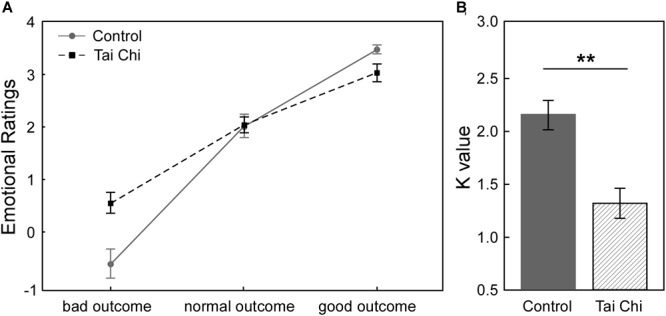
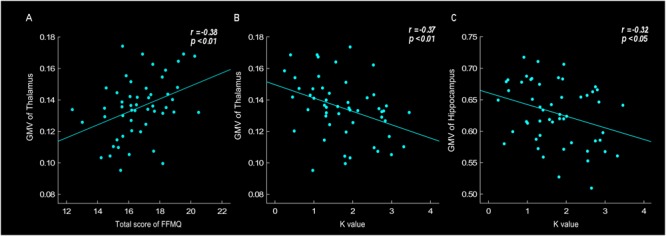
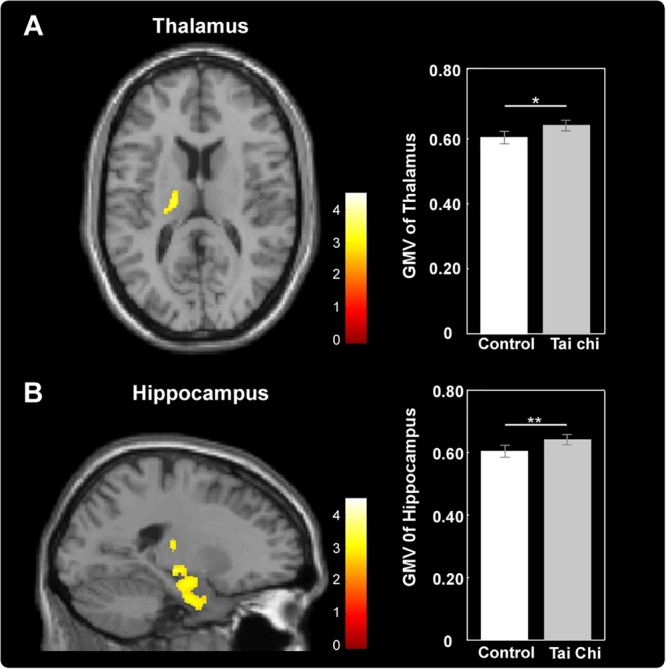
Brain adverse structural changes, especially the atrophy of gray matter, are inevitable in aging. Fortunately, the human brain is plastic throughout its entire life. The current cross-section study aimed to investigate whether long-term Tai Chi exercise could slow gray matter atrophy and explore the possible links among gray matter volume (GMV), long-term Tai Chi experience and emotional stability in a sequential risk-taking task by using voxel-based morphometry. Elders with long-term Tai Chi experience and controls, who were matched to Tai Chi group in age, gender, physical activity level, participated in the study. A T1-weighted multiplanar reconstruction sequence was acquired for each participant. Behaviorally, the Tai Chi group showed higher meditation level, stronger emotional stability and less risk-taking tendency in the sequential risk-taking compared to the control group. Moreover, the results revealed that the GMV of the thalamus and hippocampus were larger in the Tai Chi group compared with the control group. Notably, the GMV of the thalamus was positively correlated with both meditation level and emotional stability. The current study suggested the protective role of long-term Tai Chi exercise at slowing gray matter atrophy, improving the emotional stability and achieving successful aging for elders.
大脑的不良结构变化,尤其是灰质萎缩,在衰老过程中是不可避免的。幸运的是,人类大脑在其整个生命周期中都具有可塑性。当前的横断面研究旨在通过基于体素的形态测量法,调查长期太极拳练习是否能减缓灰质萎缩,并探索在一个连续冒险任务中灰质体积(GMV)、长期太极拳经历和情绪稳定性之间的可能联系。有长期太极拳经历的老年人以及在年龄、性别、身体活动水平上与太极拳组相匹配的对照组参与了这项研究。为每位参与者获取了一个T1加权多平面重建序列。在行为方面,与对照组相比,太极拳组在连续冒险任务中表现出更高的冥想水平、更强的情绪稳定性和更低的冒险倾向。此外,结果显示,与对照组相比,太极拳组丘脑和海马体的GMV更大。值得注意的是,丘脑的GMV与冥想水平和情绪稳定性均呈正相关。当前的研究表明长期太极拳练习对减缓老年人灰质萎缩、改善情绪稳定性和实现成功衰老具有保护作用。