Nephrology Clinic, University Hospital "Tsaritsa Yoanna-ISUL," Medical University-Sofia, Sofia, Bulgaria.
Department of Biochemistry, Molecular Medicine and Nutrigenomics, Medical University Varna, Varna, Bulgaria.
Front Immunol. 2019 Jan 29;10:64. doi: 10.3389/fimmu.2019.00064. eCollection 2019.
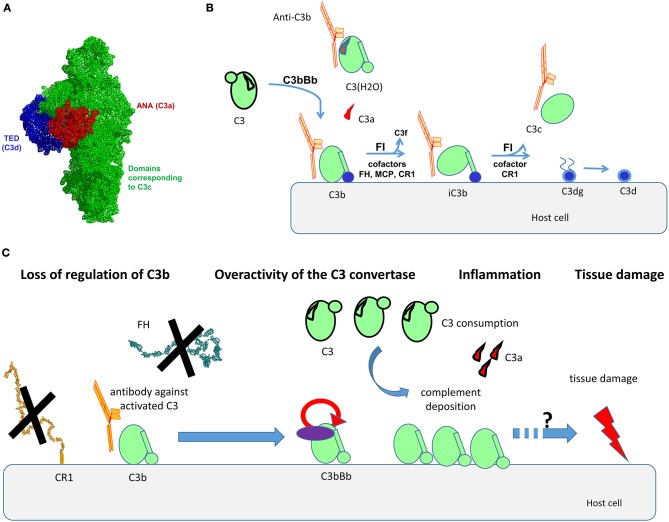
The complement component C3 is at the heart of the complement cascade. It is a complex protein, which generates different functional activated fragments (C3a, C3b, iC3b, C3c, C3d). C3b is a constituent of the alternative pathway C3 convertase (C3bBb), binds multiple regulators, and receptors, affecting thus the functioning of the immune system. The activated forms of C3 are a target for autoantibodies. This review focuses on the discovery, disease relevance, and functional consequences of the anti-C3b autoantibodies. They were discovered about 70 years ago and named immunoconglutinins. They were found after infections and considered convalescent factors. At the end of the twentieth century IgG against C3b were found in systemic lupus erythematosus and recently in lupus nephritis, correlating with the disease severity and flare. Cases of C3 glomerulopathy and immune complex glomerulonephritis were also reported. These antibodies recognize epitopes, shared between C3(H2O)/C3b/iC3b/C3c and have overt functional activity. They correlate with low plasmatic C3 levels in patients. , they increase the activity of the alternative pathway C3 convertase, without being C3 nephritic factors. They perturb the binding of the negative regulators Complement Receptor 1 and Factor H. The clear functional consequences and association with disease severity warrant further studies to establish the link between the anti-C3b autoantibodies and tissue injury. Comparative studies with such antibodies, found in patients with infections, may help to uncover their origin and epitopes specificity. Patients with complement overactivation due to presence of anti-C3b antibodies may benefit from therapeutic targeting of C3.
补体成分 C3 是补体级联反应的核心。它是一种复杂的蛋白质,可生成不同功能的活化片段(C3a、C3b、iC3b、C3c、C3d)。C3b 是替代途径 C3 转化酶(C3bBb)的组成部分,可结合多种调节剂和受体,从而影响免疫系统的功能。C3 的活化形式是自身抗体的靶标。本文重点介绍抗 C3b 自身抗体的发现、与疾病的相关性以及功能后果。这些自身抗体大约在 70 年前被发现,被命名为免疫凝聚素。它们在感染后被发现,并被认为是恢复期因子。在 20 世纪末,系统性红斑狼疮中发现了针对 C3b 的 IgG,最近在狼疮肾炎中也发现了针对 C3b 的 IgG,与疾病的严重程度和复发相关。还报道了 C3 肾小球病和免疫复合物性肾小球肾炎的病例。这些抗体识别 C3(H2O)/C3b/iC3b/C3c 之间共享的表位,具有明显的功能活性。它们与患者的低血浆 C3 水平相关。这些抗体增加替代途径 C3 转化酶的活性,而不是 C3 肾炎因子。它们扰乱了负调节剂补体受体 1 和因子 H 的结合。明确的功能后果和与疾病严重程度的关联需要进一步研究以建立抗 C3b 自身抗体与组织损伤之间的联系。与感染患者中发现的此类抗体进行比较研究,可能有助于揭示其起源和表位特异性。由于存在抗 C3b 抗体而导致补体过度激活的患者可能受益于 C3 的靶向治疗。