Department of Angiology, Jagiellonian University Medical College, 8 Skawinska St, 31-066, Krakow, Poland.
Krakow Cardiovascular Research Institute, Krakow, Poland.
J Thromb Thrombolysis. 2019 May;47(4):540-549. doi: 10.1007/s11239-019-01826-9.
Hypolysible fibrin clots composed of tightly packed fibers characterize patients with peripheral artery disease (PAD) especially those with critical limb ischemia (CLI). Little is known about the impact of a prothrombotic clot phenotype on restenosis following endovascular revascularization in CLI. The goal of this study was to compare fibrin clot properties and their determinants in CLI patients with restenosis after endovascular treatment (ET) and those free of this complication.
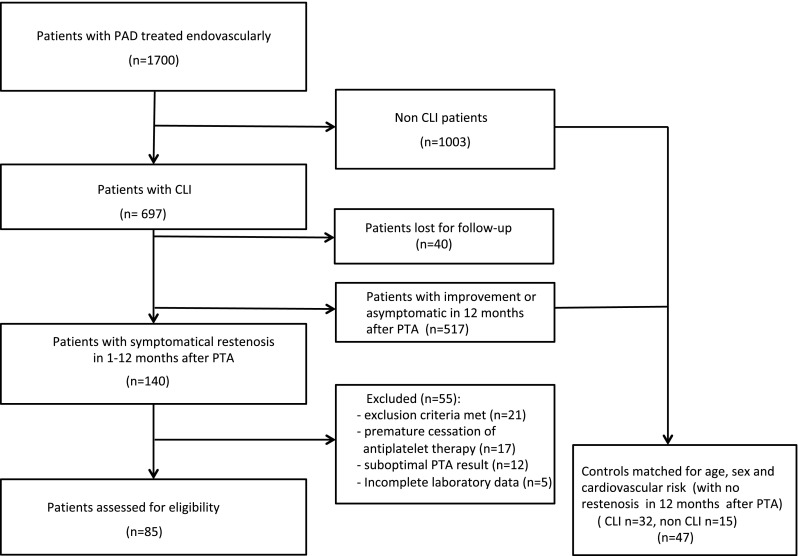
85 patients with CLI and restenosis within 1 year after ET on optimal pharmacotherapy and 47 PAD control patients without restenosis were included into the study. Plasma fibrin clot permeability (Ks, a measure of the average pore size in the fibrin network) and clot lysis time (CLT) with its potential determinants were determined. During follow-up, the composite endpoint including re-intervention, amputation and death was assessed.
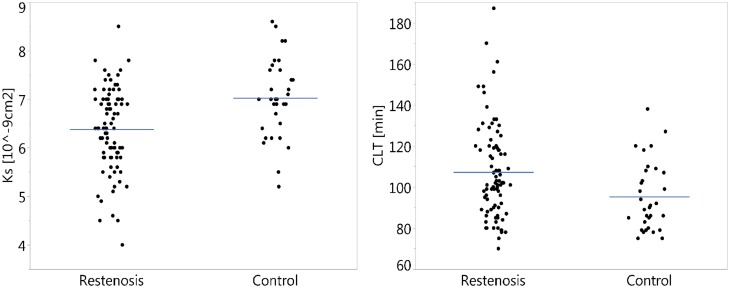
Compared with the control group, patients with restenosis had reduced K (- 9.5%, p < 0.001), prolonged CLT (+ 12.4%, p = 0.003), higher thrombin generation (+ 7.9%, p < 0.001) and elevated von Willebrand factor (vWF) antigen (+ 14.2%, p < 0.001). During a 24 months follow-up the composite endpoint occurred in 54 CLI patients with restenosis (63.5%) and nine control patients (19.1%, p < 0.001) with no association with baseline K and CLT.
The increased thrombin formation and unfavorable fibrin clot properties occur in patients with CLI who experienced restenosis despite optimal endovascular and pharmacological therapy.
由紧密堆积的纤维组成的低纤维蛋白溶解纤维蛋白凝块是外周动脉疾病(PAD)患者,尤其是有严重肢体缺血(CLI)患者的特征。关于血栓形成的凝块表型对 CLI 患者血管内血运重建后再狭窄的影响知之甚少。本研究的目的是比较经血管内治疗(ET)后出现 CLI 再狭窄和无再狭窄的患者的纤维蛋白凝块特性及其决定因素。
本研究纳入了 85 名接受最佳药物治疗后 1 年内 CLI 再狭窄的患者和 47 名无再狭窄的 PAD 对照患者。测定了纤维蛋白凝块通透性(Ks,衡量纤维蛋白网络中平均孔径的指标)和凝块溶解时间(CLT)及其潜在决定因素。在随访期间,评估了包括再次干预、截肢和死亡的复合终点。
与对照组相比,再狭窄患者的 Ks 值降低(-9.5%,p<0.001),CLT 延长(+12.4%,p=0.003),凝血酶生成增加(+7.9%,p<0.001),血管性血友病因子(vWF)抗原升高(+14.2%,p<0.001)。在 24 个月的随访中,54 名再狭窄的 CLI 患者(63.5%)发生了复合终点事件,9 名对照患者(19.1%)发生了复合终点事件(p<0.001),但与基线 K 和 CLT 无关。
尽管进行了最佳的血管内和药物治疗,CLI 患者仍经历再狭窄,这与血栓形成增加和不利的纤维蛋白凝块特性有关。