Zaid Taher, Ereqat Suheir, Nasereddin Abdelmajeed, Al-Jawabreh Amer, Abdelkader Ahmad, Abdeen Ziad
Biochemistry and Molecular Biology Department, Faculty of Medicine, Al-Quds University, Abu Dis, Palestine.
UCD School of Veterinary Medicine, University College Dublin, Belfield, Ireland.
Vet Med Sci. 2019 May;5(2):230-242. doi: 10.1002/vms3.150. Epub 2019 Feb 14.
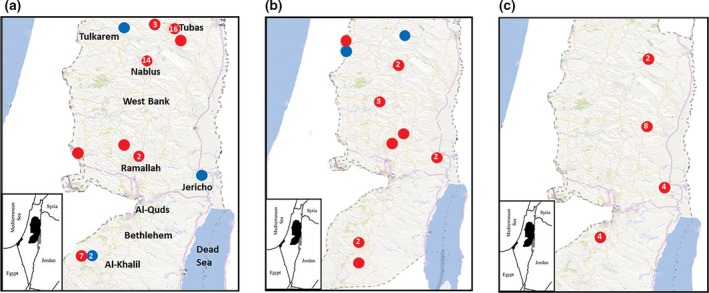
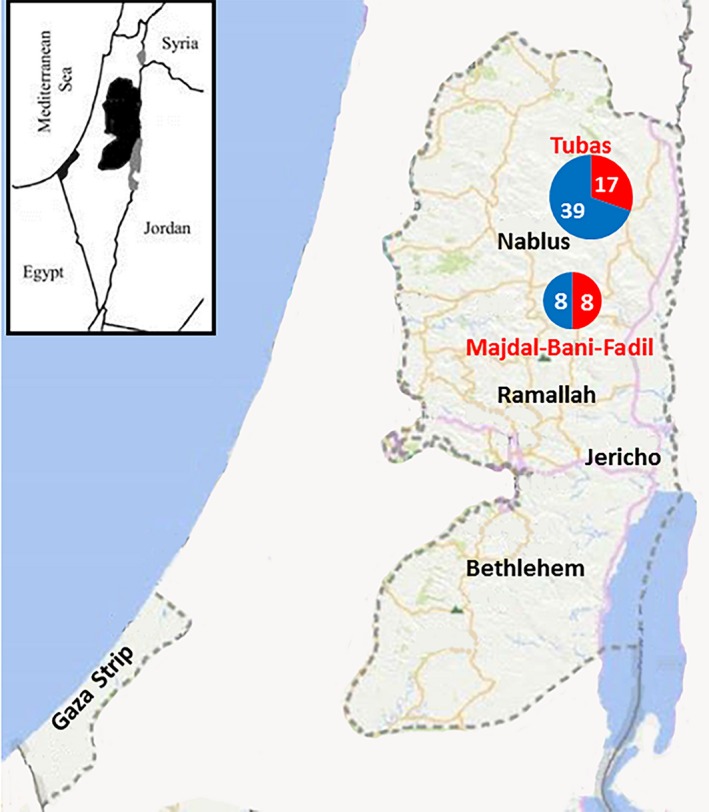
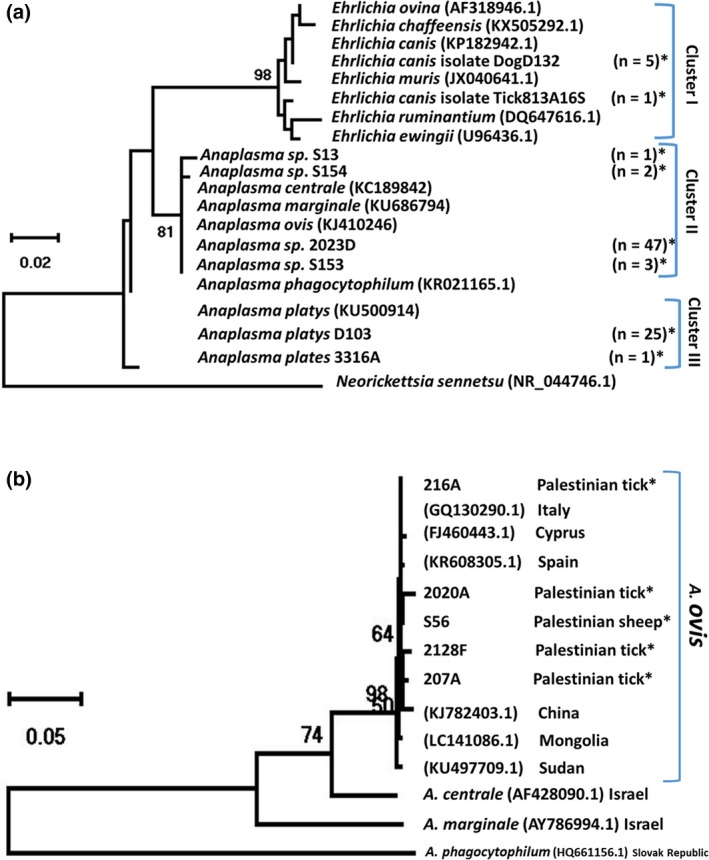
Tick-borne anaplasmosis and ehrlichiosis are clinically important emerging zoonoses usually overlooked by veterinarians and physicians alike. This study aimed at detecting and genetically characterizing Ehrlichia and Anaplasma species in ixodid ticks and their animal hosts from the West Bank, Palestine. A total of 723 ixodid ticks belonging to three genera (Rhipicephalus, Hyalomma, Haemaphysalis) were collected from dogs, sheep, goats and camels. In addition, 189 blood samples were collected from dogs, sheep, camels, horses and a goat from the West Bank, Palestine. All tick and blood samples were investigated for the presence of Anaplasma and Ehrlichia targeting a 345 bp fragment of the 16S rRNA gene followed by sequence analysis. The infection rate of Anaplasma spp. in ticks was 6.5% (47/723). Anaplasma platys was identified in 28% (13/47) of them. Whereas, based on a partial sequence (851 bp) of msp4 gene, 38% (18/47) were identified as A. ovis. The species of the remaining 16 positive samples (16/47, 34%) could not be identified. Simultaneously, the infection rate of Ehrlichia spp. in the ticks was 0.6% (4/723). Three of which were E. canis and one was Ehrlichia spp. The infection rate of A. platys in dogs' blood samples was 10% (13/135), while it was 1.5% (2/135) for E. canis. The infection rate of Anaplasma in sheep blood samples was 40% (19/47), out of which 26% (5/19) were caused by A. ovis as revealed by msp4-PCR. Implementation of purely-spatial analysis by saTScan for all cases of Anaplasma revealed two statistically significant clusters in two districts; Tubas town and Majdal-Bani-Fadil village on the western hills of the Jordan Valley. Most cases of Anaplasma (83%) were from rural areas where life cycle components (vector, host and reservoir) abundantly interact. This study is the first in Palestine to reveal the presence of Anaplasma and Ehrlichia in ticks, dogs and sheep providing crucial platform for future epidemiological surveys and control strategies in the country and region.
蜱传无形体病和埃立克体病是临床上重要的新发人畜共患病,通常被兽医和医生忽视。本研究旨在检测巴勒斯坦约旦河西岸硬蜱及其动物宿主中的埃立克体属和无形体属细菌,并对其进行基因特征分析。从狗、绵羊、山羊和骆驼身上共采集了723只属于三个属(璃眼蜱属、硬蜱属、血蜱属)的硬蜱。此外,从巴勒斯坦约旦河西岸的狗、绵羊、骆驼、马和一只山羊身上采集了189份血液样本。所有蜱和血液样本均针对16S rRNA基因的345 bp片段进行无形体属和埃立克体属检测,随后进行序列分析。蜱中无形体属细菌的感染率为6.5%(47/723)。其中28%(13/47)鉴定为血小板无形体。而基于msp4基因的部分序列(851 bp),38%(18/47)被鉴定为绵羊无形体。其余16个阳性样本(16/47,34%)的种类无法鉴定。同时,蜱中埃立克体属细菌的感染率为0.6%(4/723)。其中3只为犬埃立克体,1只为埃立克体属细菌。狗血液样本中血小板无形体的感染率为~10%(13/135),而犬埃立克体的感染率为1.5%(2/135)。绵羊血液样本中无形体属细菌的感染率为40%(19/47)?,其中msp4-PCR显示26%(5/19)由绵羊无形体引起。通过saTScan对所有无形体病例进行纯空间分析,发现在两个地区有两个具有统计学意义的聚集区;图巴斯镇和约旦河谷西山的迈季代勒-巴尼-法迪勒村。大多数无形体病例(83%)来自农村地区,那里生命周期的各个组成部分(媒介、宿主和储存宿主)大量相互作用。本研究是巴勒斯坦首次揭示蜱、狗和绵羊中存在无形体属和埃立克体属细菌,为该国和该地区未来的流行病学调查和控制策略提供了关键平台。