Li Min, Luo Zheng, Yu Sisi, Tang Zhenyu
Department of Neurology, The Second Affiliated Hospital of Nanchang University.
Department of Nursing School of Nanchang University, Nanchang, PR China.
Medicine (Baltimore). 2019 Feb;98(7):e14422. doi: 10.1097/MD.0000000000014422.
Proton pump inhibitors (PPIs) are an established kind of drugs used to the treatment of most acid-related diseases. Some prospective studies have noticed that PPI use was associated with increased dementia risk. However, the results of those studies were inconsistent and controversial. This meta-analysis aims to determine the association of PPI use and risk of dementia among older people.
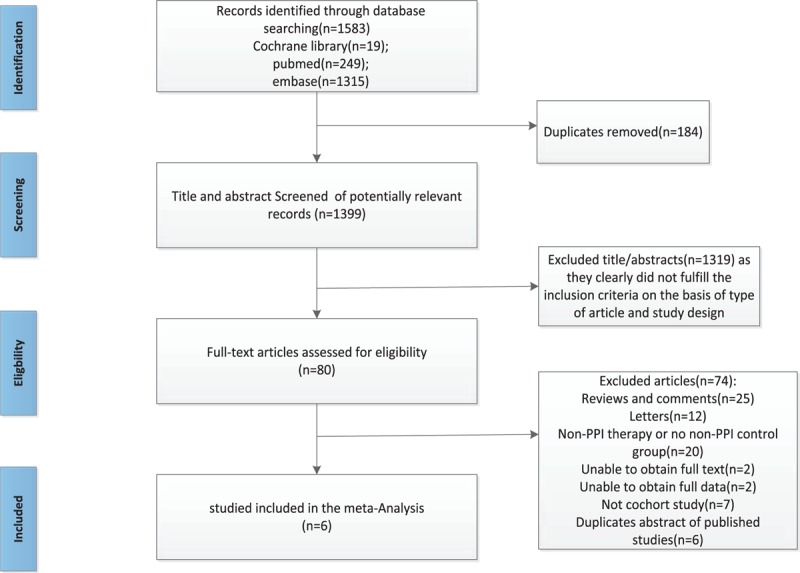
Relevant articles were systematically identified by searching the PubMed, EMBASE, and Cochrane Library databases from inception to February 2018. Cohort studies that reported the risk of dementia or Alzheimer's disease (AD) among PPI users compared with non-PPI users were included. The quality of studies was assessed using the Newcastle-Ottawa Scale (NOS). The publication bias was detected by a funnel plot and Egger test. The meta-analysis will abstract risk estimates including relative risks (RRs), hazard ratios (HRs), and odds ratios (ORs) with a 95% confidence interval (CI) for the associations between PPI use and dementia or Alzheimer's risk. Study-specific results were pooled using a random-effects model.
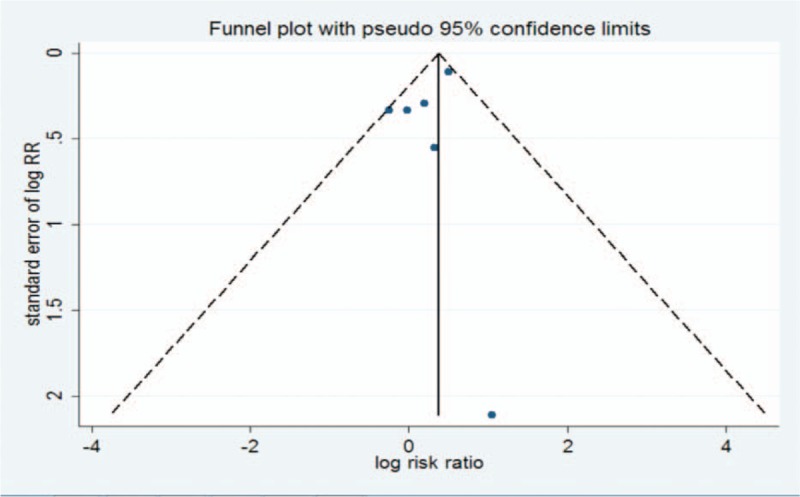
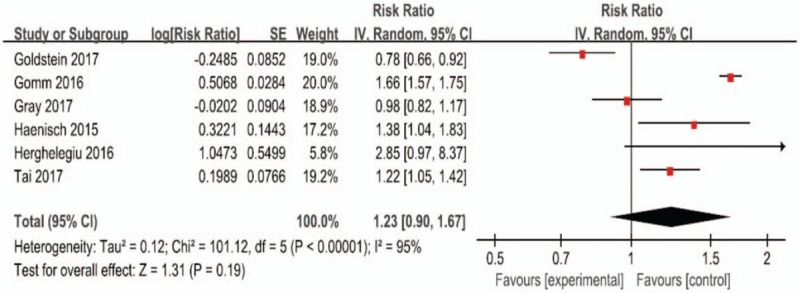
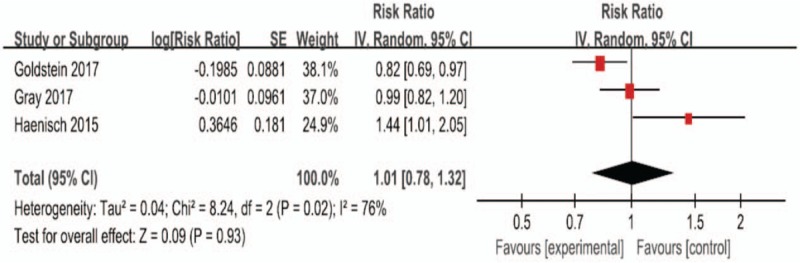
Six cohort studies were selected finally. The pooled RRs of dementia and AD were 1.23 (95% CI: 0.90-1.67) and 1.01 (95% CI: 0.78-1.32), respectively, compared with those of non-PPI use. The Egger test and funnel plot showed no existence of publication bias. Overall, there was no statistically significant association between PPI use and risk of dementia or AD (P >.05).
This meta-analysis suggests that there was no statistical association between PPIs use and increased risk of dementia or AD.
质子泵抑制剂(PPIs)是一类已被确立用于治疗大多数酸相关性疾病的药物。一些前瞻性研究已注意到使用PPIs与痴呆风险增加有关。然而,这些研究的结果并不一致且存在争议。本荟萃分析旨在确定老年人使用PPIs与痴呆风险之间的关联。
通过检索从创刊至2018年2月的PubMed、EMBASE和Cochrane图书馆数据库,系统地识别相关文章。纳入报告了使用PPIs者与未使用PPIs者相比的痴呆或阿尔茨海默病(AD)风险的队列研究。使用纽卡斯尔-渥太华量表(NOS)评估研究质量。通过漏斗图和Egger检验检测发表偏倚。荟萃分析将提取风险估计值,包括使用PPIs与痴呆或阿尔茨海默病风险之间关联的相对风险(RRs)、风险比(HRs)和比值比(ORs)及其95%置信区间(CI)。使用随机效应模型汇总各研究的结果。
最终选择了六项队列研究。与未使用PPIs相比,痴呆和AD的合并RRs分别为1.23(95%CI:0.90-1.67)和1.01(95%CI:0.78-1.32)。Egger检验和漏斗图显示不存在发表偏倚。总体而言,使用PPIs与痴呆或AD风险之间无统计学显著关联(P>0.05)。
本荟萃分析表明,使用PPIs与痴呆或AD风险增加之间无统计学关联。