Division of Neuroscience, Department of Pharmacology, ISF College of Pharmacy, Moga, Punjab, India (Affiliated to IK Gujral Punjab Technical University), Jalandhar, Punjab, 144603, India.
Department of Medical Elementology and Toxicology, School of Chemical and Life Sciences, Jamia Hamdard, New Delhi-110062, India.
Curr Alzheimer Res. 2024;20(11):739-757. doi: 10.2174/0115672050289946240223050737.
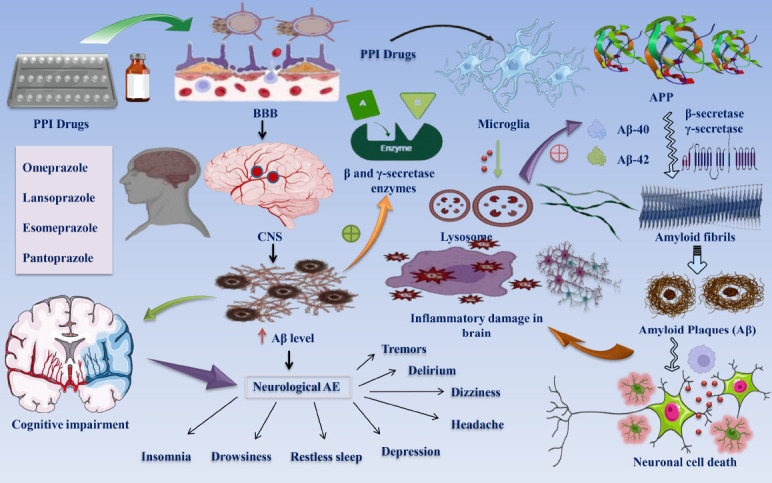
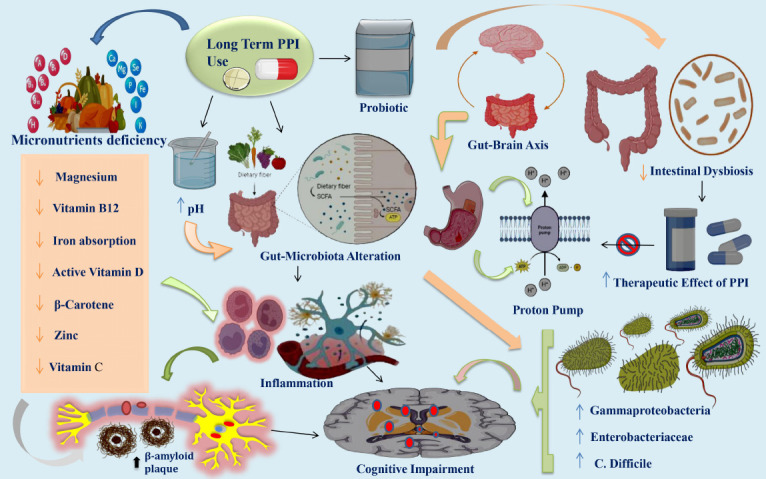
Dementia, an international health issue distinguished by the impairment of daily functioning due to cognitive decline, currently affects more than 55 million people worldwide, with the majority residing in low-income and middle-income countries. Globally, dementia entails significant economic burdens in 2019, amounting to a cost of 1.3 trillion US dollars. Informal caregivers devote considerable hours to providing care for those affected. Dementia imposes a greater caregiving and disability-adjusted life-year burden on women. A recent study has established a correlation between prolonged Proton Pump Inhibitor (PPI) usage and dementia, in addition to other neurodegenerative conditions. PPIs are frequently prescribed to treat peptic ulcers and GERD (gastroesophageal reflux disease) by decreasing stomach acid secretion. They alleviate acid-related symptoms through the inhibition of acid-secreting H-K ATPase. In a number of observational studies, cognitive decline and dementia in the elderly have been linked to the use of PPIs. The precise mechanism underlying this relationship is unknown. These drugs might also alter the pH of brain cells, resulting in the accumulation of amyloid-beta (Aβ) peptides and the development of Alzheimer's disease (AD). Despite the compelling evidence supporting the association of PPIs with dementia, the results of studies remain inconsistent. The absence of a correlation between PPI use and cognitive decline in some studies emphasizes the need for additional research. Chronic PPI use can conceal underlying conditions, including cancer, celiac disease, vitamin B12 deficiency, and renal injury, highlighting dementia risk and the need for further investigations on cognitive health.
痴呆症是一个全球性的健康问题,其特征是由于认知能力下降而导致日常功能受损,目前全球有超过 5500 万人受到影响,其中大多数居住在低收入和中等收入国家。全球范围内,痴呆症在 2019 年造成了巨大的经济负担,成本达到 1.3 万亿美元。非专业护理人员为患者提供了大量的护理时间。痴呆症对女性的护理和残疾调整生命年负担更大。最近的一项研究表明,质子泵抑制剂(PPI)的长期使用与痴呆症以及其他神经退行性疾病有关。PPI 常用于治疗消化性溃疡和胃食管反流病(GERD),通过减少胃酸分泌来缓解胃酸相关症状。它们通过抑制胃酸分泌的 H-K ATPase 来抑制胃酸。在一些观察性研究中,老年人的认知能力下降和痴呆症与 PPI 的使用有关。这种关系的确切机制尚不清楚。这些药物也可能改变脑细胞的 pH 值,导致淀粉样β(Aβ)肽的积累和阿尔茨海默病(AD)的发展。尽管有大量证据支持 PPI 与痴呆症之间的关联,但研究结果仍然不一致。一些研究中 PPI 使用与认知能力下降之间没有相关性,这强调了需要进一步研究。慢性 PPI 使用可能掩盖潜在的疾病,包括癌症、乳糜泻、维生素 B12 缺乏和肾损伤,突出了痴呆症的风险,并需要进一步研究认知健康。