Department of Preventive Veterinary Medicine, Laboratory of Zoonoses and Public Health, Londrina State University, Londrina, Paraná, Brazil.
Department of Animal Production and Health, São Paulo State University, Araçatuba, São Paulo, Brazil.
PLoS One. 2019 Feb 14;14(2):e0212375. doi: 10.1371/journal.pone.0212375. eCollection 2019.
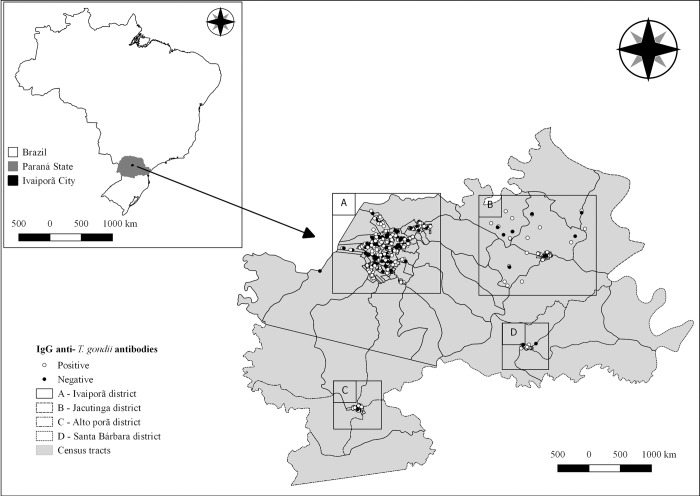
Human toxoplasmosis, a protozoonosis caused by Toxoplasma gondii, has been described as a worldwide foodborne disease with important public health impact. Despite infection has reportedly varied due to differences in alimentary, cultural and hygienic habits and geographic region, social vulnerability influence on toxoplasmosis distribution remains to be fully established. Accordingly, the present study has aimed to assess T. gondii seroprevalence and factors associated to social vulnerability for infection in households of Ivaiporã, southern Brazil, with 33.6% population making half minimum wage or less, ranked 1,055th in population (31,816 habitants), 1,406th in per capita income (U$ 211.80 per month) and 1,021st in HDI (0.764) out of 5,570 Brazilian cities. Serum samples and epidemiological questionnaires were obtained from citizen volunteers with official City Secretary of Health assistance in 2015 and 2016. In overall, serosurvey has revealed 526/715 (73.57%) positive samples for anti-T. gondii antibodies by Indirect Fluorescent Antibody Test. Logistic regression has shown a significant increase associated to adults (p = 0.021) and elderly (p = 0.014) people, illiterates (p = 0.025), unemployment (p <0.001) and lack of household water tank (p = 0.039). On the other hand, sex (male or female), living area (urban or rural), yard hygiene, meat ingestion, sand or land contact, owning pets (dog, cat or both) were not significant variables of positivity for anti-T. gondii antibodies in the surveyed population. Although no significant spatial cluster was found, high intensity areas of seropositive individuals were located in the Kernel map where the suburban neighborhoods are located. In conclusion, socioeconomic vulnerability determinants may be associated to Toxoplasma gondii exposure. The increased risk due to illiteracy, adult or elderly age, unemployment and lack of household water tank were confirmed by multivariate analysis and the influence of low family income for seropositivity by the spatial analysis.
人弓形体病,一种由刚地弓形虫引起的原虫病,已被描述为一种具有重要公共卫生影响的全球性食源性疾病。尽管据报道,由于饮食、文化和卫生习惯以及地理位置的不同,感染情况有所不同,但社会脆弱性对弓形虫病分布的影响仍有待充分确定。因此,本研究旨在评估巴西南部伊瓦伊波拉纳市家庭中刚地弓形虫的血清阳性率和与社会脆弱性相关的感染因素,该市 33.6%的人口收入为最低工资或以下,人口排名第 1055 位(31816 居民),人均收入排名第 1406 位(每月 211.80 美元),人类发展指数排名第 1021 位(0.764),在巴西 5570 个城市中排名第 1055 位。血清样本和流行病学调查问卷于 2015 年和 2016 年由公民志愿者在市卫生局长官的协助下获得。总的来说,间接荧光抗体试验显示,血清调查发现 526/715(73.57%)阳性样本抗刚地弓形虫抗体。逻辑回归表明,成年人(p=0.021)和老年人(p=0.014)、文盲(p=0.025)、失业(p<0.001)和缺乏家庭水箱(p=0.039)与阳性率显著增加有关。另一方面,性别(男性或女性)、居住区域(城市或农村)、庭院卫生、肉类摄入、沙或土地接触、拥有宠物(狗、猫或两者都有)在被调查人群中并不是抗刚地弓形虫抗体阳性的显著变量。尽管没有发现显著的空间聚类,但在核密度图中位于郊区社区的地方发现了血清阳性个体的高感染强度区域。总之,社会经济脆弱性决定因素可能与刚地弓形虫暴露有关。多变量分析证实,文盲、成年或老年、失业和缺乏家庭水箱会增加感染风险,空间分析证实,家庭收入低会增加血清阳性率。