Laboratory of Amyloid Biology, St. Petersburg State University, 199034 St. Petersburg, Russia.
Department of Biology, Tufts University, Medford, MA 02421, USA.
Genes (Basel). 2019 Feb 5;10(2):118. doi: 10.3390/genes10020118.
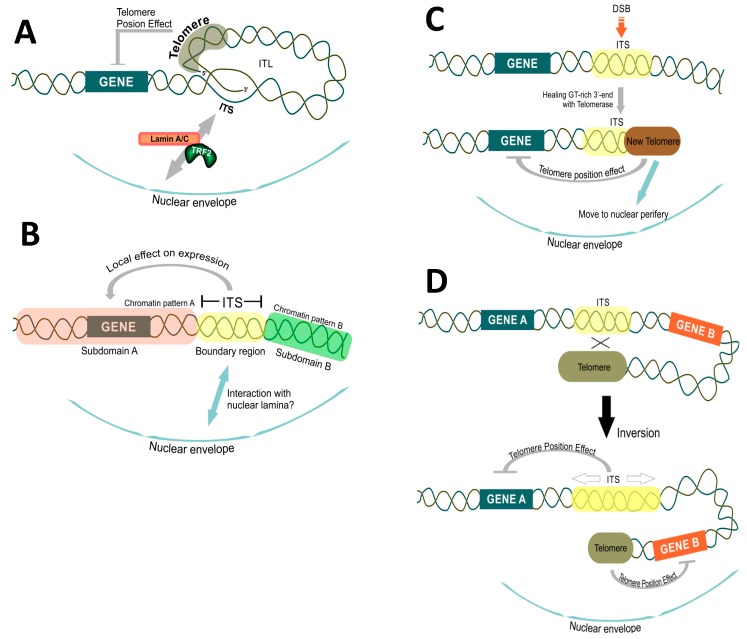
Tandem DNA repeats derived from the ancestral (TTAGGG)n run were first detected at chromosome ends of the majority of living organisms, hence the name telomeric DNA repeats. Subsequently, it has become clear that telomeric motifs are also present within chromosomes, and they were suitably called interstitial telomeric sequences (ITSs). It is well known that telomeric DNA repeats play a key role in chromosome stability, preventing end-to-end fusions and precluding the recurrent DNA loss during replication. Recent data suggest that ITSs are also important genomic elements as they confer its karyotype plasticity. In fact, ITSs appeared to be among the most unstable microsatellite sequences as they are highly length polymorphic and can trigger chromosomal fragility and gross chromosomal rearrangements. Importantly, mechanisms responsible for their instability appear to be similar to the mechanisms that maintain the length of genuine telomeres. This review compares the mechanisms of maintenance and dynamic properties of telomeric repeats and ITSs and discusses the implications of these dynamics on genome stability.
串联 DNA 重复序列来源于祖先(TTAGGG)n 序列,最初在大多数生物的染色体末端被检测到,因此被命名为端粒 DNA 重复序列。随后,人们清楚地发现端粒基序也存在于染色体内部,因此被恰当地称为间插端粒序列(ITSs)。众所周知,端粒 DNA 重复序列在染色体稳定性中起着关键作用,防止端到端融合,并防止在复制过程中反复发生 DNA 丢失。最近的数据表明,ITSs 也是重要的基因组元件,因为它们赋予了其染色体组的可塑性。事实上,ITSs 似乎是最不稳定的微卫星序列之一,因为它们高度长度多态性,并且可以引发染色体脆弱性和巨大染色体重排。重要的是,负责它们不稳定性的机制似乎与维持真正端粒长度的机制相似。这篇综述比较了端粒重复序列和 ITSs 的维持机制和动态特性,并讨论了这些动态对基因组稳定性的影响。