Division of Nephrology, Shanghai Ninth People's Hospital, School of Medicine, Shanghai Jiaotong University, 639 Zhizaoju Road, Shanghai, 200011, China.
Department of Medical Statistics, Children's Hospital; Center for Evidence-based Medicine, Fudan University, Shanghai, 200433, China.
BMC Nephrol. 2019 Feb 14;20(1):57. doi: 10.1186/s12882-019-1238-9.
Protein-bound uremic toxins are associated with poor outcomes in patients with chronic kidney disease. The aim of this study is to investigate the relationship between indoxyl sulfate (IS), a protein-bound solute, and 90-day mortality in patients with acute kidney injury.
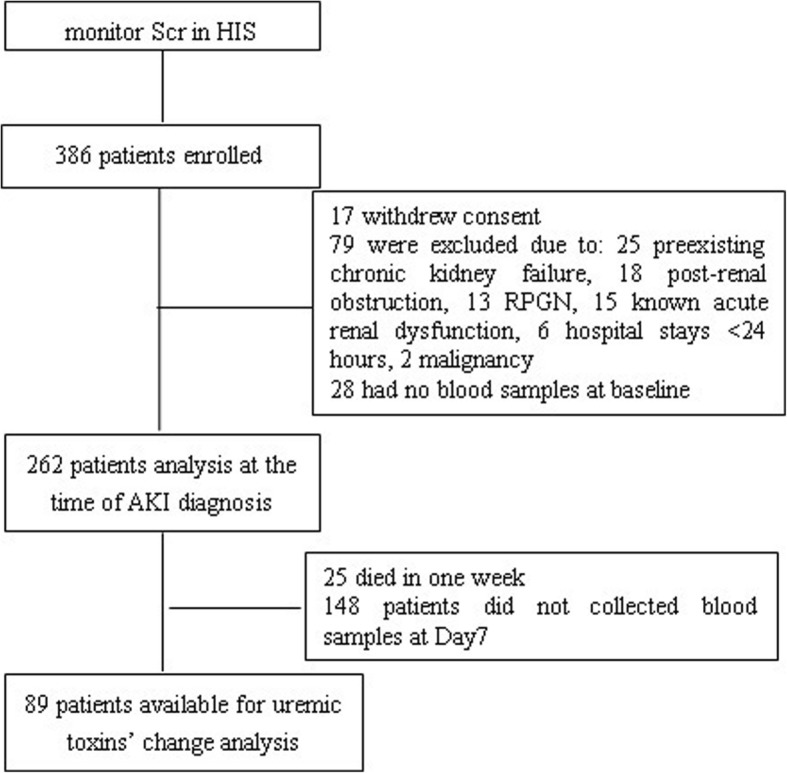
Adults with hospital-acquired AKI (HA-AKI) were enrolled in this prospective cohort study between 2014 and 2015, according to the KDIGO creatinine criteria. The primary end point was all-cause death during follow-up.
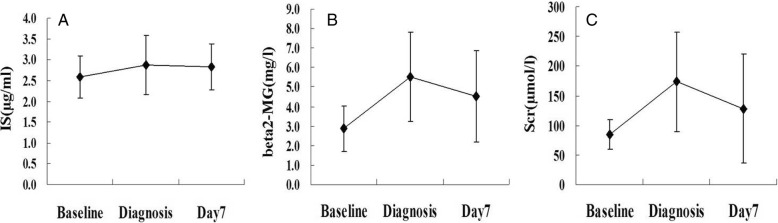
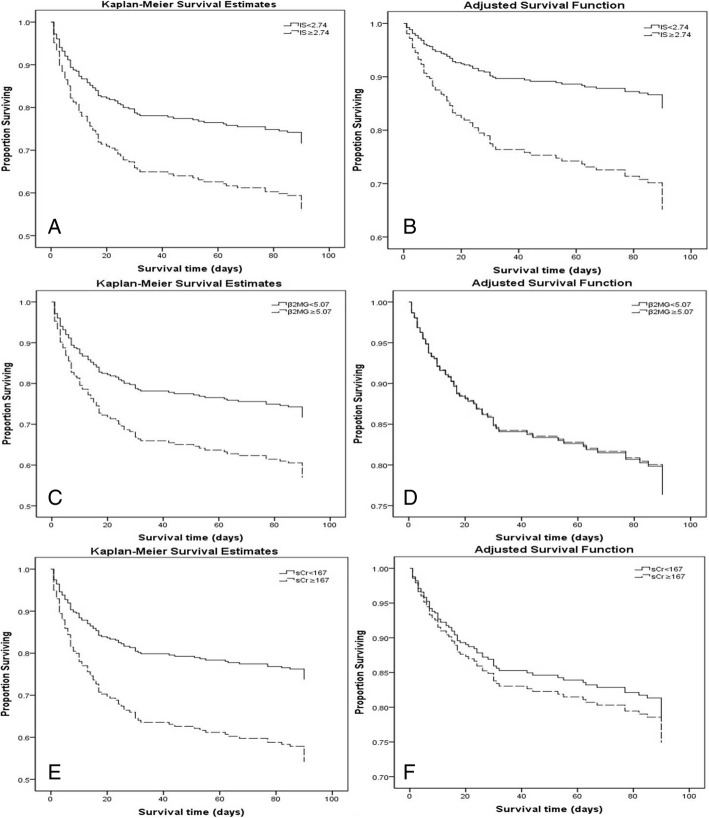
The mean serum IS level in patients with HA-AKI was 2.74 ± 0.75 μg/ml, which was higher than that in healthy subjects (1.73 ± 0.11 μg/ml, P < 0.001) and critically ill patients (2.46 ± 0.35 μg/ml, P = 0.016) but was lower than that in patients with chronic kidney disease (3.07 ± 0.31 μg/ml, P < 0.001). Furthermore, serum IS levels (2.83 ± 0.55 μg/ml) remained elevated in patients with HA-AKI on the seventh day after AKI diagnosis. Patients with HA-AKI were divided into the following two groups according to the median serum IS level: the low-IS group and the high-IS group. A total of 94 (35.9%) patient deaths occurred within 90 days, including 76 (29.0%) in the low-IS group and 112 (42.7%) in the high-IS group (P = 0.019). Kaplan-Meier analysis revealed that the two groups differed significantly with respect to 90-day survival (log-rank P = 0.007), and Cox regression analysis showed that an IS level ≥ 2.74 μg/ml was significantly associated with a 2.0-fold increased risk of death (adjusted hazard ratio [HR], 2.92; 95% confidence interval [CI], 1.76 to 4.86; P < 0.001) compared with an IS level < 2.74 μg/ml.
Serum IS levels were significantly elevated in patients with HA-AKI compared to those in healthy subjects and critically ill patients and were associated with a worse prognosis of HA-AKI.
www.clinicaltrials.gov NCT 00953992. Registered 6 August 2009.
蛋白结合性尿毒症毒素与慢性肾脏病患者的不良预后相关。本研究旨在探讨血清硫酸吲哚酚(IS)与急性肾损伤(AKI)患者 90 天死亡率之间的关系。
本前瞻性队列研究于 2014 年至 2015 年期间纳入符合 KDIGO 肌酐标准的医院获得性 AKI(HA-AKI)成年患者。主要终点为随访期间的全因死亡。
HA-AKI 患者的平均血清 IS 水平为 2.74±0.75μg/ml,高于健康受试者(1.73±0.11μg/ml,P<0.001)和危重症患者(2.46±0.35μg/ml,P=0.016),但低于慢性肾脏病患者(3.07±0.31μg/ml,P<0.001)。此外,在 AKI 诊断后第 7 天,HA-AKI 患者的血清 IS 水平(2.83±0.55μg/ml)仍升高。根据血清 IS 中位数水平,将 HA-AKI 患者分为低 IS 组和高 IS 组。90 天内共有 94 例(35.9%)患者死亡,其中低 IS 组 76 例(29.0%),高 IS 组 112 例(42.7%)(P=0.019)。Kaplan-Meier 分析显示,两组 90 天生存率差异有统计学意义(对数秩检验 P=0.007),Cox 回归分析显示,IS 水平≥2.74μg/ml 与死亡风险增加 2 倍相关(调整后危险比[HR],2.92;95%置信区间[CI],1.76 至 4.86;P<0.001),与 IS 水平<2.74μg/ml 相比。
与健康受试者和危重症患者相比,HA-AKI 患者的血清 IS 水平显著升高,且与 HA-AKI 的预后不良相关。
www.clinicaltrials.gov NCT 00953992。2009 年 8 月 6 日注册。