Nanoneurobiophysics Research Group, Department of Physics, Chemistry and Mathematics, Federal University of São Carlos, Sorocaba, 18052-780, Brazil.
Institute of Tropical Medicine of São Paulo, University of São Paulo, São Paulo, 05403-000, Brazil.
Sci Rep. 2019 Feb 14;9(1):2033. doi: 10.1038/s41598-018-36578-8.
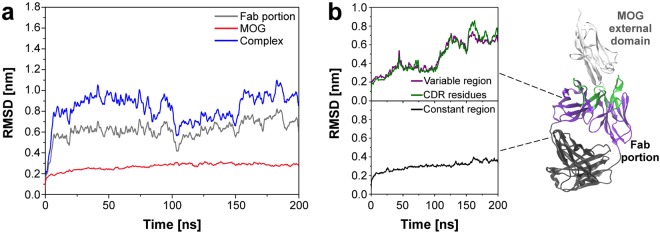
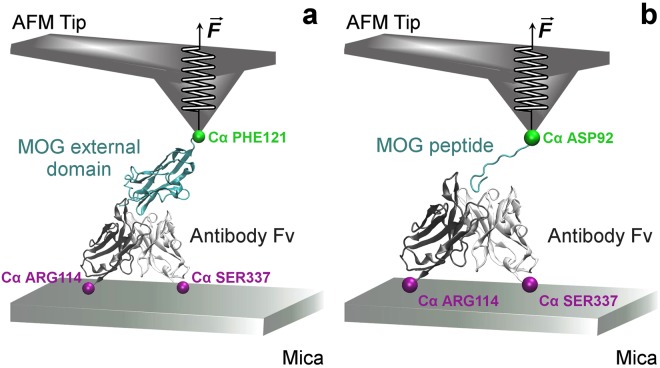
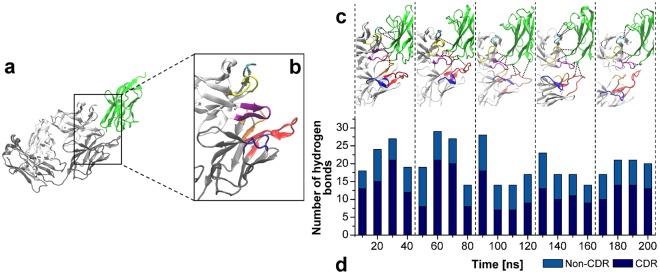
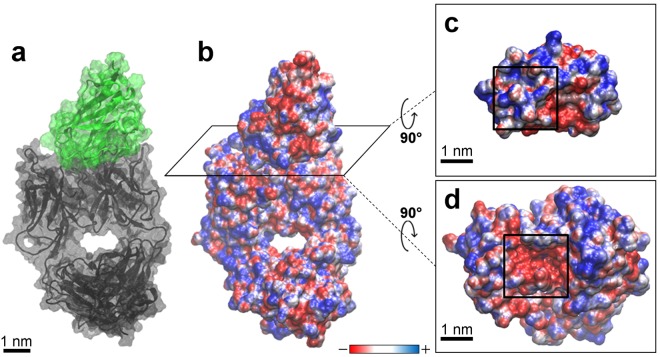
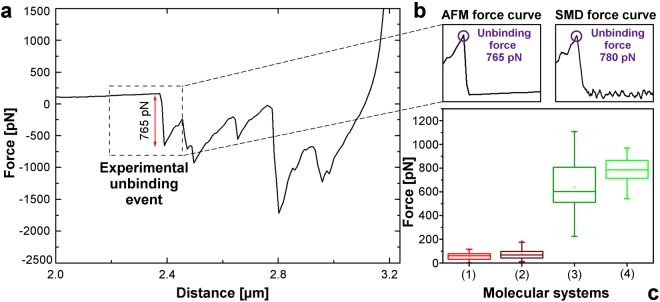
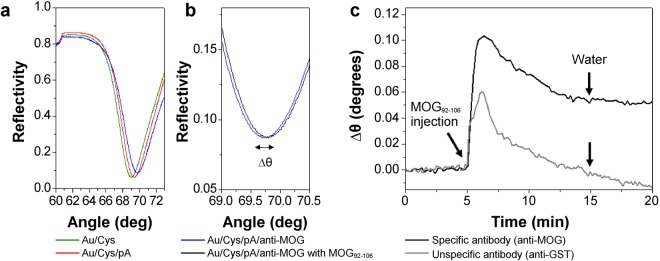
Antigen-antibody interaction is crucial in autoimmune disease pathogenesis, as multiple sclerosis and neuromyelitis optica. Given that, autoantibodies are essential biomolecules, of which the myelin oligodendrocyte glycoprotein (MOG) can figure as a target. Here we combined Molecular Dynamics (MD), Steered Molecular Dynamics (SMD), and Atomic Force Microscope (AFM) to detail MOG recognition by its specific antibody. The complex model consisted of the MOG external domain interacting with an experimental anti-MOG antibody from the Protein Data Bank (1PKQ). Computational data demonstrated thirteen MOG residues with a robust contribution to the antigen-antibody interaction. Comprising five of the thirteen anchor residues (ASP, HIS, SER, TYR, and GLN), the well-known MOG peptide in complex with the anti-MOG was analysed by AFM and SMD. These analyses evidenced similar force values of 780 pN and 765 pN for computational and experimental MOG and anti-MOG detachment, respectively. MOG was responsible for 75% of the total force measured between MOG external domain and anti-MOG, holding the interaction with the antibody. The antigen-antibody binding was confirmed by Surface Plasmon Resonance (SPR) measurements. Combined approaches presented here can conveniently be adjusted to detail novel molecules in diseases research. This can optimize pre-clinical steps, guiding experiments, reducing costs, and animal model usage.
抗原-抗体相互作用在自身免疫性疾病发病机制中至关重要,如多发性硬化症和视神经脊髓炎。鉴于此,自身抗体是重要的生物分子,髓鞘少突胶质细胞糖蛋白 (MOG) 可以作为其靶标。在这里,我们结合分子动力学 (MD)、导向分子动力学 (SMD) 和原子力显微镜 (AFM) 来详细描述 MOG 与其特异性抗体的识别。该复合物模型由与来自蛋白质数据库 (1PKQ) 的实验性抗 MOG 抗体相互作用的 MOG 外域组成。计算数据表明,13 个 MOG 残基对抗原-抗体相互作用有很强的贡献。包含 13 个锚定残基中的 5 个 (ASP、HIS、SER、TYR 和 GLN),复合物中与抗 MOG 结合的众所周知的 MOG 肽通过 AFM 和 SMD 进行了分析。这些分析表明,计算和实验 MOG 与抗 MOG 分离的力值分别为 780 pN 和 765 pN,非常相似。MOG 负责 MOG 外域和抗 MOG 之间测量的总力的 75%,保持与抗体的相互作用。表面等离子体共振 (SPR) 测量证实了抗原-抗体结合。这里提出的组合方法可以方便地调整以详细研究疾病研究中的新型分子。这可以优化临床前步骤,指导实验,降低成本和动物模型的使用。