Department of Radiology, Aichi Medical University Hospital, Aichi, Japan.
Department of Oculoplastic, Orbital, and Lacrimal Surgery, Aichi Medical University Hospital, Aichi, Japan.
Sci Rep. 2019 Feb 14;9(1):2027. doi: 10.1038/s41598-019-38640-5.
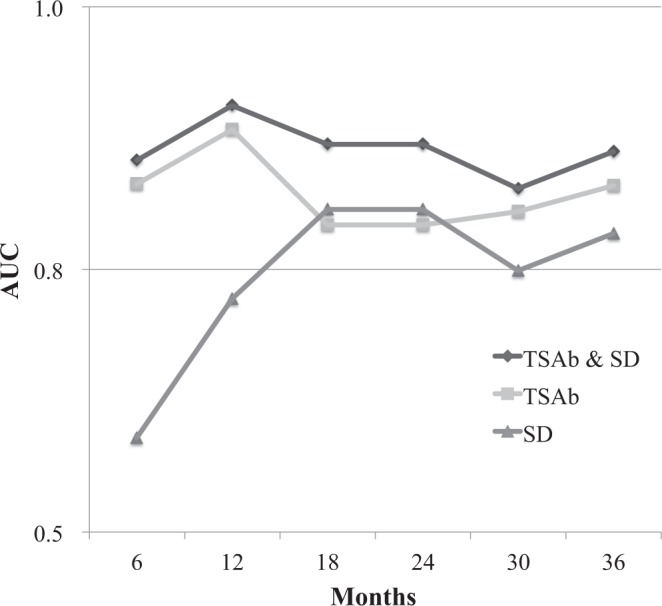
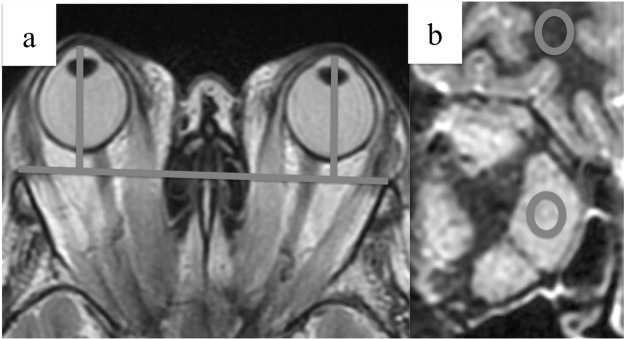
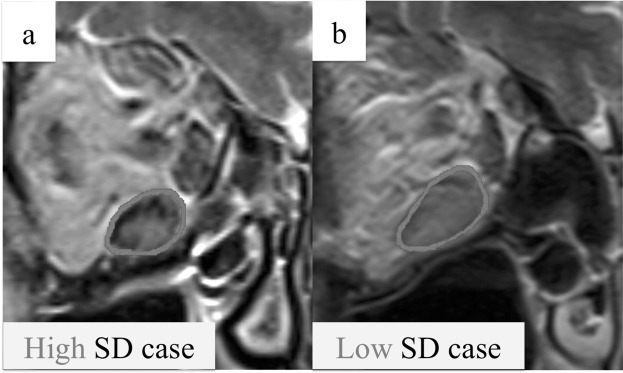
To identify predictive factors of prognosis after radiotherapy with concurrent steroid pulse therapy for thyroid eye disease, retrospective analyses were performed among 77 patients. Clinical activity score and magnetic resonance imaging were used to evaluate degrees of orbital inflammation. As a pre-treatment work-up, the thyroid-stimulating antibody (TSAb) level was measured. During a median follow-up of 25.0 months, the 2-year cumulative relapse-free rate (CRFR) was 80.9%. In the univariate analysis, a worse 2-year CRFR was significantly associated with the presence of optic neuropathy (P = 0.001), a higher TSAb rate (P = 0.001), and lower standard deviation (SD) of signal intensity at the extraocular muscle in T2-weighted images (P = 0.006). In the multivariate analysis, TSAb rate and SD affected the CRFR independently. When TSAb activity of 2800% was set as a cut-off at 2 years after treatment, the predictive sensitivity and specificity of relapse were 81.2% and 90.6%, respectively. With regard to SD, the respective sensitivity and specificity values were 81.2% and 82.7% when 100 was set as a cut-off. In conclusion, high TSAb and low SD were significant risk factors for cumulative relapse in orbital radiotherapy. Cut-off values of 2800% for TSAb and 100 for SD may be suitable.
为了确定甲状腺眼病行放射治疗联合类固醇脉冲治疗后预后的预测因素,对 77 例患者进行了回顾性分析。采用临床活动评分和磁共振成像来评估眼眶炎症程度。在治疗前评估中,检测了甲状腺刺激抗体(TSAb)水平。在中位数为 25.0 个月的随访中,2 年无复发生存率(CRFR)为 80.9%。在单因素分析中,较差的 2 年 CRFR 与视神经病变(P = 0.001)、较高的 TSAb 率(P = 0.001)和 T2 加权图像中外眼肌信号强度标准差(SD)降低(P = 0.006)显著相关。在多因素分析中,TSAb 率和 SD 独立影响 CRFR。当将治疗后 2 年的 TSAb 活性设定为 2800%作为截点时,复发的预测敏感性和特异性分别为 81.2%和 90.6%。关于 SD,当将 100 设定为截点时,其敏感性和特异性值分别为 81.2%和 82.7%。总之,高 TSAb 和低 SD 是眼眶放疗后累积复发的显著危险因素。TSAb 的截点值为 2800%,SD 的截点值为 100,可能较为合适。