Ding Ning, Jiang Jing, Xu Anping, Tang Yinshan, Li Zhigang
School of Acupuncture-Moxibustion and Tuina, Beijing University of Chinese Medicine, Beijing, China.
School of Nursing, Beijing University of Chinese Medicine, Beijing, China.
Front Neurosci. 2019 Jan 31;13:37. doi: 10.3389/fnins.2019.00037. eCollection 2019.
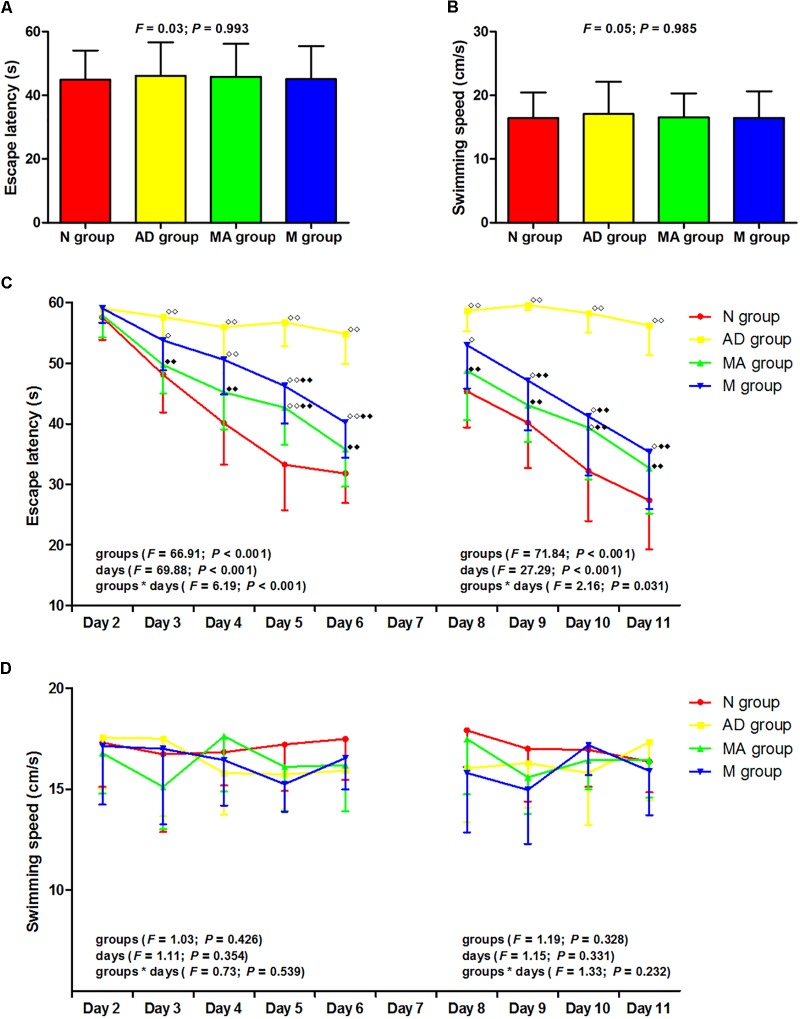
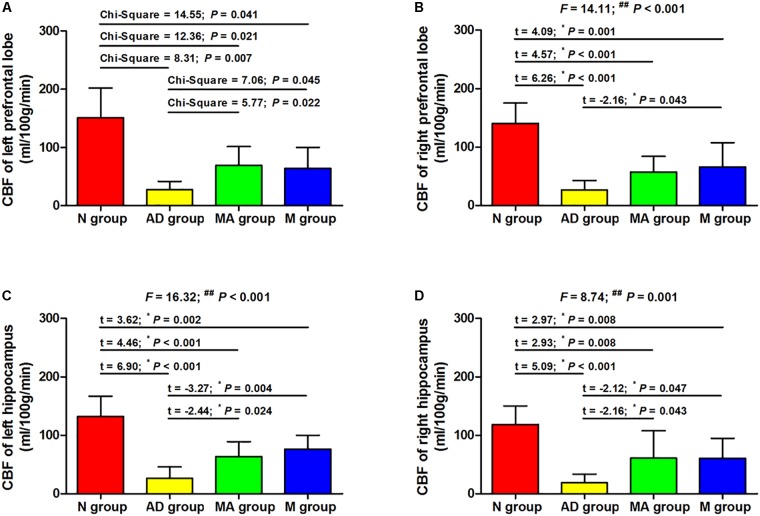
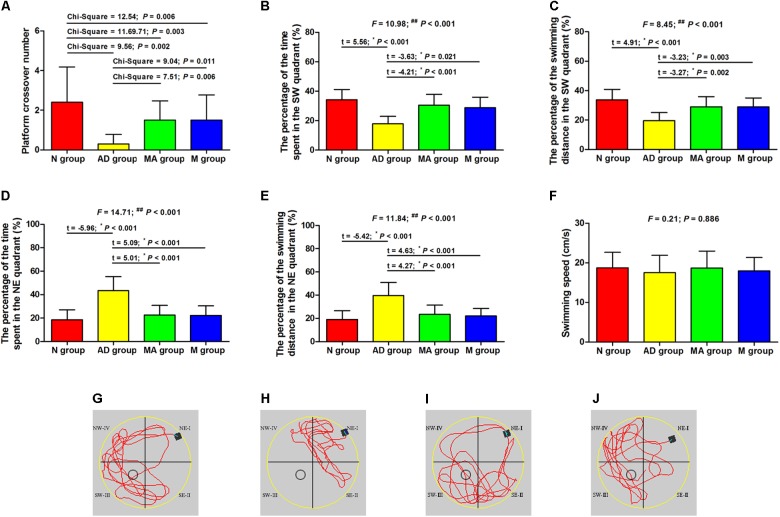
A growing body of evidence has demonstrated that cerebrovascular function abnormality plays a key role in occurrence and worsening of Alzheimer's disease (AD). Reduction of cerebral blood flow (CBF) is a sensitive marker to early perfusion deficiencies in AD. As one of the most important therapies in complementary and alternative medicine, manual acupuncture (MA) has been used in the treatment of AD. However, the moderating effect of MA on CBF remains largely unknown. To investigate the effect of MA on the behavior and CBF of SAMP8 mice. SAMP8 mice were randomly divided into the AD, MA, and medicine (M) groups, with SAMR1 mice used as the normal control (N) group. Mice in the M group were treated with donepezil hydrochloride at 0.65 μg/g. In the MA group, MA was applied at Baihui (GV20) and Yintang (GV29) for 20 min. The above treatments were administered once a day for 15 consecutive days. The Morris water maze and arterial spin labeling MRI were used to assess spatial learning and memory in behavior and CBF respectively. Compared with the AD group, both MA and donepezil significantly decreased the escape latency ( < 0.01), while also elevating platform crossover number and the percentage of time and swimming distance in the platform quadrant ( < 0.01 or < 0.05). The remarkable improvement in escape latency in the MA group appeared earlier than the M group, and no significant statistical significance was observed between the N and MA group with the exception of days 5 and 10. The CBF in the prefrontal lobe and hippocampus in the MA group was substantially higher than in the AD group ( < 0.05) with the exception of the right prefrontal lobe, with similar effects of donepezil. Manual acupuncture can effectively improve the spatial learning, relearning and memory abilities of SAMP8 mice. The increase in CBF in the prefrontal lobe and hippocampus could be an important mechanism for the beneficial cognitive effects of MA in AD.
越来越多的证据表明,脑血管功能异常在阿尔茨海默病(AD)的发生和病情恶化中起关键作用。脑血流量(CBF)减少是AD早期灌注不足的一个敏感指标。作为补充和替代医学中最重要的疗法之一,手动针刺(MA)已被用于治疗AD。然而,MA对CBF的调节作用在很大程度上仍不清楚。为了研究MA对SAMP8小鼠行为和CBF的影响。将SAMP8小鼠随机分为AD组、MA组和药物(M)组,将SAMR1小鼠作为正常对照(N)组。M组小鼠用0.65μg/g盐酸多奈哌齐治疗。在MA组,在百会(GV20)和印堂(GV29)进行针刺20分钟。上述治疗每天进行一次,连续进行15天。采用莫里斯水迷宫和动脉自旋标记MRI分别评估行为学中的空间学习和记忆以及CBF。与AD组相比,MA和多奈哌齐均显著降低逃避潜伏期(<0.01),同时还提高了平台穿越次数以及在平台象限的时间百分比和游泳距离(<0.01或<0.05)。MA组逃避潜伏期的显著改善比M组出现得更早,除第5天和第10天外,N组和MA组之间未观察到显著统计学差异。MA组前额叶和海马的CBF除右侧前额叶外均显著高于AD组(<0.05),多奈哌齐也有类似作用。手动针刺可有效改善SAMP8小鼠的空间学习、再学习和记忆能力。前额叶和海马CBF的增加可能是MA对AD有益认知作用的重要机制。