Suresh Babu, Asati Vikas, Lakshmaiah K C, Babu Govind, Lokanatha D, Jacob Linu Abraham, Lokesh K N, Rudresh A H, Rajeev L K, Smitha Saldanha, Anand Abhishek, Patidar Rajesh, Premalata C S
Department of Medical Oncology, Kidwai Cancer Institute, Bengaluru, Karnataka, India.
South Asian J Cancer. 2019 Jan-Mar;8(1):57-59. doi: 10.4103/sajc.sajc_52_18.
Gastrointestinal tract (GIT) is the most common extranodal site for non-Hodgkin's lymphoma (NHL) and constitutes about 10%-15% of all NHL. This was a prospective study to evaluate the epidemiological, clinicopathological characteristics, and treatment outcome of primary GIT diffuse large B-cell lymphoma (PGIL).
Newly diagnosed patients of PGIL with DLBCL histology were eligible. Lugano staging system was used. All patients were treated with prephase treatment (1 mg vincristine and 100 mg prednisolone) followed by CHOP-based chemotherapy (with or without rituximab) as definitive treatment.
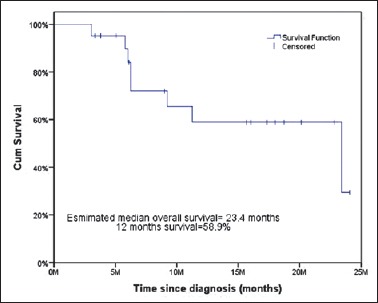
A total of 21 patients of PGIL were diagnosed. The median age was 46 years (range: 27-69 years) with male:female ratio of 2:1. Dull aching abdominal pain was the most common presenting complaint. Stomach was the most common site involved (52.4%, = 11) followed by the colon (23.8%, = 5). The estimated median survival in patients with Stage IV disease was significantly lower as compared to patients with localized disease (Stage I and II) (6.23 months vs. 23.4 months; = 0.04). Patients, who did not achieve complete response (CR), had 15.5 times higher risk of death, as compared to those who achieved CR ( = 0.01).
Stomach was the most common site for PGIL. Localized disease and CR after first-line chemotherapy were associated with better survival. A higher cost of rituximab was the prohibitive factor for cure in these patients.
胃肠道(GIT)是非霍奇金淋巴瘤(NHL)最常见的结外部位,约占所有NHL的10%-15%。这是一项前瞻性研究,旨在评估原发性胃肠道弥漫性大B细胞淋巴瘤(PGIL)的流行病学、临床病理特征及治疗结果。
符合条件的为新诊断的组织学为弥漫大B细胞淋巴瘤的PGIL患者。采用卢加诺分期系统。所有患者均接受前期治疗(1 mg长春新碱和100 mg泼尼松龙),随后进行以CHOP为基础的化疗(联合或不联合利妥昔单抗)作为确定性治疗。
共诊断出21例PGIL患者。中位年龄为46岁(范围:27-69岁),男女比例为2:1。隐痛性腹痛是最常见的主诉。胃是最常受累的部位(52.4%,n = 11),其次是结肠(23.8%,n = 5)。IV期疾病患者的估计中位生存期明显低于局限性疾病(I期和II期)患者(6.23个月对23.4个月;P = 0.04)。未达到完全缓解(CR)的患者死亡风险比达到CR的患者高15.5倍(P = 0.01)。
胃是PGIL最常见的部位。局限性疾病和一线化疗后达到CR与更好的生存相关。利妥昔单抗的较高成本是这些患者治愈的阻碍因素。