Department of Health and Biomedical Sciences, University of Texas Rio Grande Valley, One West University Blvd., Brownsville, Texas, 78520.
Department of Physics and Astronomy, University of Texas Rio Grande Valley, One West University Blvd., Brownsville, Texas, 78520.
J Biomed Mater Res B Appl Biomater. 2019 Oct;107(7):2317-2324. doi: 10.1002/jbm.b.34324. Epub 2019 Feb 15.
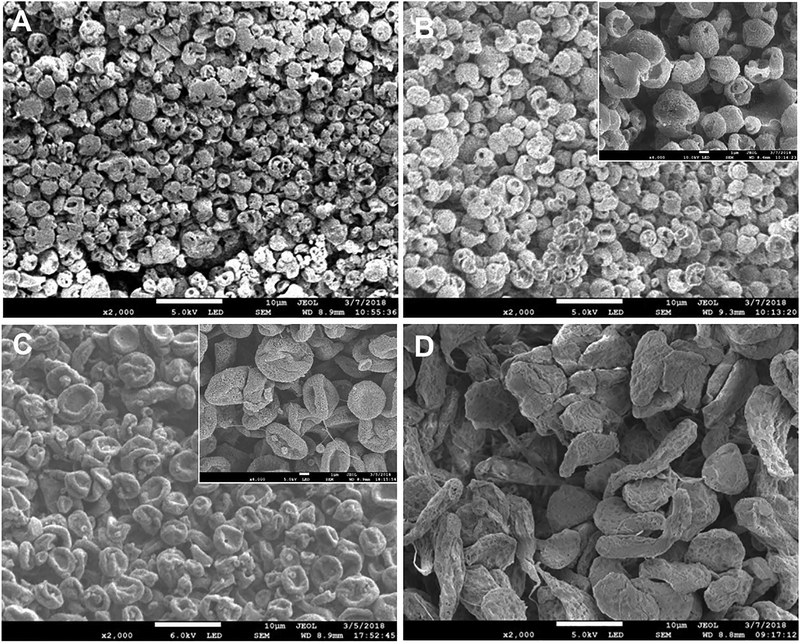
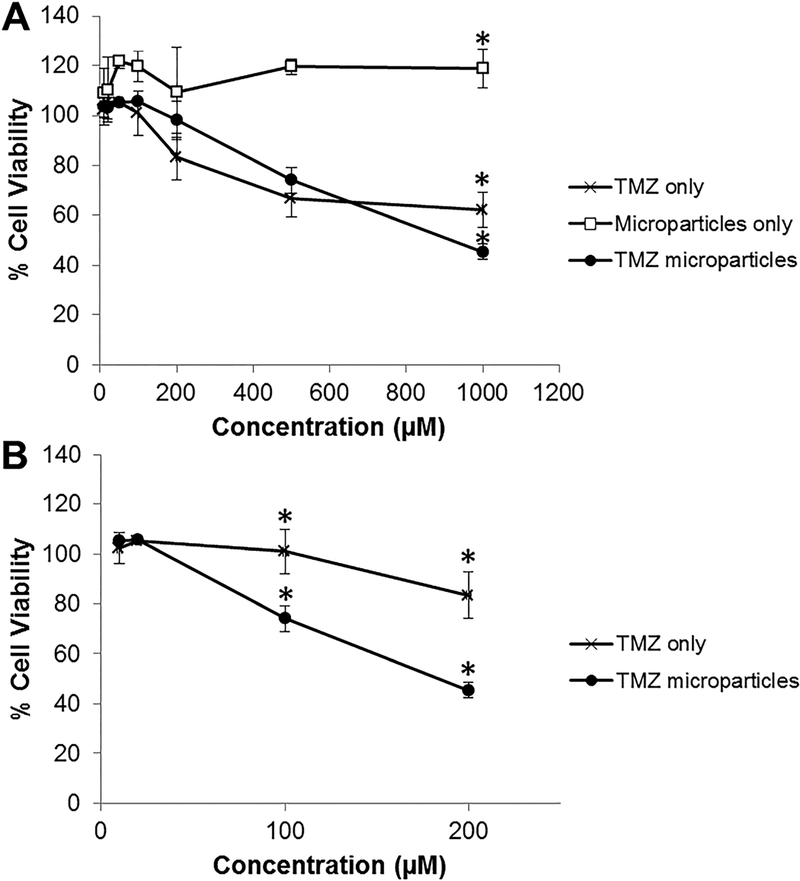
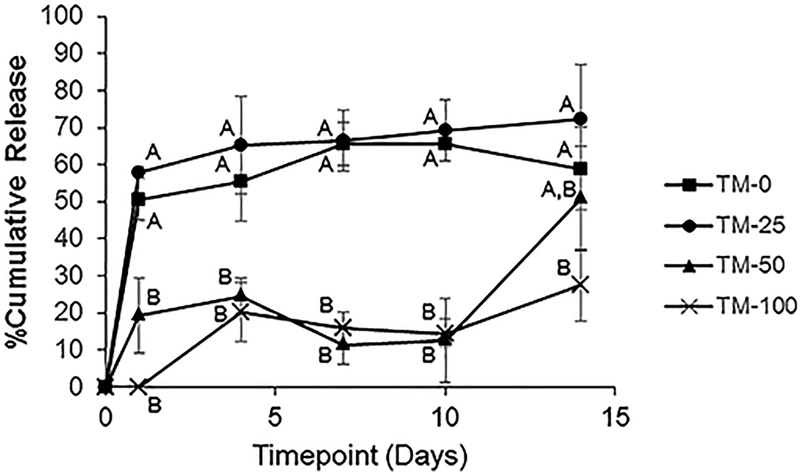
Glioblastoma multiforme (GBM) is the most common and invasive form of malignant brain tumors and despite advances in surgery, radiotherapy, and chemotherapy, the survival of patients with GBM still remains poor. Temozolomide (TMZ) is the chemotherapy drug that is most commonly given orally after surgical resection of these tumors. In this study, the effects of solvents (i.e., dichloromethane and acetonitrile) used for the fabrication of electrosprayed TMZ-loaded poly(lactic-co-glycolic acid) (PLGA) on drug loading, loading efficiency, drug release kinetics, surface morphology, and particle size were investigated. The results from this study demonstrated that by using a larger volume of a solvent with higher polarity (i.e., acetonitrile) which allows for a higher amount of hydrophilic TMZ to dissolve into the polymer solution, higher drug loading could be achieved. However, the particles fabricated with high amount of acetonitrile, which has a lower vapor pressure, had large pores and a smaller diameter which led to an initial burst release and high cumulative release at the end of the study. An optimal combination of the two solvents is needed to result in particles with a good amount of loading and minimal initial burst release. The electrosprayed microparticles were able to illicit a cytotoxic response in U-87 MG glioblastoma cells at a lower concentration of drug compared to the free drug. This work indicated that electrospraying is a promising method for the fabrication of TMZ-loaded PLGA microparticles for the treatment of GBM and solvent composition can be altered to control drug loading and release kinetics. © 2019 Wiley Periodicals, Inc. J Biomed Mater Res Part B: Appl Biomater 107B: 2317-2324, 2019.
多形性胶质母细胞瘤(GBM)是最常见和最具侵袭性的恶性脑肿瘤,尽管在手术、放疗和化疗方面取得了进展,但 GBM 患者的生存率仍然很差。替莫唑胺(TMZ)是这些肿瘤切除术后最常口服给予的化疗药物。在这项研究中,研究了用于制造电喷雾载 TMZ 的聚(乳酸-共-乙醇酸)(PLGA)的溶剂(即二氯甲烷和乙腈)的效果对药物负载、载药量、药物释放动力学、表面形态和粒径的影响。这项研究的结果表明,通过使用具有更高极性的较大体积的溶剂(即乙腈),可以将更多的亲水性 TMZ 溶解到聚合物溶液中,从而可以实现更高的载药量。然而,用高比例乙腈(其蒸气压较低)制造的颗粒具有较大的孔和较小的直径,导致初始突释和研究结束时的高累积释放。需要两种溶剂的最佳组合才能得到具有良好载药量和最小初始突释的颗粒。与游离药物相比,电喷雾微球在较低药物浓度下就能引起 U-87 MG 胶质母细胞瘤细胞的细胞毒性反应。这项工作表明,电喷雾是制造用于治疗 GBM 的载 TMZ 的 PLGA 微球的一种很有前途的方法,并且可以改变溶剂组成来控制药物负载和释放动力学。© 2019 威利父子公司。生物材料研究杂志 B 部分:应用生物材料 107B:2317-2324,2019 年。