Washington University School of Medicine, St. Louis, MO.
Washington University School of Medicine, St. Louis, MO.
J Am Acad Child Adolesc Psychiatry. 2019 Mar;58(3):339-349. doi: 10.1016/j.jaac.2018.07.909. Epub 2019 Jan 8.
This study characterized 3- to 6-year-old children's understanding of death as a function of depression status, suicidal ideation (SI), and media consumption.
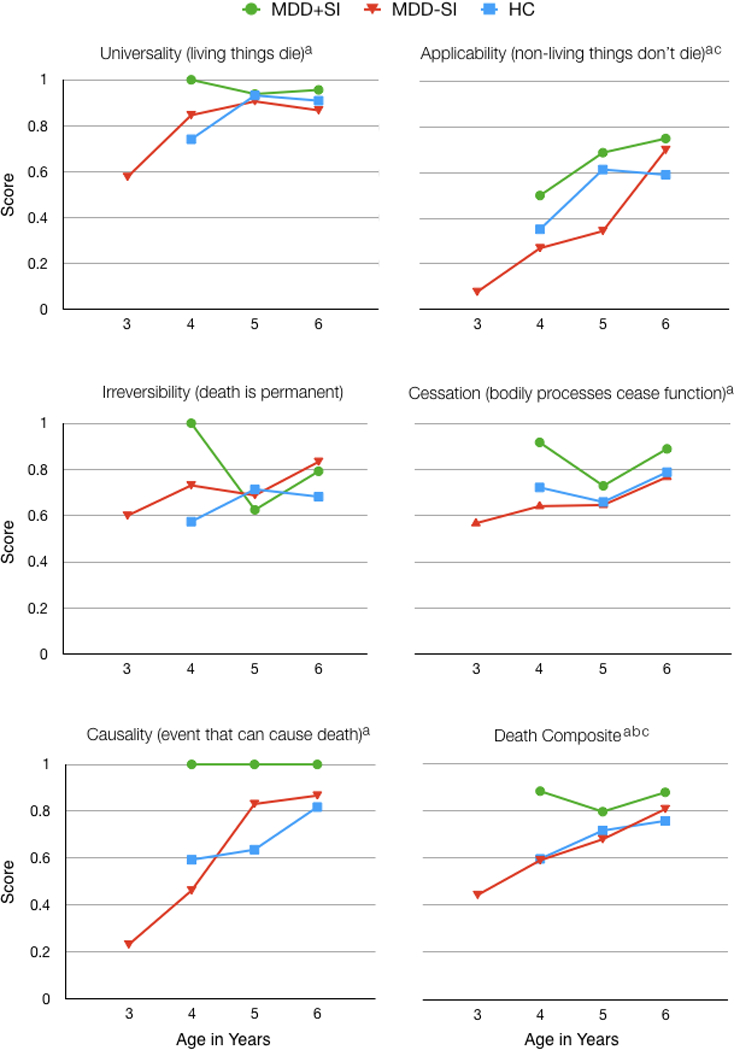
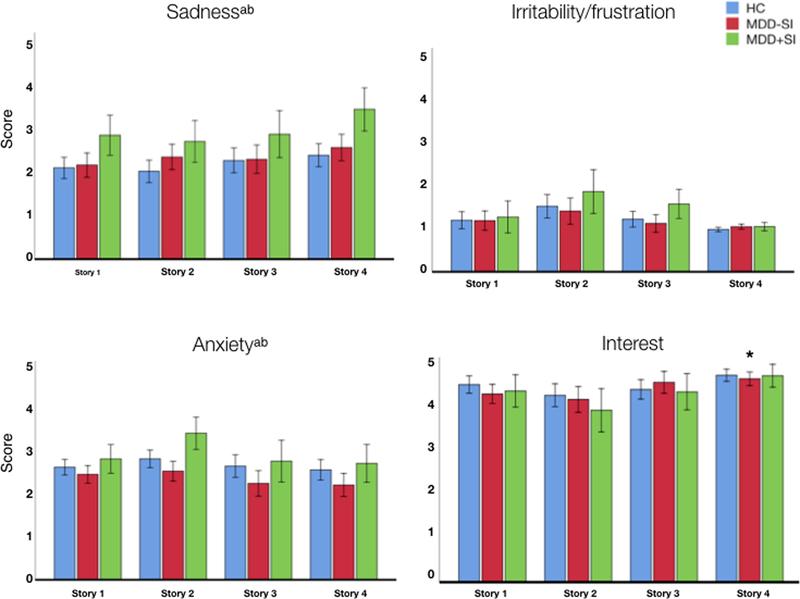
Participants were 79 children with depression (3.0-6.11 years old) who completed a comprehensive psychiatric assessment and experimenter-led death interview and a comparison group of 60 healthy children (4.0-7.12 years old). The interview assessed children's understanding of 5 concepts of death: universality, applicability, irreversibility, cessation, and causality. Children's mastery of each concept and overall understanding of death was examined as a function of depression and SI status: depressed with SI (n = 22), depressed without SI (n = 57), and healthy (n = 60). Children's observed emotional reactions to hearing about natural death, accidental death, and suicide were assessed by death-themed stories. Parent reports of children's television and videogames/internet consumption assessed links between media exposure and understanding of death.
Children with depression and SI scored higher on overall understanding of death than those with depression without SI and healthy children. They also exhibited more sad and anxious affect listening to death-themed stories and were more likely to describe death as caused by violence. Across this sample, older children also were more likely to depict death as violent. More television use was associated with less understanding of death, including the concept of irreversibility.
Children with depression and SI have a more advanced understanding of death than their peers, dispelling the myth that these ideations arise in the context of a poor understanding of death. The increase in violence attributions across early childhood could indicate increasing normalization of violence in children's perceptions of death.
A Randomized Controlled Trial of PCIT-ED for Preschool Depression; http://clinicaltrials.gov; NCT00595283.
本研究通过评估抑郁状态、自杀意念(SI)和媒体使用情况,描述了 3 至 6 岁儿童对死亡的理解。
参与者为 79 名患有抑郁症的儿童(3.0-6.11 岁),他们完成了全面的精神病学评估和实验者主导的死亡访谈,以及 60 名健康儿童(4.0-7.12 岁)的对照组。访谈评估了儿童对 5 个死亡概念的理解:普遍性、适用性、不可逆性、停止和因果关系。检查了抑郁和 SI 状态对儿童掌握每个概念和整体理解死亡的影响:有 SI 的抑郁(n=22)、无 SI 的抑郁(n=57)和健康(n=60)。通过死亡主题故事评估了儿童对自然死亡、意外死亡和自杀的观察情绪反应。儿童的电视和视频游戏/互联网消费的父母报告评估了媒体暴露与对死亡的理解之间的联系。
患有抑郁症和 SI 的儿童在整体死亡理解方面的得分高于没有 SI 的抑郁症儿童和健康儿童。他们在听死亡主题故事时也表现出更多的悲伤和焦虑情绪,更有可能将死亡描述为暴力引起的。在这个样本中,年龄较大的儿童也更有可能将死亡描述为暴力。更多的电视使用与对死亡的理解减少有关,包括不可逆转的概念。
患有抑郁症和 SI 的儿童对死亡的理解比同龄人更深入,消除了这些观念是在对死亡缺乏理解的背景下产生的误解。整个童年时期暴力归因的增加可能表明儿童对死亡的看法中暴力的日益正常化。
PCIT-ED 治疗学龄前抑郁症的随机对照试验;http://clinicaltrials.gov;NCT00595283。