Division of Infectious Disease, Beth Israel Deaconess Medical Center, Boston, MA, USA.
The Fenway Institute, Fenway Health, Boston, MA, USA.
J Int AIDS Soc. 2019 Feb;22(2):e25250. doi: 10.1002/jia2.25250.
Discontinuations of HIV preexposure prophylaxis (PrEP) by at-risk individuals could decrease the effectiveness of PrEP. Our objective was to characterize patterns of, reasons for, and clinical outcomes associated with PrEP discontinuations in primary care.
We conducted medical chart reviews for patients prescribed PrEP during 2011 to 2014 at a Boston community health centre specializing in healthcare for sexual and gender minorities. Patients were followed through 2015. We characterized patients' sociodemographics, relationship status, behavioural health conditions, patterns of and reasons for PrEP discontinuations, and HIV seroconversions. Cox proportional hazards models were used to assess patient factors associated with PrEP discontinuations.
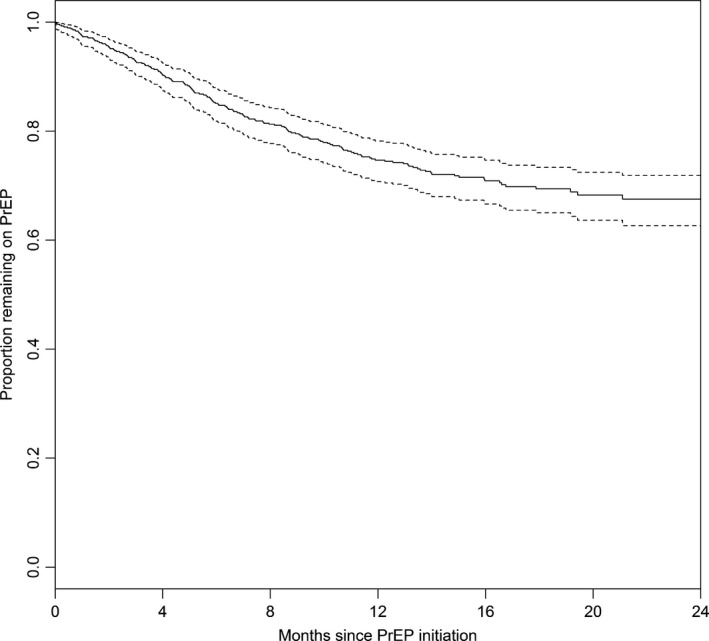
Of the 663 patients prescribed PrEP, the median age was 33 years, 96% were men who have sex with men (MSM) and 73% were non-Hispanic white; 40% were in committed relationships and 15% had HIV-infected partners. Patients either used PrEP continuously (60%), had 1 or more discontinuations (36%), or did not initiate PrEP (4%). Discontinuations were most often due to a decrease in HIV risk perception (33%), non-adherence to care plans (16%), or insurance barriers (12%). Of the 7 (1.1%) PrEP patients diagnosed with HIV, 1 was HIV-infected at baseline, 2 seroconverted while using PrEP, and 4 seroconverted after discontinuations. In a multivariable model adjusted for race/ethnicity, relationship status, substance use disorders, and insurance status, those who were less than 30 years old (aHR 2.0, 95% CI 1.4 to 2.9 for ages 18 to 24, aHR 2.2, 95% CI 1.6 to 3.1 for ages 25 to 29, vs. ages 30 to 39 years), who identified as transgender women (aHR 2.0, 95% CI 1.2 to 3.4, vs. cisgender men), and who had mental health disorders (aHR 1.2, 95% CI 1.1 to 1.4 for each additional disorder) were more likely to have discontinuations.
Discontinuations of PrEP use among this American sample of predominately MSM were common, particularly among patients who were younger, identified as transgender women, or had behavioural health issues. As HIV seroconversions occurred after discontinuations of PrEP, strategies to prevent inappropriate discontinuations are needed.
高危人群中断 HIV 暴露前预防 (PrEP) 可能会降低 PrEP 的效果。我们的目的是描述初级保健中 PrEP 停药的模式、原因和与临床结局相关的因素。
我们对 2011 年至 2014 年在一家专门为性少数群体提供医疗保健的波士顿社区健康中心接受 PrEP 治疗的患者进行了病历回顾。患者随访至 2015 年。我们描述了患者的社会人口统计学特征、关系状况、行为健康状况、PrEP 停药模式和原因以及 HIV 血清转化。使用 Cox 比例风险模型评估与 PrEP 停药相关的患者因素。
在接受 PrEP 治疗的 663 名患者中,中位年龄为 33 岁,96%为男男性行为者 (MSM),73%为非西班牙裔白人;40%处于稳定关系中,15%有 HIV 感染的伴侣。患者要么连续使用 PrEP(60%),要么有 1 次或多次停药(36%),要么未开始 PrEP(4%)。停药最常见的原因是 HIV 风险感知下降(33%)、不遵守护理计划(16%)或保险障碍(12%)。在 7 名(1.1%)被诊断为 HIV 的 PrEP 患者中,1 名患者在基线时已感染 HIV,2 名患者在使用 PrEP 时血清转化,4 名患者在停药后血清转化。在调整种族/民族、关系状况、物质使用障碍和保险状况的多变量模型中,年龄在 18 至 24 岁的患者(年龄在 25 至 29 岁的患者的年龄调整 HR 为 2.0,95%CI 为 1.4 至 2.9;年龄在 30 至 39 岁的患者的年龄调整 HR 为 2.2,95%CI 为 1.6 至 3.1),被认定为跨性别女性的患者(年龄调整 HR 为 2.0,95%CI 为 1.2 至 3.4,与顺性别男性相比)和有精神健康障碍的患者(每增加一种障碍的年龄调整 HR 为 1.2,95%CI 为 1.1 至 1.4)更有可能停药。
在我们的美国 MSM 样本中,PrEP 的停药情况很常见,特别是在年龄较小、被认定为跨性别女性或有行为健康问题的患者中。由于 PrEP 停药后发生了 HIV 血清转化,因此需要采取策略来预防不当停药。