Zhang Jiahe, Soltani Amin, Deng An, Jaksa Mark B
School of Civil, Environmental and Mining Engineering, The University of Adelaide, Adelaide, SA 5005, Australia.
Materials (Basel). 2019 Feb 14;12(4):576. doi: 10.3390/ma12040576.
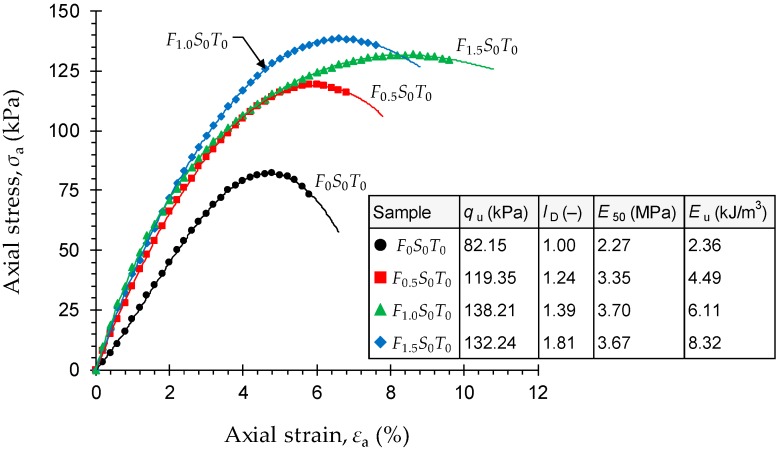
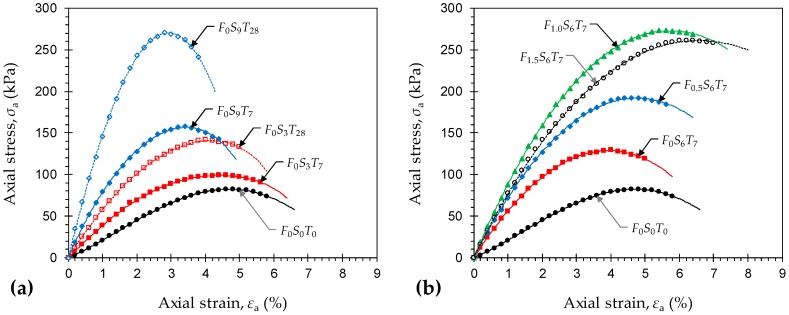
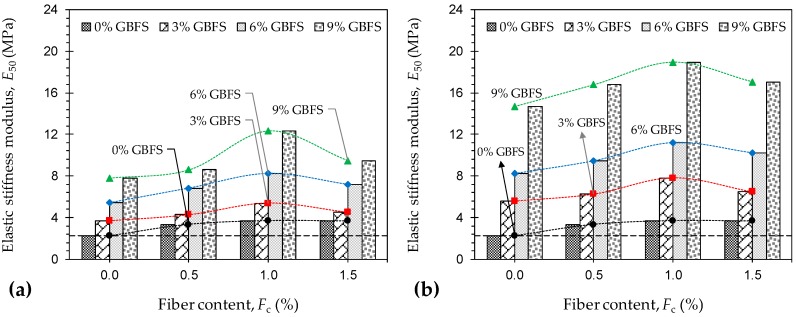
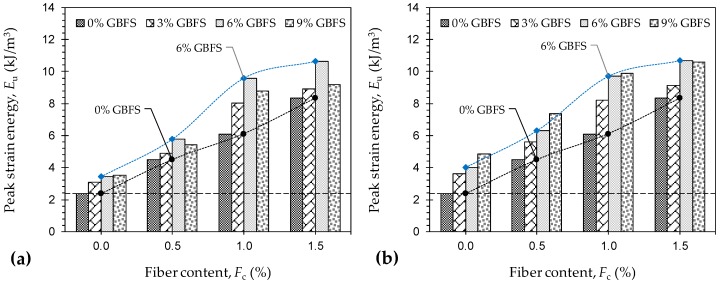
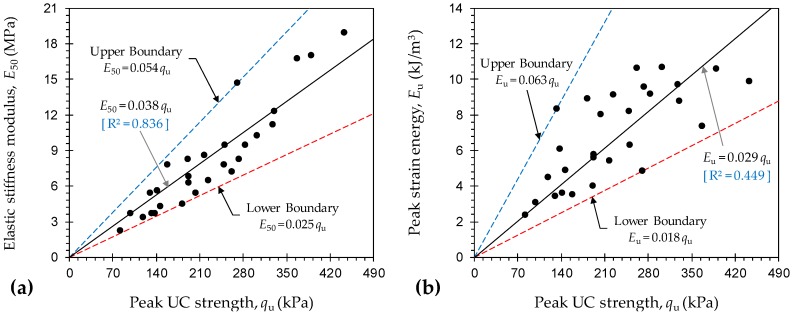
The combined capacity of Jute Fibers (JF), the reinforcement, and Ground-Granulated Blast-Furnace Slag (GBFS), the binder, was examined as a sustainable solution towards ameliorating the inferior engineering properties of micaceous clays. A total of sixteen JF + GBFS mix designs, i.e., JF (% by total mass) = {0, 0.5, 1.0, 1.5} and GBFS (% by total mass) = {0, 3, 6, 9}, were tested for unconfined compression (UC) strength; for those mix designs containing GBFS, curing was allowed for 7 and 28 days prior to testing. Scanning electron microscopy (SEM) studies were also carried out to observe the evolution of fabric in response to JF, GBFS and JF + GBFS amendments. The greater the JF content the higher the developed strength and stiffness up to 1% JF, beyond of which the effect of JF-reinforcement led to some adverse results. The JF inclusions, however, consistently improved the ductility and toughness of the composite. The addition of GBFS to the JF-reinforced samples improved the soil⁻fiber connection interface, and thus led to further improvements in the composite's strength, stiffness and toughness. The mix design "1% JF + 9% GBFS" managed to satisfy ASTM's strength criterion and hence was deemed as the optimum choice in this investigation. Finally, a non-linear, multivariable regression model was developed and validated to quantify the peak UC strength as a function of the composite's index properties. The proposed model contained a limited number of fitting parameters, all of which can be calibrated by little experimental effort, and thus implemented for preliminary design assessments.
研究了黄麻纤维(JF)(增强材料)和磨细粒化高炉矿渣(GBFS)(粘结剂)的组合能力,作为改善云母质粘土不良工程性质的可持续解决方案。总共对16种JF + GBFS混合料设计进行了无侧限抗压(UC)强度测试,即JF(占总质量的百分比)={0, 0.5, 1.0, 1.5}和GBFS(占总质量的百分比)={0, 3, 6, 9};对于含有GBFS的混合料设计,在测试前允许养护7天和28天。还进行了扫描电子显微镜(SEM)研究,以观察织物对JF、GBFS和JF + GBFS改良剂的响应演变。JF含量越高,强度和刚度发展越高,直至JF含量达到1%,超过该含量后,JF增强的效果会导致一些不利结果。然而,JF夹杂物始终提高了复合材料的延展性和韧性。向JF增强样品中添加GBFS改善了土壤-纤维连接界面,从而进一步提高了复合材料的强度、刚度和韧性。混合料设计“1% JF + 9% GBFS”成功满足了ASTM的强度标准,因此被视为本研究中的最佳选择。最后,开发并验证了一个非线性多变量回归模型,以量化峰值UC强度作为复合材料指标性质的函数。所提出的模型包含数量有限的拟合参数,所有这些参数都可以通过少量实验工作进行校准,从而用于初步设计评估。