Hefei National Laboratory for Physical Sciences at the Microscale, Collaborative Innovation Center of Chemistry for Energy Materials, University of Science and Technology of China, Hefei, 230026, P.R. China.
National Synchrotron Radiation Laboratory, University of Science and Technology of China, Hefei, 230029, P.R. China.
Nat Commun. 2019 Feb 15;10(1):788. doi: 10.1038/s41467-019-08697-x.
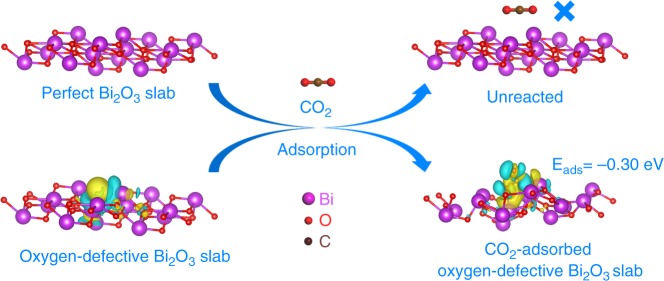
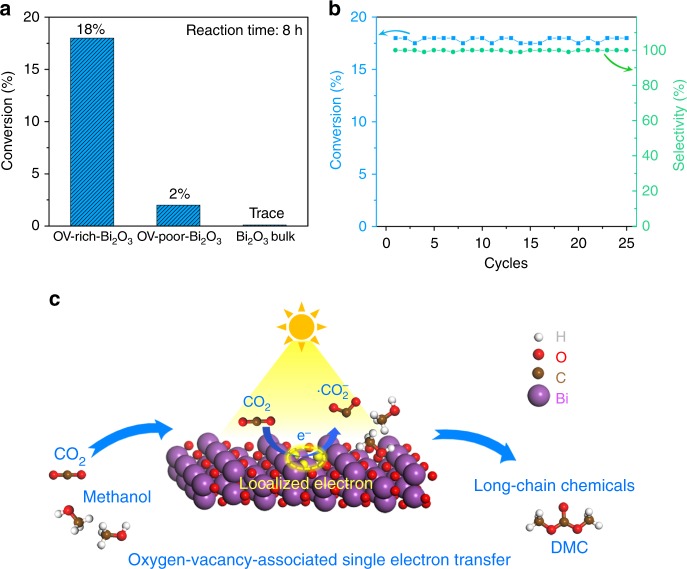
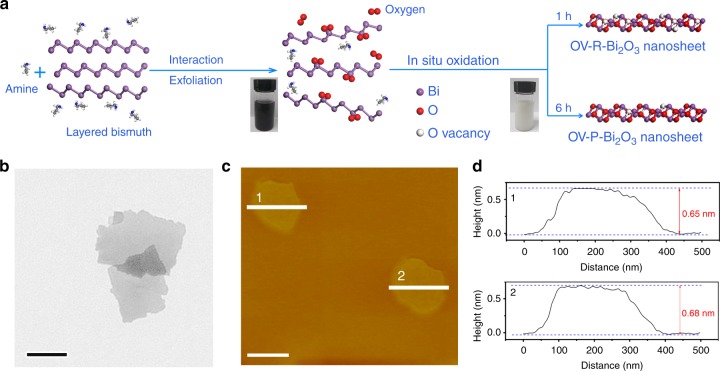
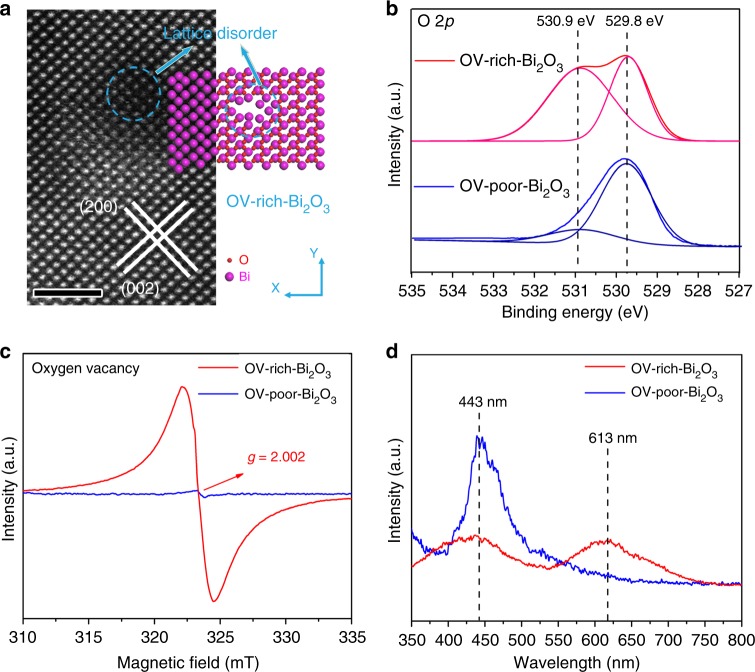
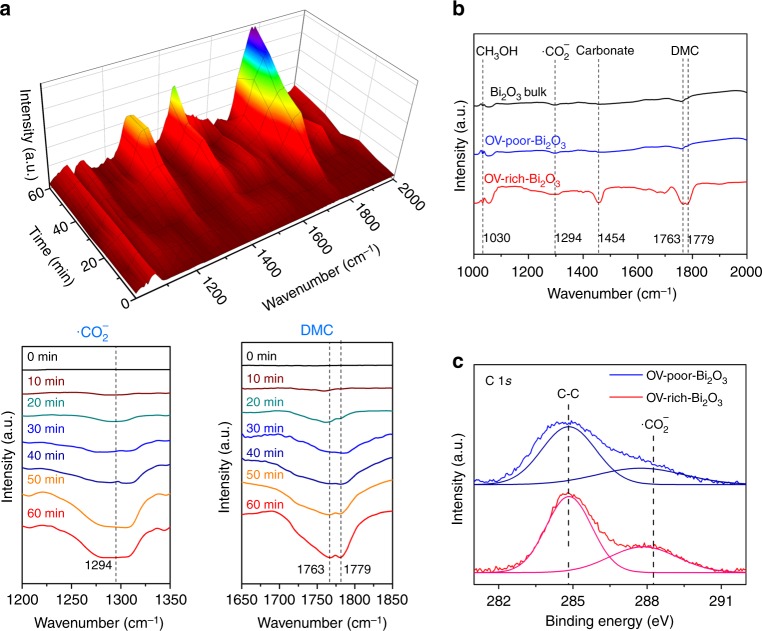
The photofixation and utilization of CO via single-electron mechanism is considered to be a clean and green way to produce high-value-added commodity chemicals with long carbon chains. However, this topic has not been fully explored for the highly negative reduction potential in the formation of reactive carbonate radical. Herein, by taking BiO nanosheets as a model system, we illustrate that oxygen vacancies confined in atomic layers can lower the adsorption energy of CO on the reactive sites, and thus activate CO by single-electron transfer in mild conditions. As demonstrated, BiO nanosheets with rich oxygen vacancies show enhanced generation of •CO species during the reaction process and achieve a high conversion yield of dimethyl carbonate (DMC) with nearly 100% selectivity in the presence of methanol. This study establishes a practical way for the photofixation of CO to long-chain chemicals via defect engineering.
通过单电子机制将 CO 光固定并加以利用被认为是一种清洁且绿色的方法,可以生产具有长碳链的高附加值商品化学品。然而,由于形成反应性碳酸根自由基的还原势非常负,这个课题还没有被充分探索。在此,我们以 BiO 纳米片作为模型体系,说明原子层中受限的氧空位可以降低 CO 在活性位上的吸附能,从而在温和条件下通过单电子转移来激活 CO。结果表明,富含氧空位的 BiO 纳米片在反应过程中表现出更高的 •CO 物种生成能力,并且在甲醇存在下,几乎 100%选择性地实现了碳酸二甲酯(DMC)的高转化率。本研究通过缺陷工程为 CO 光固定转化为长链化学品建立了一种实用途径。