Department of Biology, University of York, York, YO10 5DD, UK.
School of Biological and Marine Sciences, University of Plymouth, Plymouth, PL4 8AA, UK.
Sci Rep. 2019 Feb 15;9(1):2167. doi: 10.1038/s41598-019-38843-w.
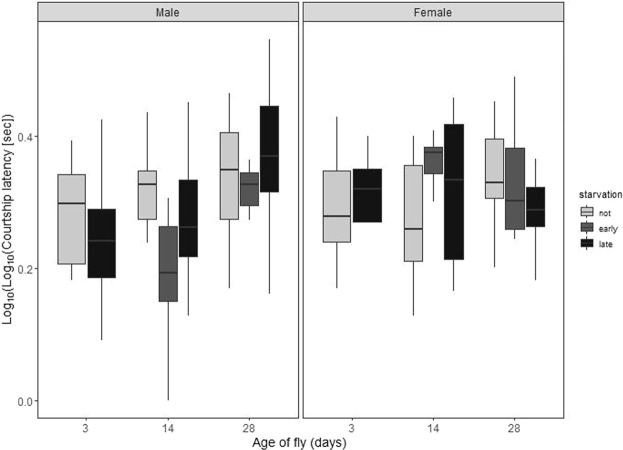
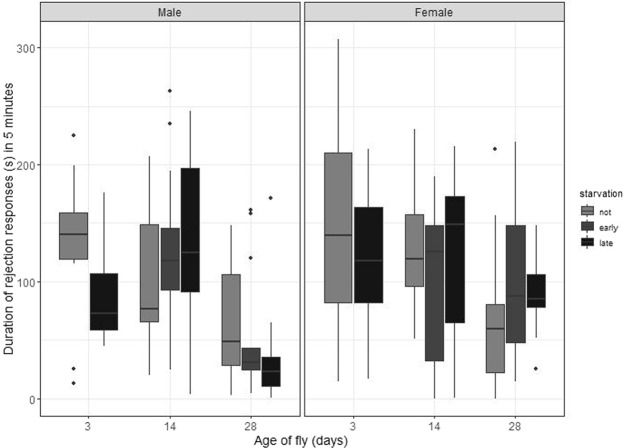
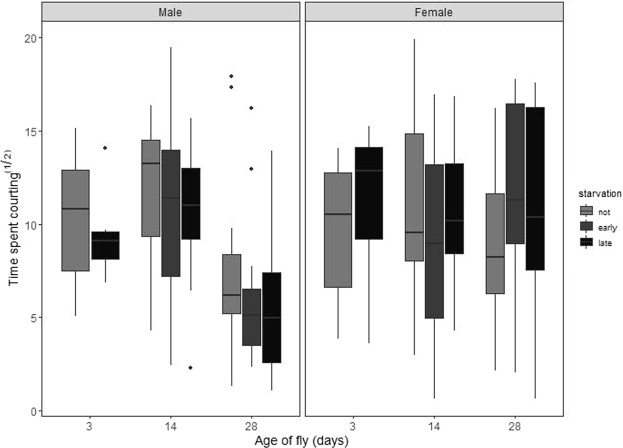
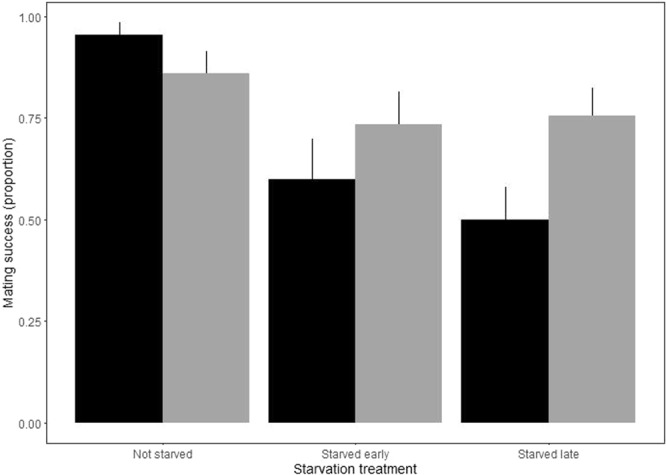
Successful reproduction requires the completion of many, often condition-dependent, stages, from mate searching and courtship through to sperm transfer, fertilisation and offspring production. Animals can plastically adjust their investment in each stage according to the physical and social environment, their own condition, their future reproductive potential, and the condition of their partner. Here we manipulate age and condition, through a nutritional challenge early or late in life, of both male and female Drosophila melanogaster and measure the effects on courtship, mating, and fitness when paired with a standardized (unmanipulated) partner. Older males were slower to start courting and mating, and courted at a slower rate, but males were indifferent to female age or condition despite older females laying and hatching fewer eggs. Female condition had a substantial effect on mating acceptance rate, which dropped dramatically after starvation, and particularly recent starvation experience. In contrast, male condition had little effect on any of the components of reproductive performance we measured. Intriguingly, we found no evidence for additive or multiplicative effects of ageing and starvation: the only significant interaction between these variables was on male latency to initiate courtship - older males were slower to start courting unless they had experienced starvation early in life. These results indicate that the immediate costs of mating differ between males and females, and that the sexes differ in their perception of the opportunity cost sustained by refusing a mating opportunity. Our results support the idea that ageing has more wide-ranging impact on reproductive behaviours than does nutritional challenge.
成功的繁殖需要完成许多阶段,这些阶段通常取决于条件,从寻找伴侣和求偶到精子转移、受精和后代生产。动物可以根据物理和社会环境、自身状况、未来繁殖潜力以及伴侣的状况,灵活调整每个阶段的投资。在这里,我们通过在生命早期或晚期对雄性和雌性黑腹果蝇进行营养挑战,操纵年龄和条件,并测量与标准化(未操纵)伴侣配对时对求偶、交配和适应性的影响。年龄较大的雄性开始求偶和交配的速度较慢,求偶速度也较慢,但雄性对雌性的年龄或状况漠不关心,尽管年龄较大的雌性产卵和孵化的卵较少。雌性状况对交配接受率有很大影响,饥饿后交配接受率急剧下降,特别是最近的饥饿经历。相比之下,雄性状况对我们测量的任何繁殖性能指标都没有影响。有趣的是,我们没有发现衰老和饥饿之间存在加性或乘法效应的证据:这些变量之间唯一显著的相互作用是雄性开始求偶的潜伏期——除非它们在生命早期经历过饥饿,否则年龄较大的雄性开始求偶的速度较慢。这些结果表明,交配的直接成本在雄性和雌性之间存在差异,并且拒绝交配机会的机会成本在两性之间存在差异。我们的研究结果支持这样一种观点,即衰老对繁殖行为的影响比营养挑战更为广泛。