School of Health in Social Science, Clinical Psychology, University of Edinburgh, Edinburgh, UK.
Psychology School, Pontificia Universidad Católica de Chile, Santiago, Chile.
BMJ Open. 2019 Feb 15;9(2):e025058. doi: 10.1136/bmjopen-2018-025058.
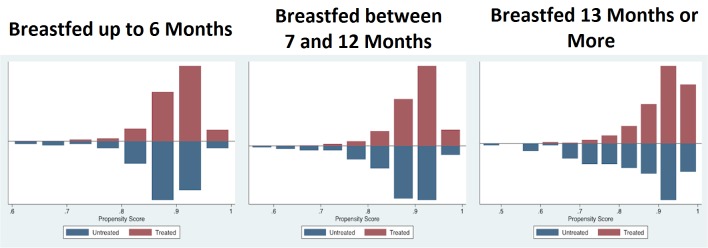
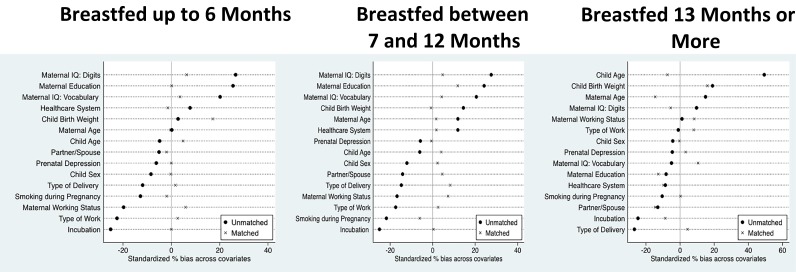
Potential effects of breast feeding on children's behaviour remains an elusive debate given inherent methodological challenges. Propensity score matching affords benefits by ensuring greater equivalence on observable social and health determinants, helping to reduce bias between groups.
We examined whether the duration of breast feeding had an impact on children's externalising and internalising behaviours.
A cohort study (Encuesta Longitudinal de la Primera Infancia cohort) that included 3037 Chilean families who were enrolled in 2010. Follow-up data was collected in 2012.
General community.
Population-based sample. Eligibility criteria: children born full-term with complete data on matching variables. Matching variables included: healthcare system as a proxy of income, presence of a partner/spouse in the household, maternal age, educational level, IQ, working status, type of work, diagnosis of prenatal depression by a healthcare professional, smoking during pregnancy, delivery type, child sex, weight at birth, incubation following delivery, and child age.
Duration of breast feeding.
Externalising and internalising problems assessed using the Child Behaviour Checklist.
Matched results revealed benefits of any breast feeding, up to 6 months, on emotional reactivity and somatic complaints (mean difference of -1.00, 95% CI, -1.84 to -0.16 and -1.02, 95% CI, -1.76 to -0.28, respectively). Children breast fed between 7 and 12 months also had reduced scores on emotional reactivity, in addition to attention problems (mean difference of -0.86, 95% CI, -1.66 to -0.06 and -0.50, 95% CI, -0.93 to -0.07, respectively). No benefits were observed for children breast fed 13 months or more.
Reduced internalising difficulties and inattention were found in children breast fed up to a year, suggesting that breast feeding may have beneficial impacts on these areas of development. The magnitude of effect was modest. Extended durations of breast feeding did not appear to offer any benefits.
鉴于固有的方法学挑战,母乳喂养对儿童行为的潜在影响仍然是一个难以捉摸的争论。倾向评分匹配通过确保在可观察的社会和健康决定因素上更大程度的等同性,有助于减少组间偏差,从而带来益处。
我们研究了母乳喂养的持续时间是否会对儿童的外在和内在行为产生影响。
这是一项队列研究(Encuesta Longitudinal de la Primera Infancia 队列),纳入了 2010 年入组的 3037 个智利家庭。2012 年收集了随访数据。
一般社区。
基于人群的样本。入选标准:足月出生且具有匹配变量完整数据的儿童。匹配变量包括:医疗保健系统作为收入的代理,家庭中是否有伴侣/配偶,母亲年龄,教育水平,智商,工作状态,工作类型,医疗保健专业人员诊断的产前抑郁症,怀孕期间吸烟,分娩方式,儿童性别,出生体重,分娩后孵育时间,以及儿童年龄。
母乳喂养的持续时间。
使用儿童行为检查表评估外在和内在问题。
匹配结果显示,任何母乳喂养持续时间长达 6 个月都有益于情绪反应和躯体抱怨(平均差异分别为-1.00,95%置信区间,-1.84 至-0.16 和-1.02,95%置信区间,-1.76 至-0.28)。母乳喂养 7 至 12 个月的儿童在情绪反应方面的评分也有所降低,同时注意问题也有所减少(平均差异分别为-0.86,95%置信区间,-1.66 至-0.06 和-0.50,95%置信区间,-0.93 至-0.07)。没有发现母乳喂养 13 个月或更长时间的儿童有任何益处。
发现母乳喂养 1 年以下的儿童内在困难和注意力不集中程度降低,这表明母乳喂养可能对这些发育领域有有益的影响。影响的幅度较小。延长母乳喂养时间似乎没有任何好处。