Department of Epidemiology and Biostatistics, School of Public Health, Xi'an Jiaotong University Health Science Center, Xi'an, Shaanxi, PR China.
Department of Epidemiology and Preventive Medicine, School of Public Health and Preventive Medicine, Monash University, Melbourne, VIC, Australia.
Genet Med. 2019 Sep;21(9):1958-1968. doi: 10.1038/s41436-019-0457-6. Epub 2019 Feb 18.
To consider the impact and cost-effectiveness of offering preventive population genomic screening to all young adults in a single-payer health-care system.
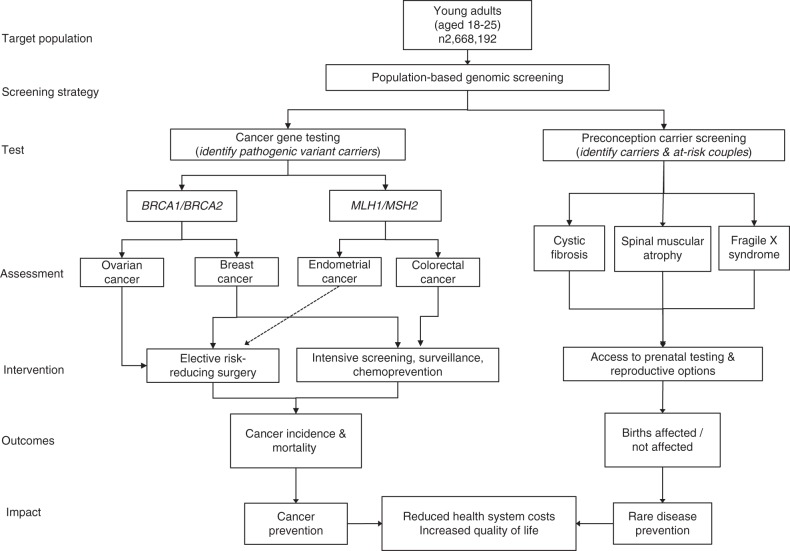
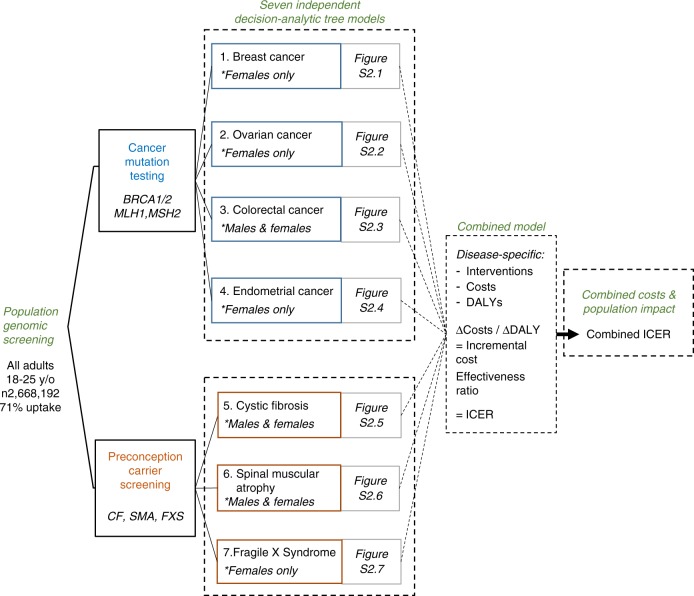
We modeled screening of 2,688,192 individuals, all adults aged 18-25 years in Australia, for pathogenic variants in BRCA1/BRCA2/MLH1/MSH2 genes, and carrier screening for cystic fibrosis (CF), spinal muscular atrophy (SMA), and fragile X syndrome (FXS), at 71% testing uptake using per-test costs ranging from AUD$200 to $1200 (~USD$140 to $850). Investment costs included genetic counseling, surveillance, and interventions (reimbursed only) for at-risk individuals/couples. Cost-effectiveness was defined below AUD$50,000/DALY (disability-adjusted life year) prevented, using an incremental cost-effectiveness ratio (ICER), compared with current targeted testing. Outcomes were cancer incidence/mortality, disease cases, and treatment costs reduced.
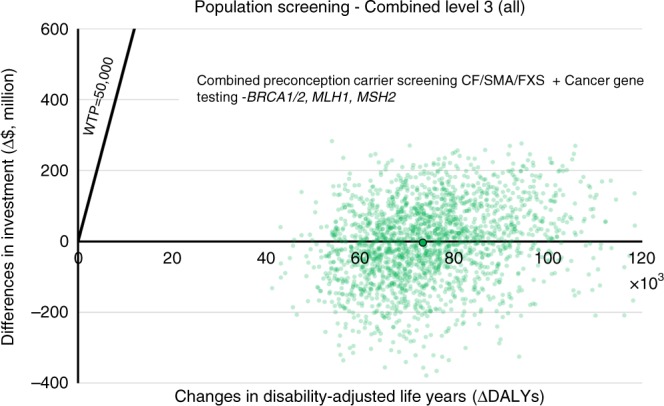
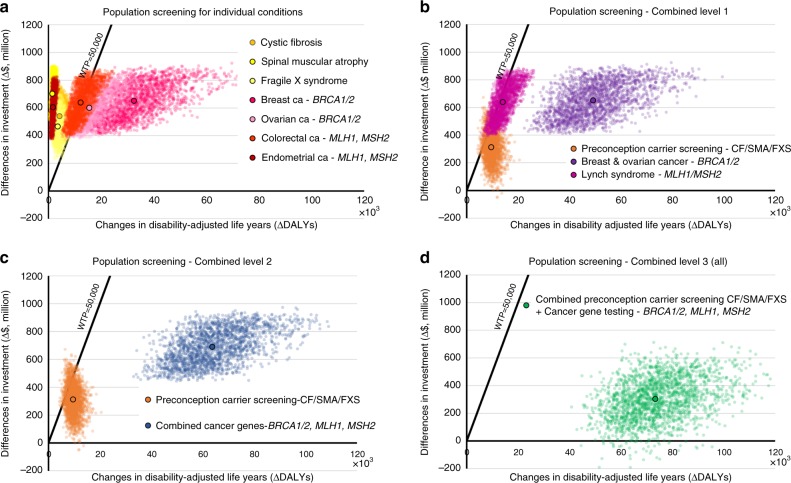
Population screening would reduce variant-attributable cancers by 28.8%, cancer deaths by 31.2%, and CF/SMA/FXS cases by 24.8%, compared with targeted testing. Assuming AUD$400 per test, investment required would be between 4 and 5 times higher than current expenditure. However, screening would lead to substantial savings in medical costs and DALYs prevented, at a highly cost-effective ICER of AUD$4038/DALY. At AUD$200 per test, screening would approach cost-saving for the health system (ICER = AUD$22/DALY).
Preventive genomic screening in early adulthood would be highly cost-effective in a single-payer health-care system, but ethical issues must be considered.
探讨在单一支付者医疗保健系统中为所有年轻成年人提供预防性群体基因组筛查的影响和成本效益。
我们对澳大利亚所有 18-25 岁成年人进行了 BRCA1/BRCA2/MLH1/MSH2 基因致病性变异和囊性纤维化(CF)、脊髓性肌萎缩症(SMA)、脆性 X 综合征(FXS)携带者筛查的建模,检测率为 71%,使用 200 至 1200 澳元(140 至 850 美元)不等的单次检测成本。投资成本包括对有风险的个体/夫妇进行基因咨询、监测和干预(仅报销)。与当前的靶向检测相比,使用增量成本效益比(ICER),将成本效益定义为低于 50000 澳元(残疾调整生命年)/预防的 DALY。结果为癌症发病率/死亡率、疾病病例和治疗费用降低。
与靶向检测相比,人群筛查可将变异相关癌症减少 28.8%,癌症死亡减少 31.2%,CF/SMA/FXS 减少 24.8%。假设每次检测费用为 400 澳元,投资需求将比目前的支出高出 4 至 5 倍。然而,筛查将导致医疗成本和预防 DALY 的大量节省,具有高度成本效益的 ICER 为 4038 澳元/DALY。每次检测费用为 200 澳元,筛查对卫生系统将接近成本节约(ICER=22 澳元/DALY)。
在单一支付者医疗保健系统中,对年轻人进行预防性基因组筛查具有很高的成本效益,但必须考虑伦理问题。