Jiang Xinjun, Wang Jingpin, Lu Yanhui, Jiang Hua, Li Mingzi
School of Nursing, Peking University, Beijing, China,
School of International Nursing, Hainan Medical University, Haikou, China.
Psychol Res Behav Manag. 2019 Jan 29;12:67-79. doi: 10.2147/PRBM.S192571. eCollection 2019.
The aims of this study were to assess the effectiveness of self-efficacy-focused education on health outcomes in persons with diabetes and review the strategies employed in the interventions.
The traditional educational interventions for persons with diabetes were insufficient to achieve the desired outcomes. Self-efficacy-focused education has been used to regulate the blood sugar level, behaviors, and psychosocial indicators for persons with diabetes.
This study is a systematic review and meta-analysis.
Studies on the effectiveness of self-efficacy-focused education in persons with diabetes were searched in six databases from inception until January 2018. The data were extracted and the quality of literature was assessed independently. Review Manager 5.3 was applied for the meta-analysis. Besides, the findings were summarized for narrative synthesis.
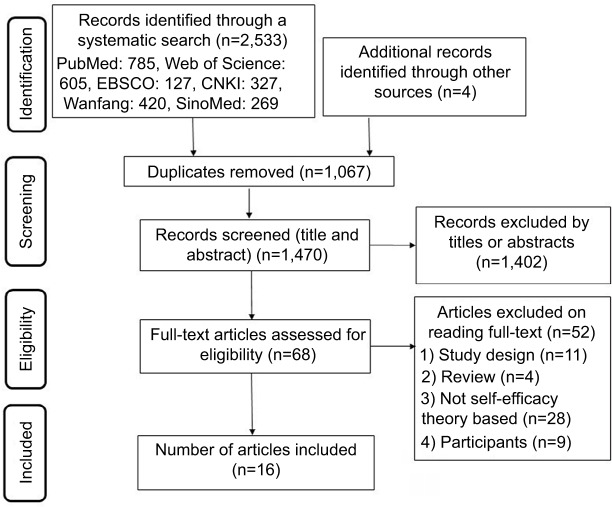
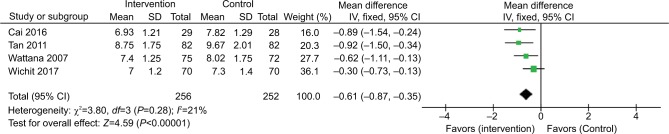
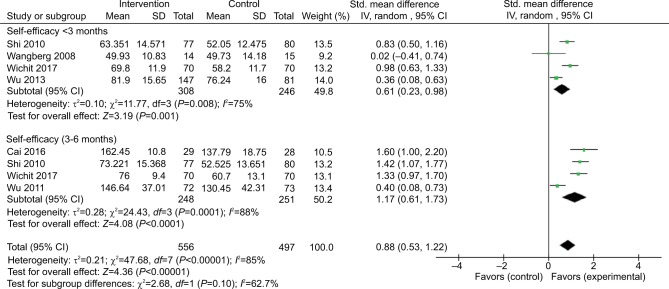
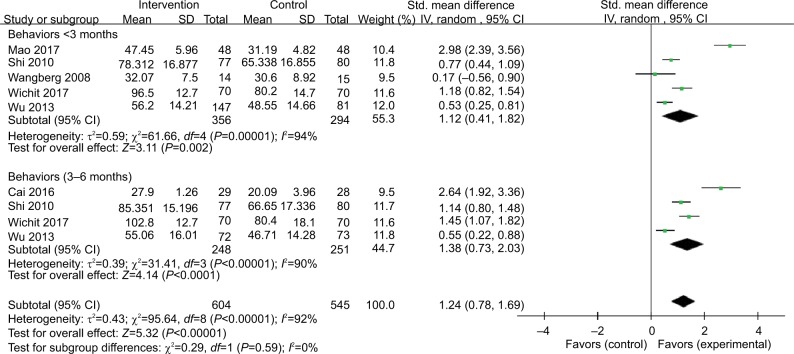
Sixteen trials with 1,745 participants were included in the systematic review and ten trails with 1,308 participants in the meta-analysis. The meta-analysis for A1C, self-efficacy, self-management behaviors, knowledge, and quality of life (QOL) were represented in four, six, six, three, and three studies, respectively. The findings indicated that self-efficacy-focused education would probably reduce A1C, enhance self-efficacy, regulate self-management behaviors, increase knowledge, and improve the QOL for patients with diabetes. Weak quality studies, limited participants, and heterogeneity hindered the results pooled of the other secondary outcomes of fasting blood glucose, 2-hour plasma glucose, weight, weight circumference, body mass index, plasma lipid profile, and other psychological indicators. Goal setting, self-management skills practicing and recording, peer models, demonstration, persuasion by health providers, and positive feedback were the most commonly used strategies in the interventions. However, physiological/emotion arousal strategies were relatively less applied and varied significantly.
Individuals with diabetes may benefit a lot from the self-efficacy-focused education. However, insufficient high-quality studies, short-term follow-up period, relatively deficient physiological/emotion strategies, and incomplete outcome assessments were the drawbacks in most studies. Establishing satisfactory self-efficacy-focused education and better evaluating the effects were required in further studies.
本研究旨在评估以自我效能为重点的教育对糖尿病患者健康结局的有效性,并回顾干预措施中采用的策略。
传统的糖尿病患者教育干预措施不足以实现预期效果。以自我效能为重点的教育已被用于调节糖尿病患者的血糖水平、行为和心理社会指标。
本研究是一项系统评价和荟萃分析。
从数据库建立至2018年1月,在六个数据库中检索关于以自我效能为重点的教育对糖尿病患者有效性的研究。提取数据并独立评估文献质量。应用Review Manager 5.3进行荟萃分析。此外,对研究结果进行总结以进行叙述性综合分析。
系统评价纳入了16项试验,共1745名参与者;荟萃分析纳入了10项试验,共1308名参与者。糖化血红蛋白(A1C)、自我效能、自我管理行为、知识和生活质量(QOL)的荟萃分析分别在4项、6项、6项、3项和3项研究中呈现。研究结果表明,以自我效能为重点的教育可能会降低糖尿病患者的糖化血红蛋白水平,增强自我效能,规范自我管理行为,增加知识,并改善生活质量。质量较差的研究、有限的参与者以及异质性阻碍了空腹血糖、餐后2小时血糖、体重、腰围、体重指数、血脂谱和其他心理指标等其他次要结局的结果汇总。目标设定以及自我管理技能的练习与记录、同伴榜样、示范、医护人员的劝说和积极反馈是干预措施中最常用的策略。然而,生理/情绪唤起策略应用相对较少且差异显著。
糖尿病患者可能会从以自我效能为重点教育中获益良多。然而,大多数研究存在高质量研究不足、随访期短、生理/情绪策略相对不足以及结局评估不完整等缺点。进一步研究需要建立令人满意的以自我效能为重点的教育并更好地评估其效果。