Le Minh H, Dao Tran Np, Le Ngoc D, Tran Van D
Faculty of Traditional Medicine, Can Tho University of Medicine and Pharmacy, Can Tho, Vietnam.
Department of Health Organization and Management, Can Tho University of Medicine and Pharmacy, Can Tho, Vietnam.
Narra J. 2025 Apr;5(1):e2029. doi: 10.52225/narra.v5i1.2029. Epub 2025 Mar 8.
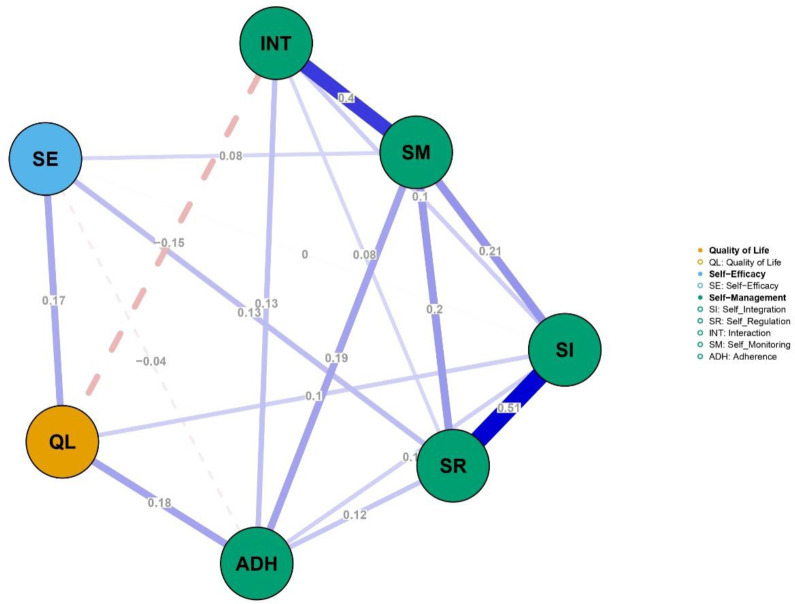
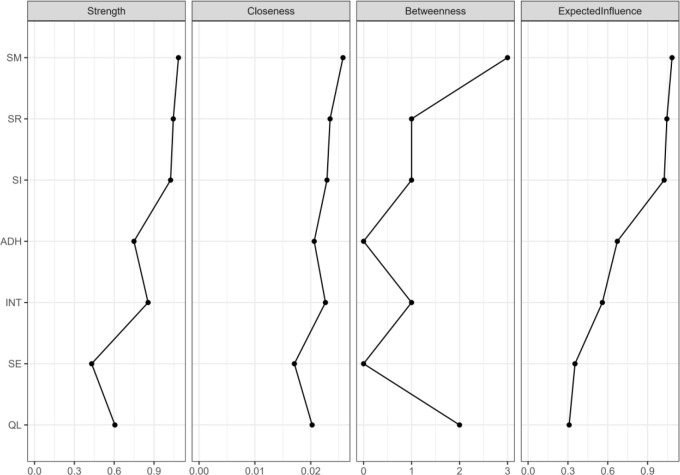
Diabetes mellitus (DM) requires constant self-management and self-efficiency, which affects the quality of life among patients. It is important to understand the complex interplay between these factors to improve the results of treatment. The aim of this study was to explore the relationship between self-management, self-efficacy, and quality of life among diabetes mellitus patients. A cross-sectional study of 363 diabetes patients from three public hospitals in Cao Lanh City, Vietnam, was conducted. Self-management, self-efficacy, and quality of life were assessed using the 35-item Diabetes Self-Management Instrument (DSMI), the 6-item Self-Efficacy for Managing Chronic Disease Scale (SECD6), and the 5-item European Quality of Life 5 Dimensions 5 Level Version (EQ-5D-5L), respectively. Network analysis was performed to visually describe the relationship between self-management (which includes five domains of self-integration, self-regulation, interaction with health professionals and other significant people, self-monitoring, and medication adherence), self-efficacy, and quality of life. The network analysis showed that self-monitoring had the highest centrality. Two subscales of self-management, adherence and self-integration, were directly and positively correlated with quality of life, while the interaction was directly and negatively correlated with quality of life. Self-efficacy was positively correlated with self-regulation and self-monitoring, while it was negatively correlated with adherence. A direct positive correlation was also found between self-efficacy and quality of life. In conclusion, these findings highlight the pivotal role of self-management and self-efficacy in enhancing quality of life. Future studies should focus on patient education interventions to enhance adherence and self-efficacy, ultimately improving the quality of life in people with diabetes.
糖尿病(DM)需要持续的自我管理和自我效能感,这会影响患者的生活质量。了解这些因素之间的复杂相互作用对于改善治疗效果很重要。本研究的目的是探讨糖尿病患者自我管理、自我效能感和生活质量之间的关系。对越南芹苴市三家公立医院的363名糖尿病患者进行了横断面研究。分别使用35项糖尿病自我管理工具(DSMI)、6项慢性病管理自我效能量表(SECD6)和5项欧洲生活质量5维度5水平版本(EQ-5D-5L)对自我管理、自我效能感和生活质量进行评估。进行网络分析以直观描述自我管理(包括自我整合、自我调节、与医疗专业人员及其他重要人物的互动、自我监测和药物依从性五个领域)、自我效能感和生活质量之间的关系。网络分析表明自我监测具有最高的中心性。自我管理的两个子量表,即依从性和自我整合,与生活质量直接正相关,而互动与生活质量直接负相关。自我效能感与自我调节和自我监测正相关,而与依从性负相关。自我效能感与生活质量之间也发现了直接正相关。总之,这些发现突出了自我管理和自我效能感在提高生活质量方面的关键作用。未来的研究应侧重于患者教育干预措施,以提高依从性和自我效能感,最终改善糖尿病患者的生活质量。