Quynh Anh Le Ho Thi, Quoc Huy Nguyen Vu, Minh Tam Nguyen, Wens Johan, Derese Anselme, Peersman Wim, Ha My Vo Ngoc, Thang Tran Binh, Phuong Anh Nguyen Thi, Truc Ly Tran Thi, Pype Peter
Family Medicine Centre, Hue University of Medicine and Pharmacy, Hue University, Hue, Vietnam.
Department of Obstetrics and Gynecology, Hue University of Medicine and Pharmacy, Hue University, Hue, Vietnam.
SAGE Open Med. 2024 Dec 23;12:20503121241310016. doi: 10.1177/20503121241310016. eCollection 2024.
Our study aimed to identify the complex interplay between self-efficacy, self-care practice, and glycaemic control among people with type 2 diabetes mellitus (PWDs) to inform the design of more targeted and effective behavioural interventions in primary care.
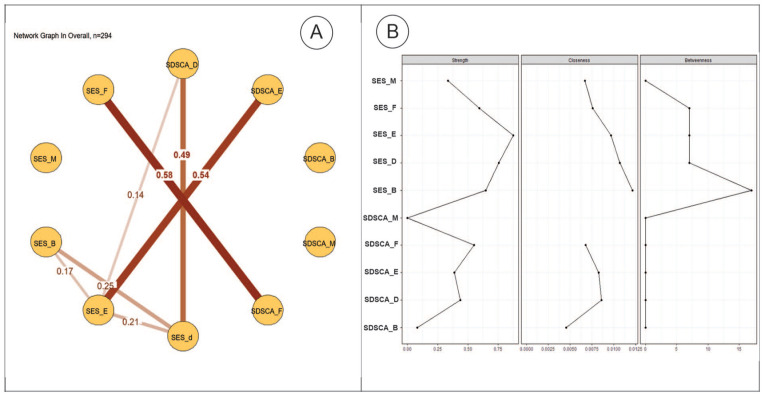
A cross-sectional descriptive study was performed with 294 PWDs managed in primary care. The Diabetes Management Self-Efficacy Scale (DMSES) and Summary of Diabetes Self-Care Activities (SDSCA) questionnaire measured patients' self-efficacy and self-care practice. Multivariate logistic regression models were developed to explore how SDSCA, DMSES, and their combined effect relate to glycaemic control, adjusting for patient characteristics. Network analysis in R software examined relationships between self-efficacy and self-care dimensions across glycaemic control subgroups using a Gaussian graphical model with the extended Bayesian information criterion.
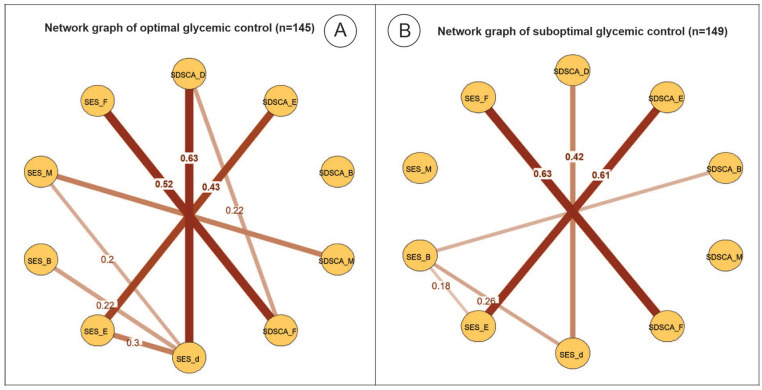
Half the PWDs (50.7%) had suboptimal glycaemic control. Better glycaemic control was consistently associated with higher self-efficacy (odds ratio (OR) = 0.76, 95% confidence (CI) (0.60, 0.97), = 0.03), shorter duration of diabetes (OR = 1.89, 95% CI (1.08, 3.31), = 0.03), normal waist circumference (OR = 1.76, 95% CI (1.02, 3.05), = 0.04), absence of diabetes complications (OR = 2.09, 95% CI (1.10, 3.98), = 0.02), and treatment with oral hypoglycaemic agents (OR = 3.05, 95% CI (1.53, 6.09), < 0.01). Network analysis among people with well-controlled HbA1c revealed that diet adherence and self-efficacy had the most robust connection, with diet self-efficacy strongly associated with most self-efficacy dimensions. Self-efficacy in exercise, blood glucose monitoring, and foot care are the most central factors in the network structures for PWDs with suboptimal glycaemic control.
Our study highlights the critical role of self-efficacy in diabetes primary care. For people with optimal glycaemic control, prioritising self-efficacy in diet adherence is crucial for sustaining glycaemic outcomes and supporting other self-care behaviours. Among those with suboptimal glycaemic control, enhancing self-efficacy in exercise, blood glucose monitoring, and foot care is essential. Targeted education programs, personalised counselling, and E-health tools can further empower patients to manage their diabetes more effectively.
我们的研究旨在确定2型糖尿病患者(PWDs)的自我效能、自我护理实践和血糖控制之间的复杂相互作用,以为初级保健中更具针对性和有效性的行为干预措施的设计提供信息。
对294名在初级保健机构接受管理的PWDs进行了横断面描述性研究。使用糖尿病管理自我效能量表(DMSES)和糖尿病自我护理活动总结(SDSCA)问卷来测量患者的自我效能和自我护理实践。建立多变量逻辑回归模型,以探索SDSCA、DMSES及其综合效应与血糖控制之间的关系,并对患者特征进行调整。使用R软件中的网络分析,通过带有扩展贝叶斯信息准则的高斯图形模型,研究血糖控制亚组中自我效能与自我护理维度之间的关系。
一半的PWDs(50.7%)血糖控制不理想。更好的血糖控制始终与更高的自我效能相关(优势比(OR)=0.76,95%置信区间(CI)(0.60,0.97),P = 0.03)、糖尿病病程较短(OR = 1.89,95%CI(1.08,3.31),P = 0.03)、腰围正常(OR = 1.76,95%CI(1.02,3.05),P = 0.04)、无糖尿病并发症(OR = 2.09,95%CI(1.10,3.98),P = 0.02)以及使用口服降糖药治疗(OR = 3.05,95%CI(1.53,6.09),P < 0.01)有关。对糖化血红蛋白(HbA1c)控制良好的患者进行的网络分析显示,饮食依从性和自我效能之间的联系最为紧密,饮食自我效能与大多数自我效能维度密切相关。对于血糖控制不理想的PWDs,运动、血糖监测和足部护理方面的自我效能是网络结构中最核心的因素。
我们的研究强调了自我效能在糖尿病初级保健中的关键作用。对于血糖控制理想的患者,在饮食依从性方面优先考虑自我效能对于维持血糖结果和支持其他自我护理行为至关重要。在血糖控制不理想的患者中,提高运动、血糖监测和足部护理方面的自我效能至关重要。有针对性的教育项目、个性化咨询和电子健康工具可以进一步增强患者更有效地管理糖尿病的能力。