Fonseca-Gomes João, Jerónimo-Santos André, Lesnikova Angelina, Casarotto Plinio, Castrén Eero, Sebastião Ana M, Diógenes Maria J
Instituto de Farmacologia e Neurociências, Faculdade de Medicina, Universidade de Lisboa, Lisbon, Portugal.
Instituto de Medicina Molecular-João Lobo Antunes, Faculdade de Medicina, Universidade de Lisboa, Lisbon, Portugal.
Front Mol Neurosci. 2019 Feb 1;12:4. doi: 10.3389/fnmol.2019.00004. eCollection 2019.
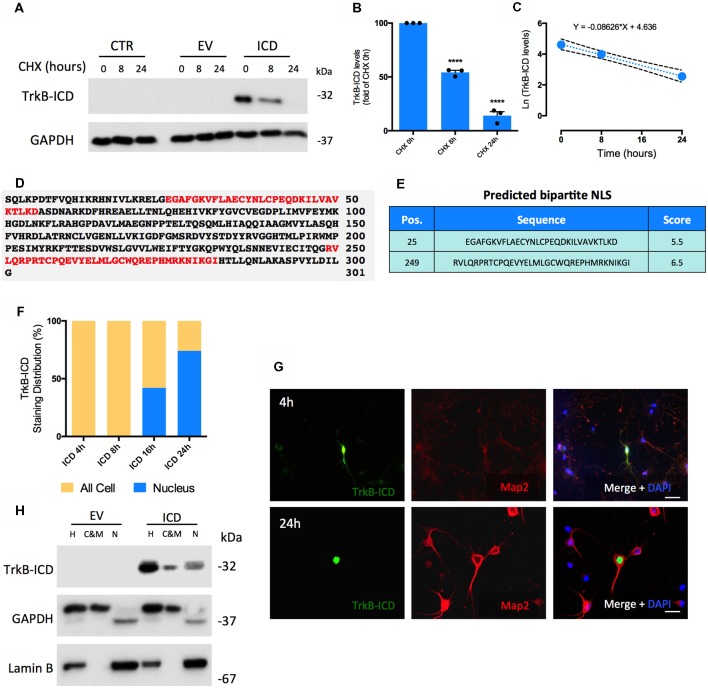
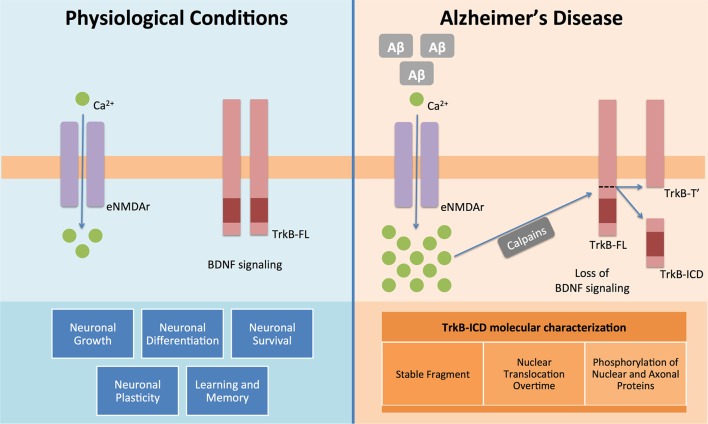
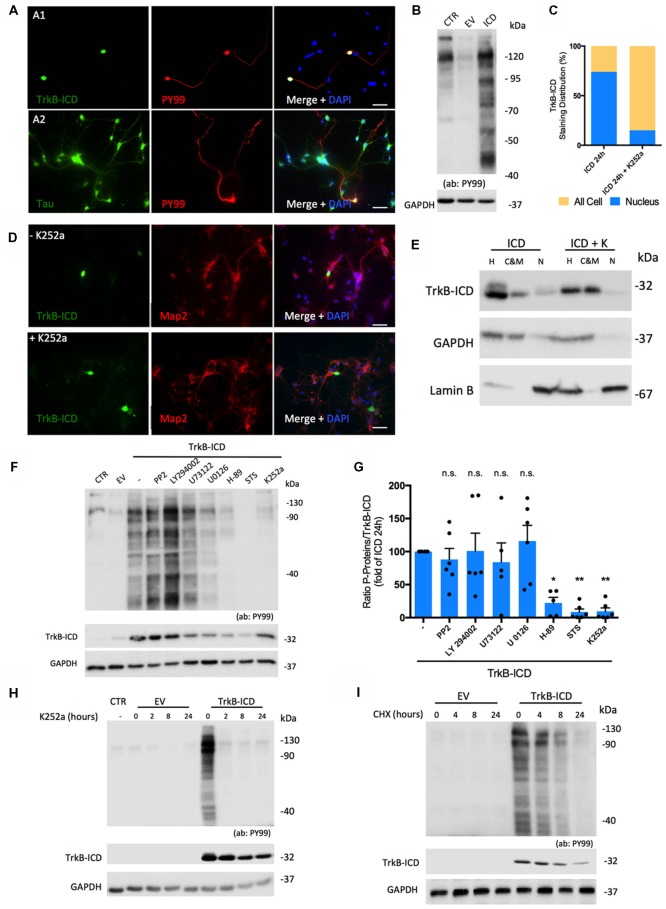
The signaling of brain-derived neurotrophic factor (BDNF) has been suggested to be impaired in Alzheimer's disease (AD), which may compromise the function of BDNF upon neuronal activity and survival. Accordingly, decreased levels of BDNF and its tropomyosin-receptor kinase B-full-length (TrkB-FL) have been detected in human brain samples of AD patients. We have previously found that neuronal exposure to amyloid-β (Aβ) peptide, a hallmark of AD, leads to calpain overactivation and subsequent TrkB-FL cleavage leading to decreased levels of TrkB-FL and the generation of two new fragments: a membrane-bound truncated receptor (TrkB-T') and an intracellular fragment (TrkB-ICD). Importantly, we identified this TrkB-FL cleavage and TrkB-ICD presence in human brain samples, which indicates that this molecular mechanism contributes to the loss of BDNF signaling in humans. The exact role of this TrkB-ICD fragment is, however, unknown. Here, we used a human neuroglioma cell line and rat cortical primary neuronal cultures to track TrkB-ICD intracellularly. Our data show that TrkB-ICD is a relatively stable fragment that accumulates in the nucleus over time, through a phosphorylation-dependent process. We also found that TrkB-ICD has tyrosine kinase activity, inducing the phosphorylation of nuclear and axonal proteins. These findings suggest that TrkB-ICD may lead to a dysregulation of the activity of several proteins, including proteins in the nucleus, to where TrkB-ICD migrates. Since TrkB-ICD is formed by Aβ peptide-induced cleavage of TrkB-FL, the present data highlights a new mechanism that may have a role in AD pathophysiology.
脑源性神经营养因子(BDNF)的信号传导在阿尔茨海默病(AD)中被认为受损,这可能会损害BDNF在神经元活动和存活方面的功能。因此,在AD患者的人脑样本中检测到BDNF及其原肌球蛋白受体激酶B全长(TrkB-FL)水平降低。我们之前发现,神经元暴露于AD的标志性物质淀粉样β(Aβ)肽会导致钙蛋白酶过度激活,随后TrkB-FL被切割,导致TrkB-FL水平降低,并产生两个新片段:一个膜结合的截短受体(TrkB-T')和一个细胞内片段(TrkB-ICD)。重要的是,我们在人脑样本中发现了这种TrkB-FL切割和TrkB-ICD的存在,这表明这种分子机制导致了人类BDNF信号的丧失。然而,这个TrkB-ICD片段的确切作用尚不清楚。在这里,我们使用人神经胶质瘤细胞系和大鼠皮质原代神经元培养物在细胞内追踪TrkB-ICD。我们的数据表明,TrkB-ICD是一个相对稳定的片段,随着时间的推移通过磷酸化依赖过程在细胞核中积累。我们还发现TrkB-ICD具有酪氨酸激酶活性,可诱导核蛋白和轴突蛋白的磷酸化。这些发现表明,TrkB-ICD可能导致几种蛋白质的活性失调,包括TrkB-ICD迁移到的细胞核中的蛋白质。由于TrkB-ICD是由Aβ肽诱导的TrkB-FL切割形成的,目前的数据突出了一种可能在AD病理生理学中起作用的新机制。