Liu Jinyu, Higgs Suzanne
School of Psychology, University of Birmingham, Birmingham, United Kingdom.
Front Psychol. 2019 Feb 1;10:159. doi: 10.3389/fpsyg.2019.00159. eCollection 2019.
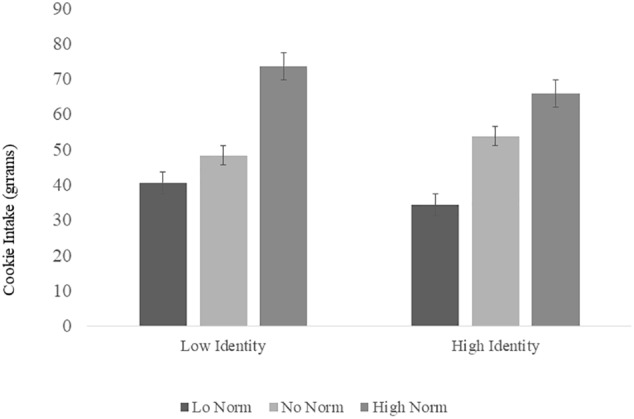
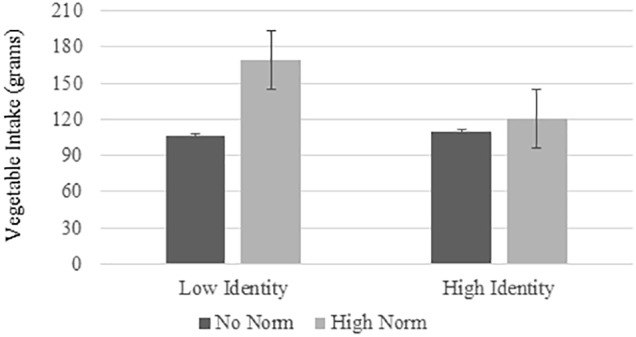
Normative information has a powerful effect on food intake and food selection. People tend to use the eating behavior of others as a reference for their own eating behaviors and match their intake to an eating partner. This is known as social modeling. There is some evidence to suggest that people are more likely to model a norm when it comes from an in-group than when it comes from an out-group, but whether the strength of identification with a norm referent group moderates modeling of intake has yet to be examined. The current paper presents the results of two studies that investigated whether modeling of intake is moderated by strength of identification with the norm referent group. In Study 1, we recruited 90 female students from the University of Birmingham (UoB) (mean age = 21). Students were allocated to either a low norm condition (presented with a sheet that presented a low cookie intake of previous participants) or a high norm condition (presented with a sheet that presented a high cookie intake of previous participants), or a no norm condition (control group without the sheet containing information about previous participants' cookie intake). Students also completed a questionnaire on their identification as a Birmingham student and cookie intake was assessed. In Study 2, we recruited 84 students (mean age = 21) who were randomly allocated to one of two conditions (a group presented with a high norm for vegetable intake or no information about a vegetable intake norm). Strong modeling effects were found across both studies but the extent to which the participants identified as a Birmingham University Student did not moderate these effects. The moderating effect of social identity on modeling of eating might be context-dependent.
规范信息对食物摄入量和食物选择有强大的影响。人们倾向于将他人的饮食行为作为自己饮食行为的参照,并使自己的摄入量与饮食伙伴相匹配。这被称为社会模仿。有证据表明,当规范来自内群体时,人们比规范来自外群体时更有可能进行模仿,但与规范参照群体的认同强度是否会调节摄入量的模仿,还有待研究。本文介绍了两项研究的结果,这两项研究调查了摄入量的模仿是否会受到与规范参照群体认同强度的调节。在研究1中,我们从伯明翰大学招募了90名女学生(平均年龄 = 21岁)。学生们被分配到低规范条件组(展示一张显示先前参与者低曲奇摄入量的表格)、高规范条件组(展示一张显示先前参与者高曲奇摄入量的表格)或无规范条件组(不包含关于先前参与者曲奇摄入量信息的对照组)。学生们还完成了一份关于他们作为伯明翰学生认同度的问卷,并对曲奇摄入量进行了评估。在研究2中,我们招募了84名学生(平均年龄 = 21岁),他们被随机分配到两种条件之一(一组展示蔬菜摄入量的高规范或没有关于蔬菜摄入量规范的信息)。两项研究都发现了强烈的模仿效应,但参与者作为伯明翰大学学生的认同程度并没有调节这些效应。社会认同对饮食模仿的调节作用可能取决于具体情境。