Carlos Arenn Faye, Poloni Tino Emanuele, Medici Valentina, Chikhladze Maia, Guaita Antonio, Ceroni Mauro
Neuropathology Department, Abbiategrasso Brain Bank, Golgi-Cenci Foundation Abbiategrasso, Milan, Italy.
University of Pavia, Pavia, Italy.
Alzheimers Dement (N Y). 2019 Feb 5;5:52-60. doi: 10.1016/j.trci.2018.12.002. eCollection 2019.
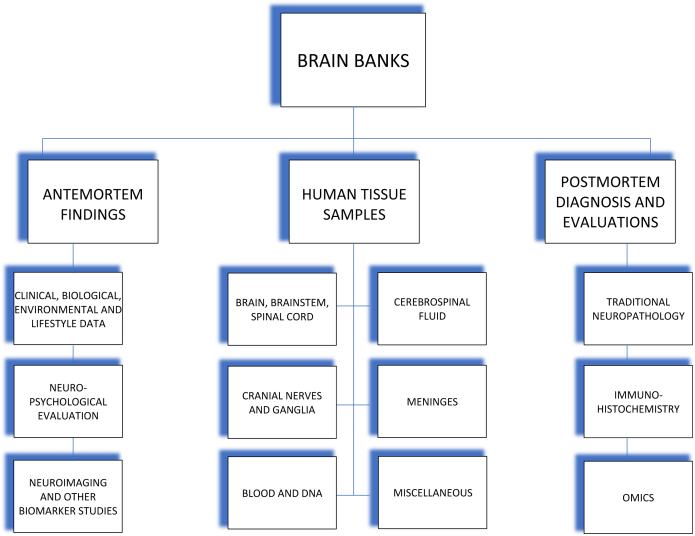
Our current knowledge of the structure, function, and diseases of the brain comes from direct examination of its substance. In the last centuries, only a few elite had managed to retrieve, gather, and preserve the elusive brain for their own research. The resulting brain collections, stored in formalin-filled jars or dried up in cabinets, served anatomical, neuropathological, anthropometric, ideological, and diagnostic purposes. In the 1960s, the first modern brain banks actively collecting and strategically preserving both diseased and healthy brains to be consequently distributed to the scientific community were instituted. In an era where state-of-the-art biochemical "Omic" studies and advanced metabolic and molecular neuroimaging exist, it is now, more than ever, that postmortem brain investigations must be performed. Only through the comparison and integration of postmortem neuropathological and biochemical findings and antemortem data from clinical, neuropsychological neuroimaging, and other biomarker examinations can we truly understand neurological disease mechanisms. Brain banks supplying brain specimens, antemortem information, and postmortem diagnosis are a major benefactor of brain research.
我们目前对大脑结构、功能及疾病的认识来自于对大脑物质的直接检查。在过去几个世纪里,只有少数精英成功获取、收集并保存了难以捉摸的大脑用于自己的研究。由此产生的大脑标本被保存在装满福尔马林的罐子中或风干在橱柜里,用于解剖学、神经病理学、人体测量学、意识形态及诊断目的。20世纪60年代,首批现代脑库开始积极收集并战略性地保存患病和健康大脑,随后分发给科学界。在一个存在先进生化“组学”研究以及先进代谢和分子神经成像技术的时代,现在比以往任何时候都更需要进行死后大脑研究。只有通过比较和整合死后神经病理学和生化研究结果以及来自临床、神经心理学、神经成像和其他生物标志物检查的生前数据,我们才能真正理解神经疾病机制。提供大脑标本、生前信息和死后诊断的脑库是大脑研究的主要受益者。