Department of Biomedical Engineering, Rensselaer Polytechnic Institute, 110 Eighth St., Troy, NY 12180, USA.
Department of Molecular and Cellular Physiology, Albany Medical College, Albany, NY 12208, USA.
Acta Biomater. 2019 Sep 1;95:357-370. doi: 10.1016/j.actbio.2019.02.014. Epub 2019 Feb 15.
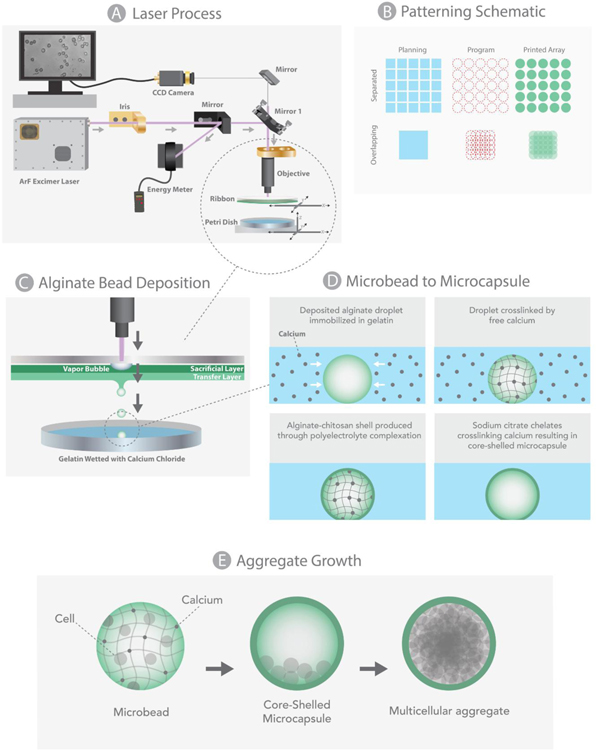
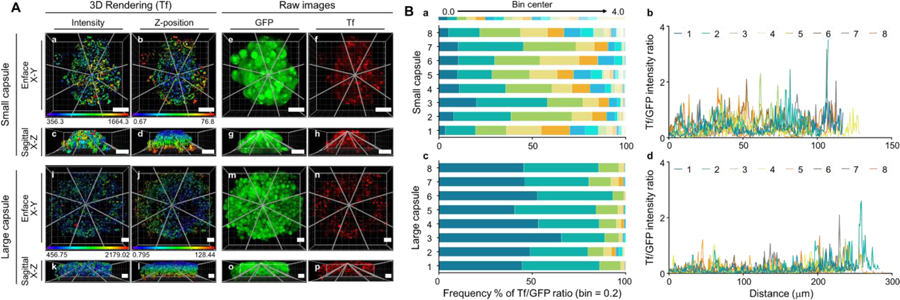
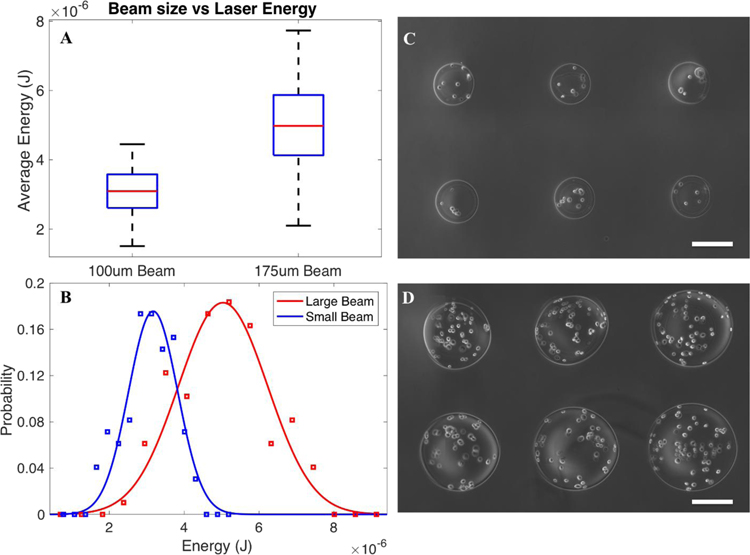
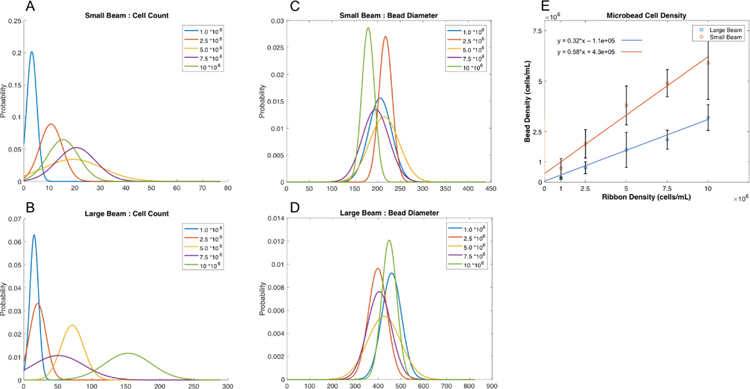
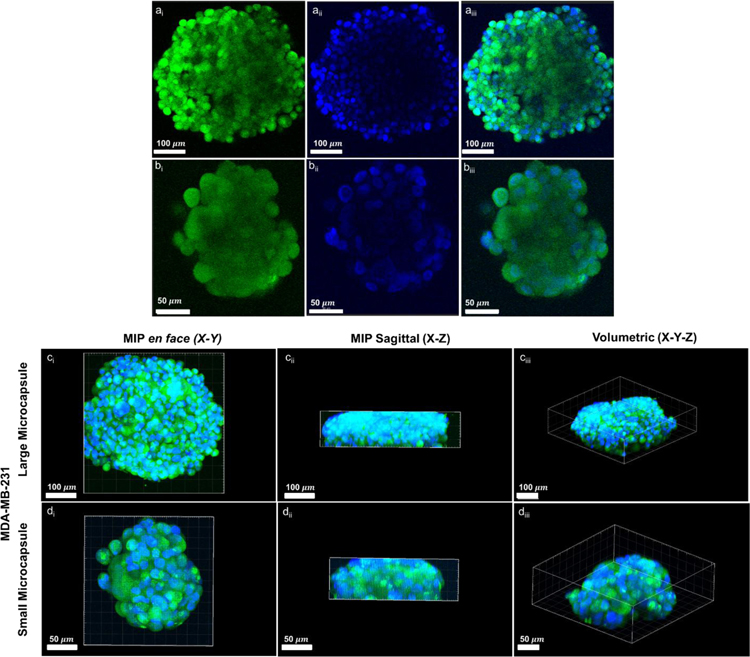
3D multicellular aggregates, and more advanced organotypic systems, have become central tools in recent years to study a wide variety of complex biological processes. Most notably, these model systems have become mainstream within oncology (multicellular tumor spheroids) and regenerative medicine (embryoid bodies) research. However, the biological behavior of these in vitro tissue surrogates is extremely sensitive to their aggregate size and geometry. Indeed, both of these geometrical parameters are key in producing pathophysiological gradients responsible for cellular and structural heterogeneity, replicating in vivo observations. Moreover, the fabrication techniques most widely used for producing these models lack the ability to accurately control cellular spatial location, an essential component for regulating homotypic and heterotypic cell signaling. Herein, we report on a 3D bioprinting technique, laser direct-write (LDW), that enables precise control of both spatial patterning and size of cell-encapsulating microbeads. The generated cell-laden beads are further processed into core-shelled structures, allowing for the growth and formation of self-contained, self-aggregating cells (e.g., breast cancer cells, embryonic stem cells). Within these structures we demonstrate our ability to produce multicellular tumor spheroids (MCTSs) and embryoid bodies (EBs) with well-controlled overall size and shape, that can be designed on demand. Furthermore, we investigated the impact of aggregate size on the uptake of a commonly employed ligand for receptor-mediated drug delivery, Transferrin, indicating that larger tumor spheroids exhibit greater spatial heterogeneity in ligand uptake. Taken together, these findings establish LDW as a versatile biomanufacturing platform for bioprinting and patterning core-shelled structures to generate size-controlled 3D multicellular aggregates. STATEMENT OF SIGNIFICANCE: Multicellular 3D aggregates are powerful in vitro models used to study a wide variety of complex biological processes, particularly within oncology and regenerative medicine. These tissue surrogates are fabricated using environments that encourage cellular self-assembly. However, specific applications require control of aggregate size and position to recapitulate key in vivo parameters (e.g., pathophysiological gradients and homotypic/heterotypic cell signaling). Herein, we demonstrate the ability to create and spatially pattern size-controlled embryoid bodies and tumor spheroids, using laser-based 3D bioprinting. Furthermore, we investigated the effect of tumor spheroid size on internalization of Transferrin, a common ligand for targeted therapy, finding greater spatial heterogeneity in our large aggregates. Overall, this technique offers incredible promise and flexibility for fabricating idealized 3D in vitro models.
3D 多细胞聚集体和更先进的器官型系统近年来已成为研究各种复杂生物过程的重要工具。特别是,这些模型系统已成为肿瘤学(多细胞肿瘤球体)和再生医学(胚胎体)研究的主流。然而,这些体外组织替代物的生物学行为对其聚集体的大小和几何形状极为敏感。事实上,这两个几何参数对于产生负责细胞和结构异质性的病理生理梯度至关重要,从而复制体内观察结果。此外,用于生产这些模型的最广泛使用的制造技术缺乏准确控制细胞空间位置的能力,而细胞空间位置是调节同型和异型细胞信号传导的重要组成部分。在这里,我们报告了一种 3D 生物打印技术,即激光直写(LDW),该技术可以精确控制细胞包封微珠的空间图案和大小。生成的细胞负载珠进一步加工成核壳结构,允许自包含、自聚集细胞(例如乳腺癌细胞、胚胎干细胞)的生长和形成。在这些结构中,我们展示了我们生产具有良好控制的整体大小和形状的多细胞肿瘤球体(MCTS)和胚胎体(EBs)的能力,可以根据需要进行设计。此外,我们研究了聚集体大小对常用于受体介导药物输送的配体转铁蛋白摄取的影响,结果表明较大的肿瘤球体在配体摄取方面表现出更大的空间异质性。总之,这些发现确立了 LDW 作为一种用于生物打印和图案化核壳结构以生成尺寸可控的 3D 多细胞聚集体的多功能生物制造平台。
多细胞 3D 聚集体是用于研究各种复杂生物过程的强大体外模型,特别是在肿瘤学和再生医学领域。这些组织替代物是使用促进细胞自组装的环境制造的。然而,特定应用需要控制聚集体的大小和位置,以再现关键的体内参数(例如,病理生理梯度和同型/异型细胞信号传导)。在这里,我们使用基于激光的 3D 生物打印演示了创建和空间图案化尺寸可控的胚胎体和肿瘤球体的能力。此外,我们研究了肿瘤球体大小对转铁蛋白摄取的影响,转铁蛋白是靶向治疗的常见配体,结果发现我们的大聚集体中存在更大的空间异质性。总体而言,该技术为制造理想的 3D 体外模型提供了令人难以置信的承诺和灵活性。