Division of Physical Medicine and Rehabilitation, University of Utah, Salt Lake City, Utah, USA
Department of Anesthesiology, University of Arkansas Medical Sciences, Little Rock, Arkansas, USA.
Reg Anesth Pain Med. 2019 Mar;44(3):389-397. doi: 10.1136/rapm-2018-000035.
No previous study has assessed the outcomes of cooled radiofrequency ablation (C-RFA) of the medial branch nerves (MBN) for the treatment of lumbar facet joint pain nor compared its effectiveness with traditional RFA (T-RFA). This study evaluated 6-month outcomes for pain, function, psychometrics, and medication usage in patients who underwent MBN C-RFA versus T-RFA for lumbar Z-joint pain.
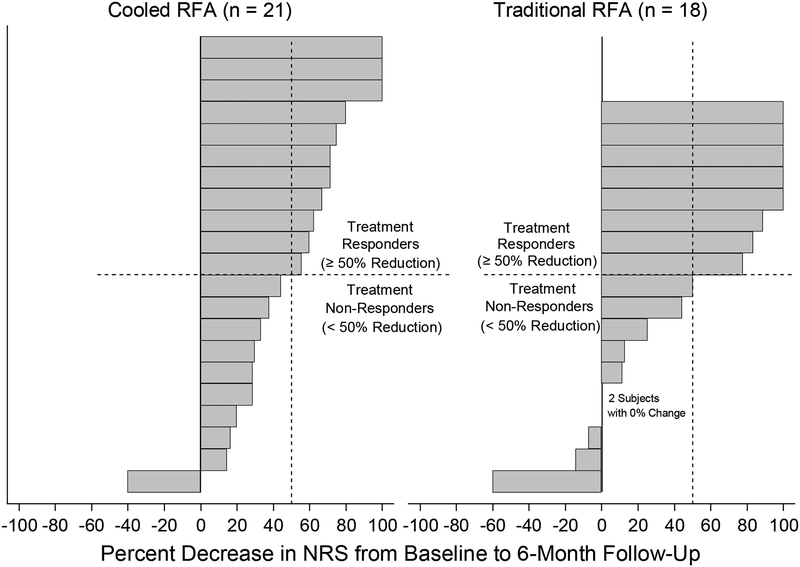
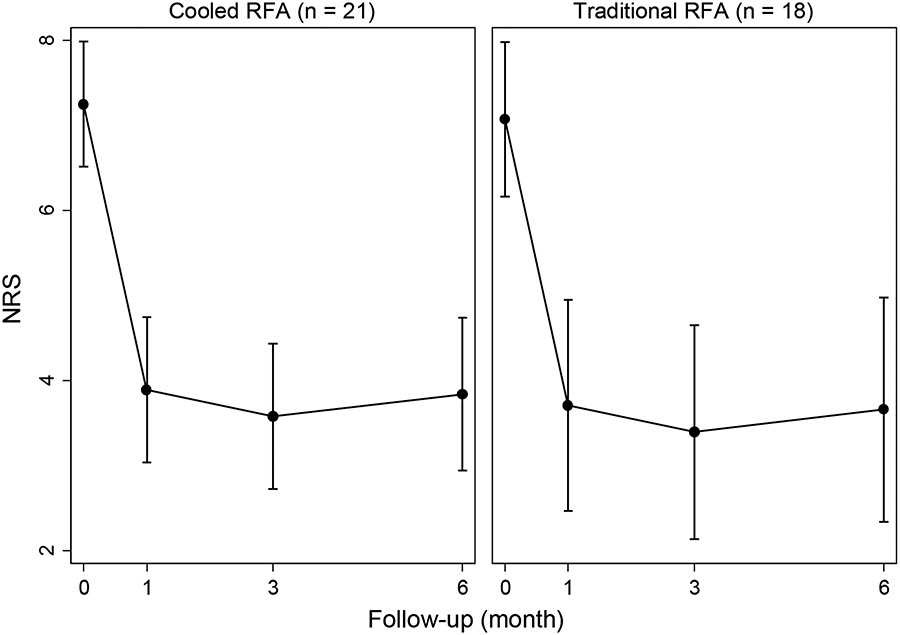
In this blinded, prospective trial, patients with positive diagnostic MBN blocks (>75% relief) were randomized to MBN C-RFA or T-RFA. The primary outcome was the proportion of 'responders' (≥50% Numeric Rating Scale (NRS) reduction) at 6 months. Secondary outcomes included NRS, Oswestry Disability Index (ODI), and Patient Global Impression of Change.
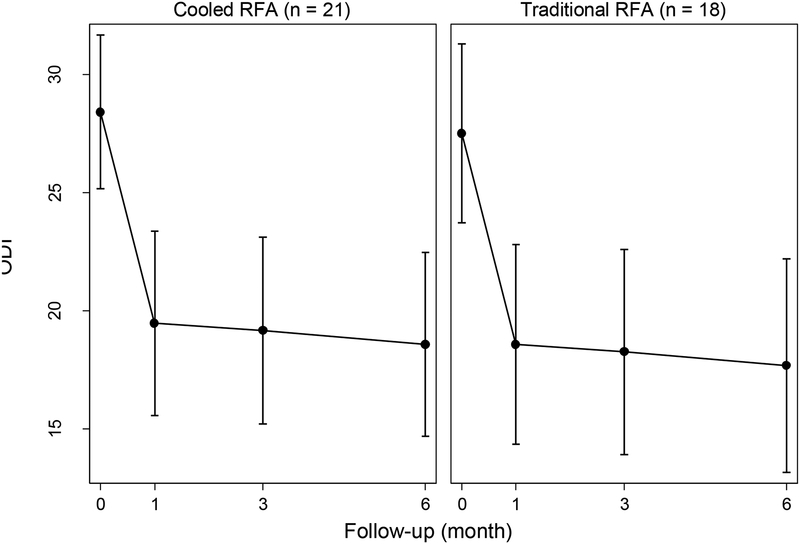
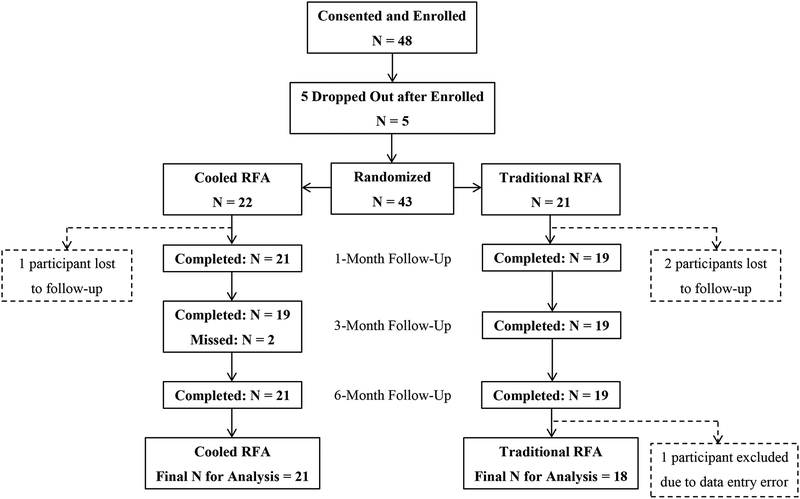
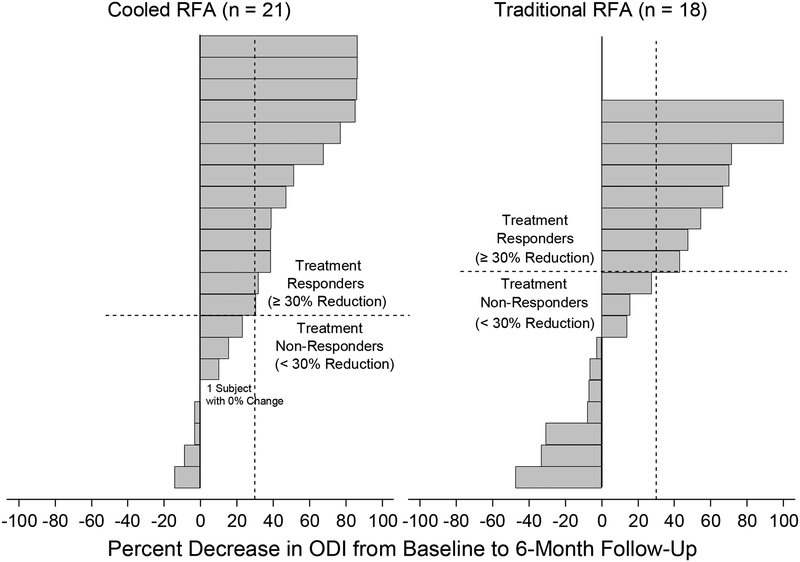
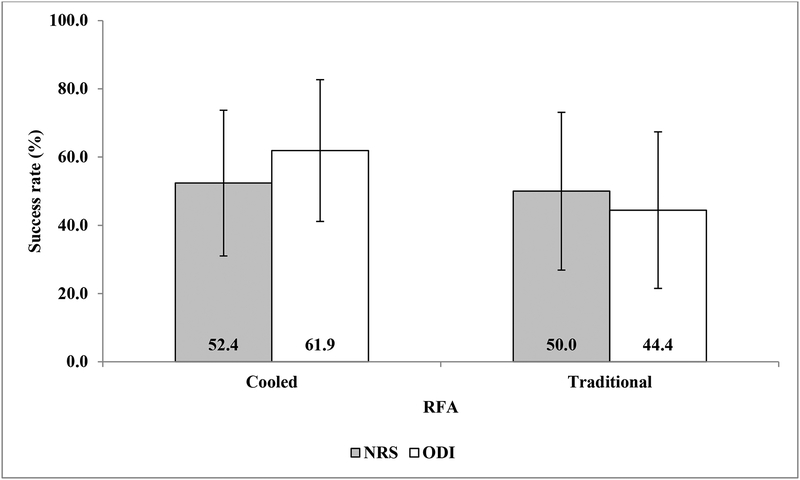
Forty-three participants were randomized to MBN C-RFA (n=21) or T-RFA (n=22). There were no significant differences in demographic variables (p>0.05). A ≥50% NRS reduction was observed in 52% (95% CI 31% to 74%) and 44% (95% CI 22% to 69%) of participants in the C-RFA and T-RFA groups, respectively (p=0.75). A ≥15-point or ≥30% reduction in ODI score was observed in 62% (95% CI 38% to 82%) and 44% (95% CI 22% to 69%) of participants in the C-RFA and T-RFA groups, respectively (p=0.21).
When using a single diagnostic block paradigm with a threshold of >75% pain reduction, both treatment with both C-RFA and T-RFA resulted in a success rate of approximately 50% when defined by both improvement in pain and physical function at 6-month follow-up. While the success rate was higher in the C-RFA group, this difference was not statistically significant.
NCT02478437.
以前没有研究评估过用于治疗腰椎小关节疼痛的冷射频消融(C-RFA)对内侧支神经(MBN)的治疗效果,也没有将其与传统射频消融(T-RFA)的效果进行比较。本研究评估了接受 MBN C-RFA 与 T-RFA 治疗腰椎 Z 关节疼痛的患者在 6 个月时疼痛、功能、心理计量和药物使用情况的结果。
在这项盲法、前瞻性试验中,对内侧支神经阻滞阳性(>75%缓解)的患者进行随机分组,分别接受 MBN C-RFA 或 T-RFA 治疗。主要结局是 6 个月时“应答者”(NRS 降低≥50%)的比例。次要结局包括 NRS、Oswestry 残疾指数(ODI)和患者总体变化印象。
43 名患者被随机分配到 MBN C-RFA 组(n=21)或 T-RFA 组(n=22)。两组患者的人口统计学变量无显著差异(p>0.05)。C-RFA 组和 T-RFA 组分别有 52%(95%CI 31%至 74%)和 44%(95%CI 22%至 69%)的患者 NRS 降低≥50%(p=0.75)。C-RFA 组和 T-RFA 组分别有 62%(95%CI 38%至 82%)和 44%(95%CI 22%至 69%)的患者 ODI 评分降低≥15 分或≥30%(p=0.21)。
当使用≥75%疼痛缓解的单一诊断性阻滞标准时,在 6 个月的随访中,无论是疼痛改善还是躯体功能改善,C-RFA 和 T-RFA 的治疗成功率均约为 50%。虽然 C-RFA 组的成功率较高,但这一差异无统计学意义。
NCT02478437。