Melbourne Dementia Research Centre, Florey Institute of Neuroscience and Mental Health, The University of Melbourne, Parkville, Vic, Australia.
Rush Institute for Healthy Aging, Rush University Medical Center, Chicago, IL, USA.
Mol Psychiatry. 2020 Nov;25(11):2932-2941. doi: 10.1038/s41380-019-0375-7. Epub 2019 Feb 18.
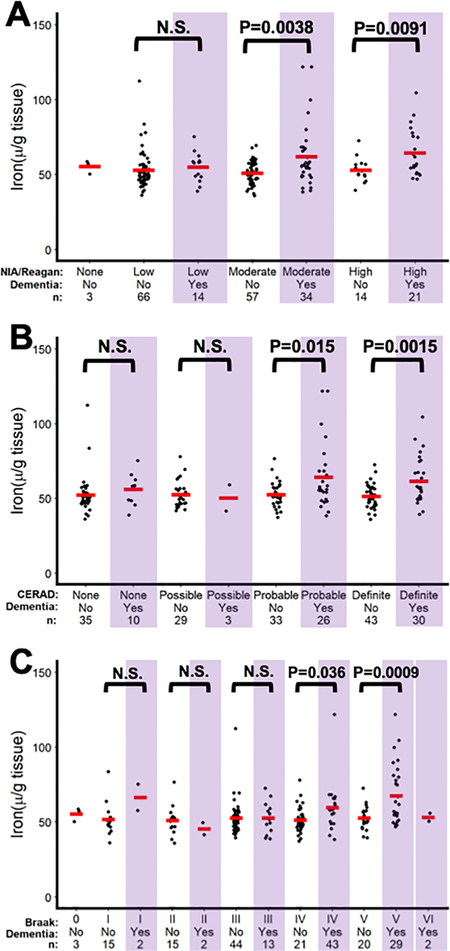
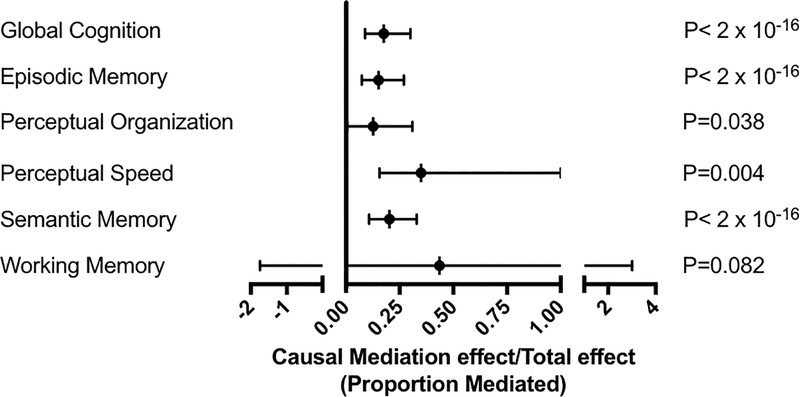
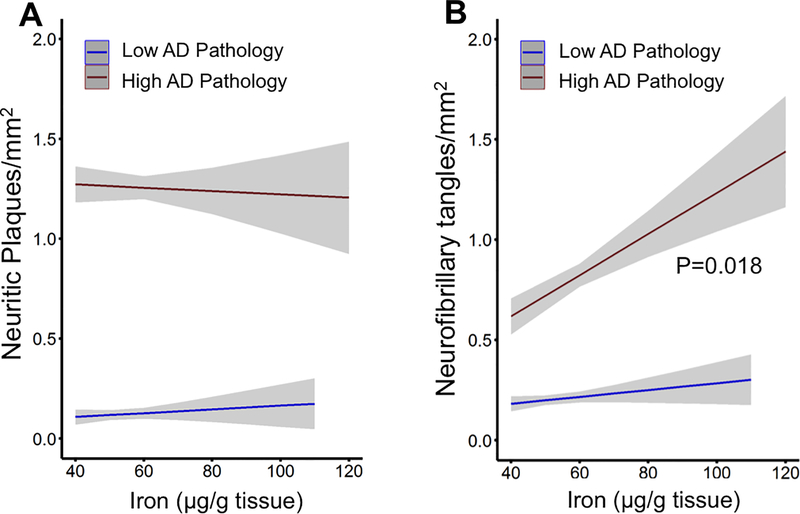
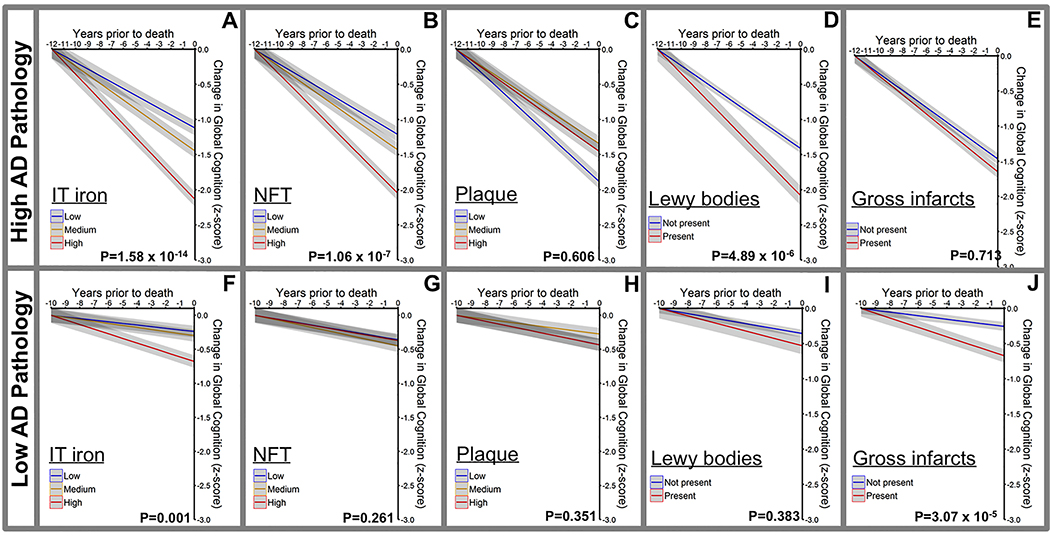
Cortical iron has been shown to be elevated in Alzheimer's disease (AD), but the impact of the directly measured iron on the clinical syndrome has not been assessed. We investigated the association between post-mortem iron levels with the clinical and pathological diagnosis of AD, its severity, and the rate of cognitive decline in the 12 years prior to death in subjects from the Memory and Aging Project (n = 209). Iron was elevated (β [SE] = 9.7 [2.6]; P = 3.0 × 10) in the inferior temporal cortex only in subjects who were diagnosed with clinical AD during life and had a diagnosis of AD confirmed post-mortem by standardized criteria. Although iron was weakly associated with the extent of proteinopathy in tissue with AD neuropathology, it was strongly associated with the rate of cognitive decline (e.g., global cognition: β [SE] = -0.040 [0.005], P = 1.6 × 10). Thus, cortical iron might act to propel cognitive deterioration upon the underlying proteinopathy of AD, possibly by inducing oxidative stress or ferroptotic cell death, or may be related to an inflammatory response.
皮质铁已被证明在阿尔茨海默病(AD)中升高,但直接测量的铁对临床综合征的影响尚未评估。我们研究了死后铁水平与 AD 的临床和病理诊断、其严重程度以及死亡前 12 年内认知下降速度之间的关系,研究对象来自记忆与衰老项目(n=209)。只有在生前被诊断为临床 AD 且死后通过标准化标准被确诊为 AD 的受试者中,下颞叶皮质的铁才升高(β[SE]=9.7[2.6];P=3.0×10)。尽管铁与具有 AD 神经病理学的组织中的蛋白病变程度弱相关,但与认知下降速度密切相关(例如,整体认知:β[SE]=-0.040[0.005],P=1.6×10)。因此,皮质铁可能通过诱导氧化应激或铁死亡细胞死亡,或者可能与炎症反应有关,从而在 AD 的潜在蛋白病变基础上加速认知恶化。