Stader Felix, Penny Melissa A, Siccardi Marco, Marzolini Catia
Division of Infectious Diseases and Hospital Epidemiology, Departments of Medicine and Clinical Research, University Hospital Basel, Basel, Switzerland.
Infectious Disease Modelling Unit, Department of Epidemiology and Public Health, Swiss Tropical and Public Health Institute, Basel, Switzerland.
CPT Pharmacometrics Syst Pharmacol. 2019 Jul;8(7):444-459. doi: 10.1002/psp4.12399. Epub 2019 Apr 2.
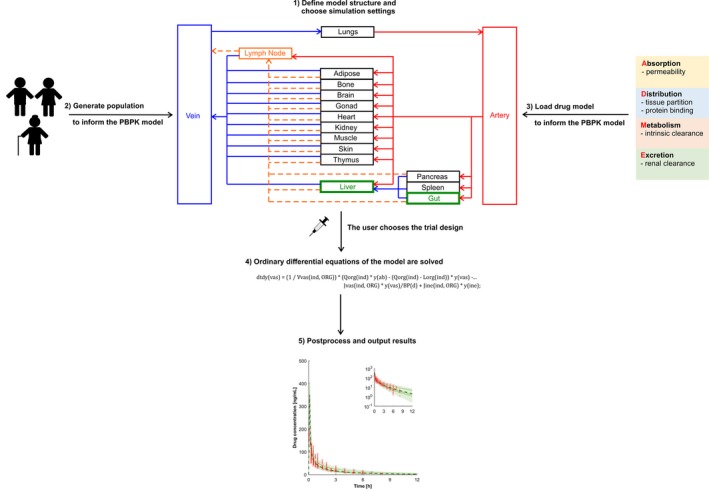
Physiologically-based pharmacokinetic (PBPK) models are useful tools to predict clinical scenarios for special populations for whom there are high hurdles to conduct clinical trials such as children or the elderly. However, the coding of a PBPK model in a mathematical programming language can be challenging. This tutorial illustrates how to build a whole-body PBPK model in Matlab to answer specific pharmacological questions involving drug disposition and magnitudes of drug-drug interactions in different patient populations.
基于生理的药代动力学(PBPK)模型是预测特殊人群临床情况的有用工具,对于儿童或老年人等进行临床试验存在高障碍的人群而言尤为如此。然而,用数学编程语言对PBPK模型进行编码可能具有挑战性。本教程说明了如何在Matlab中构建一个全身PBPK模型,以回答涉及不同患者群体中药物处置和药物 - 药物相互作用程度的特定药理学问题。