Reali Federico, Fochesato Anna, Kaddi Chanchala, Visintainer Roberto, Watson Shayne, Levi Micha, Dartois Véronique, Azer Karim, Marchetti Luca
Fondazione The Microsoft Research-University of Trento Centre for Computational and Systems Biology (COSBI), Rovereto, Italy.
Department of Mathematics, University of Trento, Povo, Italy.
Front Pharmacol. 2024 Jan 4;14:1272091. doi: 10.3389/fphar.2023.1272091. eCollection 2023.
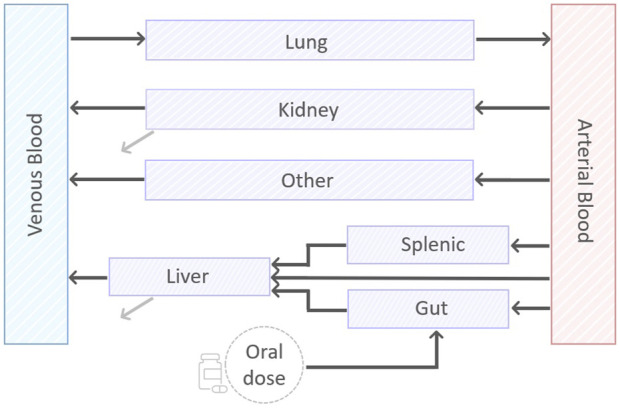
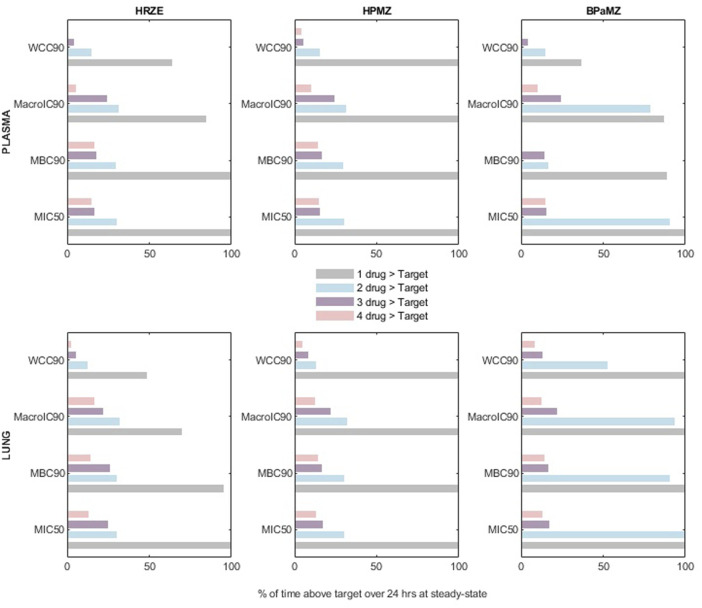
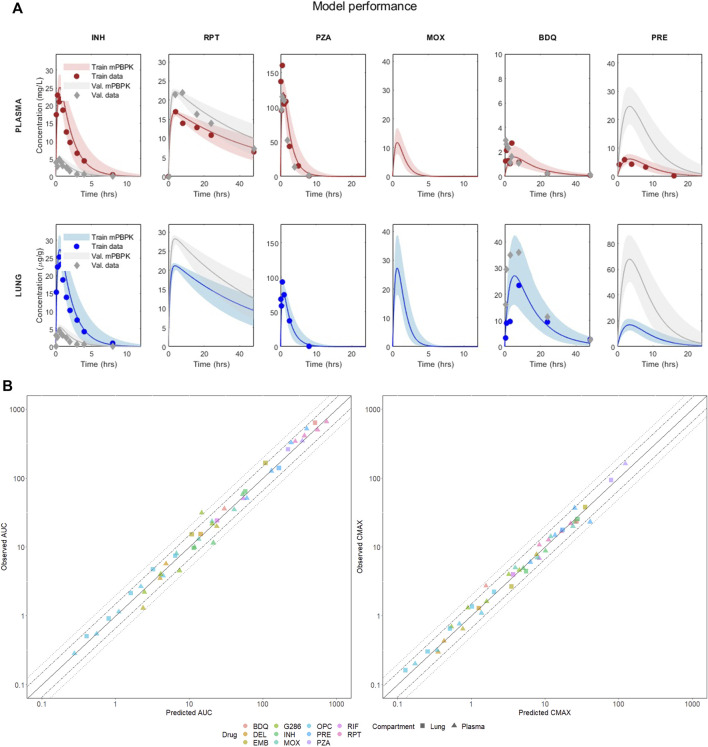
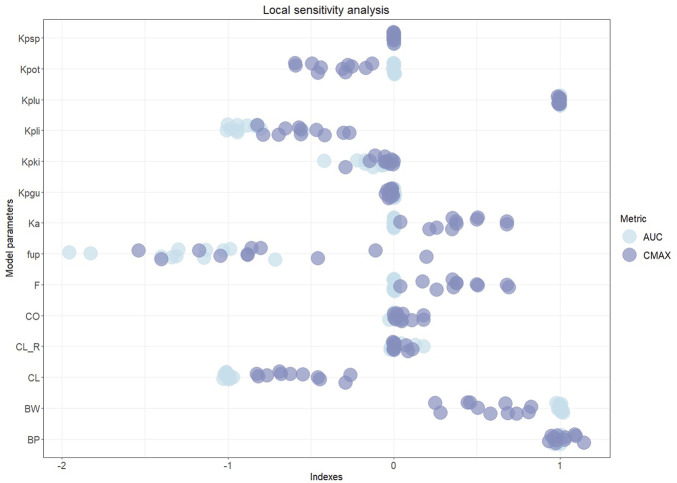
Understanding drug exposure at disease target sites is pivotal to profiling new drug candidates in terms of tolerability and efficacy. Such quantification is particularly tedious for anti-tuberculosis (TB) compounds as the heterogeneous pulmonary microenvironment due to the infection may alter lung permeability and affect drug disposition. Murine models have been a longstanding support in TB research so far and are here used as human surrogates to unveil the distribution of several anti-TB compounds at the site-of-action via a novel and centralized PBPK design framework. As an intermediate approach between data-driven pharmacokinetic (PK) models and whole-body physiologically based (PB) PK models, we propose a parsimonious framework for PK investigation (minimal PBPK approach) that retains key physiological processes involved in TB disease, while reducing computational costs and prior knowledge requirements. By lumping together pulmonary TB-unessential organs, our minimal PBPK model counts 9 equations compared to the 36 of published full models, accelerating the simulation more than 3-folds in Matlab 2022b. The model has been successfully tested and validated against 11 anti-TB compounds-rifampicin, rifapentine, pyrazinamide, ethambutol, isoniazid, moxifloxacin, delamanid, pretomanid, bedaquiline, OPC-167832, GSK2556286 - showing robust predictability power in recapitulating PK dynamics in mice. Structural inspections on the proposed design have ensured global identifiability and listed free fraction in plasma and blood-to-plasma ratio as top sensitive parameters for PK metrics. The platform-oriented implementation allows fast comparison of the compounds in terms of exposure and target attainment. Discrepancies in plasma and lung levels for the latest BPaMZ and HPMZ regimens have been analyzed in terms of their impact on preclinical experiment design and on PK/PD indices. The framework we developed requires limited drug- and species-specific information to reconstruct accurate PK dynamics, delivering a unified viewpoint on anti-TB drug distribution at the site-of-action and a flexible fit-for-purpose tool to accelerate model-informed drug design pipelines and facilitate translation into the clinic.
了解疾病靶点部位的药物暴露情况对于从耐受性和疗效方面对新的候选药物进行评估至关重要。对于抗结核(TB)化合物而言,这种量化尤其繁琐,因为感染导致的肺部微环境异质性可能会改变肺通透性并影响药物处置。到目前为止,小鼠模型一直是结核病研究的长期支撑,在此被用作人类替代物,通过一个新颖的集中式生理药代动力学(PBPK)设计框架来揭示几种抗结核化合物在作用部位的分布。作为数据驱动的药代动力学(PK)模型和全身基于生理学的(PB)PK模型之间的一种中间方法,我们提出了一种用于PK研究的简约框架(最小PBPK方法),该框架保留了结核病中涉及的关键生理过程,同时降低了计算成本和先验知识要求。通过将非结核病必需的肺外器官归并在一起,我们的最小PBPK模型有9个方程,而已发表的完整模型有36个方程,在Matlab 2022b中模拟速度加快了3倍多。该模型已针对11种抗结核化合物——利福平、利福喷汀、吡嗪酰胺、乙胺丁醇、异烟肼、莫西沙星、地拉马尼、普瑞马尼德、贝达喹啉、OPC - 167832、GSK2556286——成功进行了测试和验证,在重现小鼠PK动态方面显示出强大的预测能力。对所提出设计的结构检查确保了全局可识别性,并将血浆中的游离分数和血药浓度比列为PK指标的最敏感参数。面向平台的实现方式允许快速比较化合物在暴露和靶点达到方面的情况。针对最新的BPaMZ和HPMZ方案在血浆和肺部水平的差异,分析了它们对临床前实验设计以及PK/PD指标的影响。我们开发的框架需要有限的药物和物种特异性信息来重建准确的PK动态,提供了关于抗结核药物在作用部位分布的统一观点,以及一个灵活的、适合特定用途的工具,以加速基于模型的药物设计流程并促进向临床的转化。