Department of Human Evolution, Max Planck Institute for Evolutionary Anthropology, 04103 Leipzig, Germany;
Department of Archaeology, Simon Fraser University, Burnaby BC V5A 1S6, Canada.
Proc Natl Acad Sci U S A. 2019 Mar 12;116(11):4928-4933. doi: 10.1073/pnas.1814087116. Epub 2019 Feb 19.
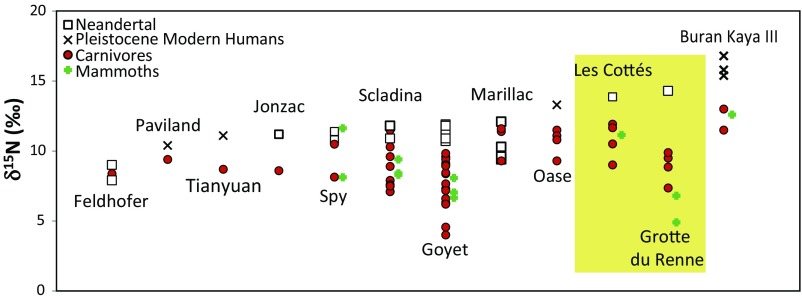
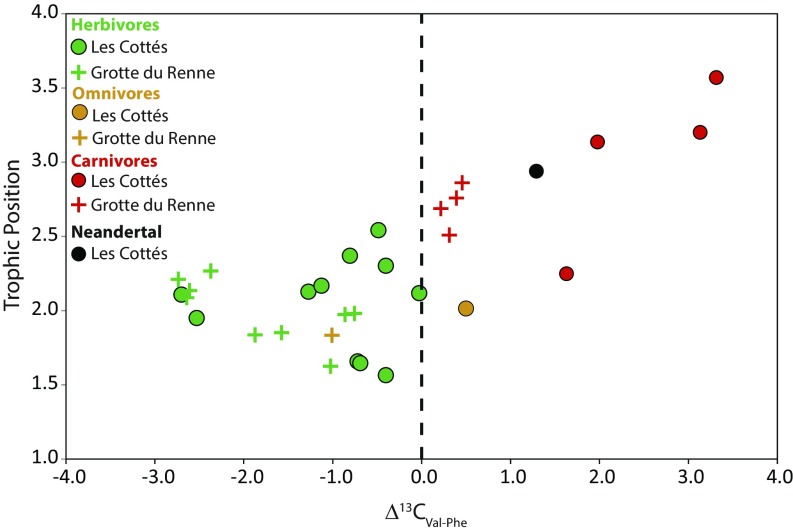
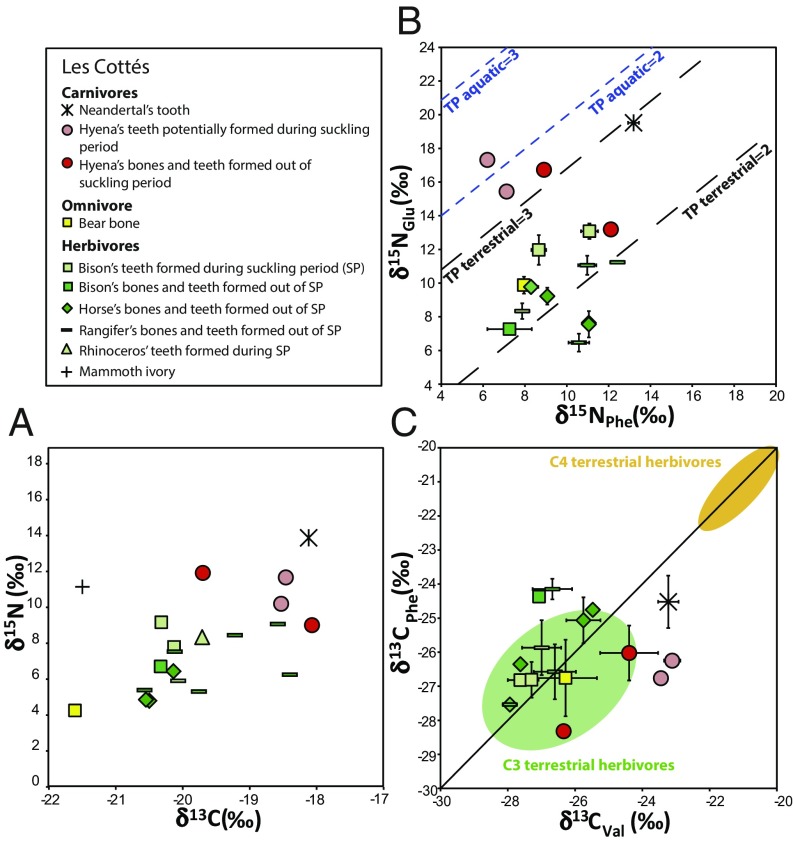
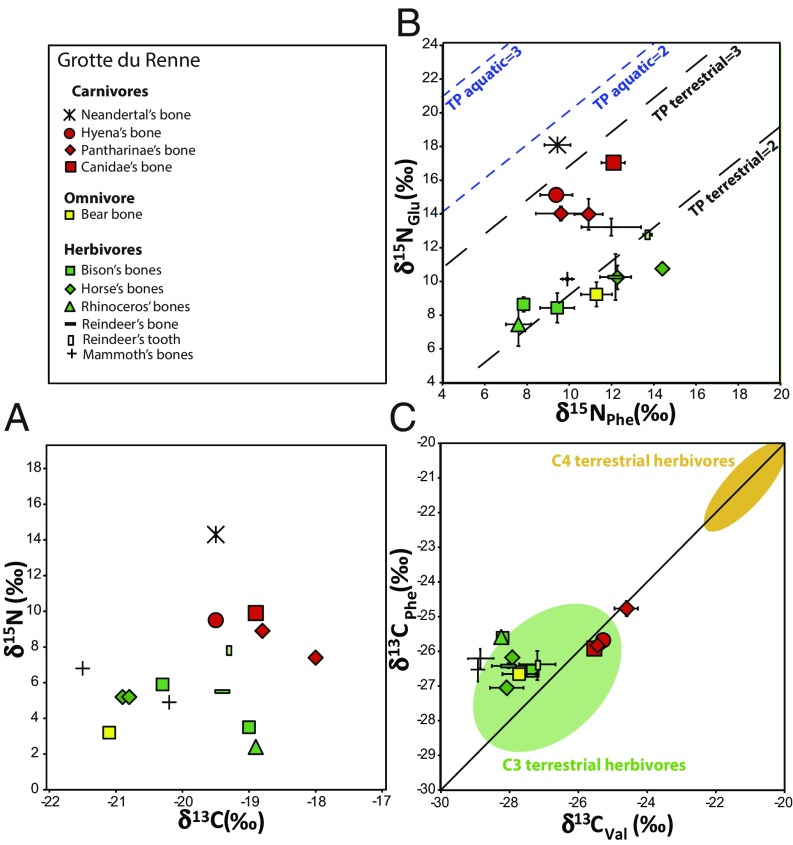
Isotope and archeological analyses of Paleolithic food webs have suggested that Neandertal subsistence relied mainly on the consumption of large herbivores. This conclusion was primarily based on elevated nitrogen isotope ratios in Neandertal bone collagen and has been significantly debated. This discussion relies on the observation that similar high nitrogen isotopes values could also be the result of the consumption of mammoths, young animals, putrid meat, cooked food, freshwater fish, carnivores, or mushrooms. Recently, compound-specific C and N isotope analyses of bone collagen amino acids have been demonstrated to add significantly more information about trophic levels and aquatic food consumption. We undertook single amino acid C and N isotope analysis on two Neandertals, which were characterized by exceptionally high N isotope ratios in their bulk bone or tooth collagen. We report here both C and N isotope ratios on single amino acids of collagen samples for these two Neandertals and associated fauna. The samples come from two sites dating to the Middle to Upper Paleolithic transition period (Les Cottés and Grotte du Renne, France). Our results reinforce the interpretation of Neandertal dietary adaptations as successful top-level carnivores, even after the arrival of modern humans in Europe. They also demonstrate that high δN values of bone collagen can solely be explained by mammal meat consumption, as supported by archeological and zooarcheological evidence, without necessarily invoking explanations including the processing of food (cooking, fermenting), the consumption of mammoths or young mammals, or additional (freshwater fish, mushrooms) dietary protein sources.
对旧石器时代食物网的同位素和考古分析表明,尼安德特人的生存主要依赖于大型食草动物的消费。这一结论主要基于尼安德特人骨骼胶原中的氮同位素比值升高,并且已经引起了广泛的争议。这种讨论依赖于这样一种观察,即类似的高氮同位素值也可能是猛犸象、幼年动物、腐肉、熟食、淡水鱼、食肉动物或蘑菇消费的结果。最近,对骨骼胶原氨基酸的碳和氮同位素的化合物特异性分析已经证明,可以提供关于营养水平和水生食物消费的更多信息。我们对两个尼安德特人进行了单个氨基酸的碳和氮同位素分析,这两个尼安德特人的骨骼或牙齿胶原中的氮同位素比值异常高。我们在这里报告了这两个尼安德特人和相关动物群的胶原样本中单个氨基酸的碳和氮同位素比值。这些样本来自两个中更新世到上新世过渡期的遗址(法国的 Les Cottés 和 Grotte du Renne)。我们的结果证实了尼安德特人作为成功的顶级食肉动物的饮食适应,即使在现代人到达欧洲之后也是如此。它们还表明,骨骼胶原中的高δN 值仅可以通过哺乳动物肉类消费来解释,这得到了考古和动物考古证据的支持,而不必援引包括食物加工(烹饪、发酵)、猛犸象或幼年哺乳动物的消费或其他(淡水鱼、蘑菇)饮食蛋白质来源在内的解释。