Stead Victoria E, Boylan Khrista, Schmidt Louis A
1Department of Psychology, Neuroscience & Behaviour, McMaster University, 1280 King St West, Hamilton, ON L8S 4K1 Canada.
2Department of Psychiatry and Behavioural Neurosciences, McMaster University, St. Joseph's Healthcare Hamilton, 100 West 5th, Administration - B3, Hamilton, L8N 3K7 ON Canada.
Borderline Personal Disord Emot Dysregul. 2019 Feb 13;6:3. doi: 10.1186/s40479-019-0100-9. eCollection 2019.
Borderline personality disorder (BPD) in adolescent samples is similar to BPD in adults concerning clinical characteristics. A notable difference is that adolescents with BPD - and adolescents in general - are more likely than adults to present with acute symptoms such as non-suicidal self-injury (NSSI) and suicidal behaviours. BPD is the only disorder in the Diagnostic and Statistical Manual- 5th Edition that includes a criterion of NSSI. Additionally, NSSI is purported to be a developmental precursor of BPD under the biosocial developmental model. Though much cross-sectional data have illustrated the robust association of adolescent NSSI and BPD, no review to date has summarized the longitudinal associations between these phenomena. The aim of this literature review was to summarize what is known about the longitudinal associations between adolescent NSSI and BPD symptoms. Information on the developmental course of NSSI in relation to BPD would be helpful to clinicians, as the rate of NSSI is high in adolescent populations, and research indicates early, possibly BPD-specific interventions are imperative.
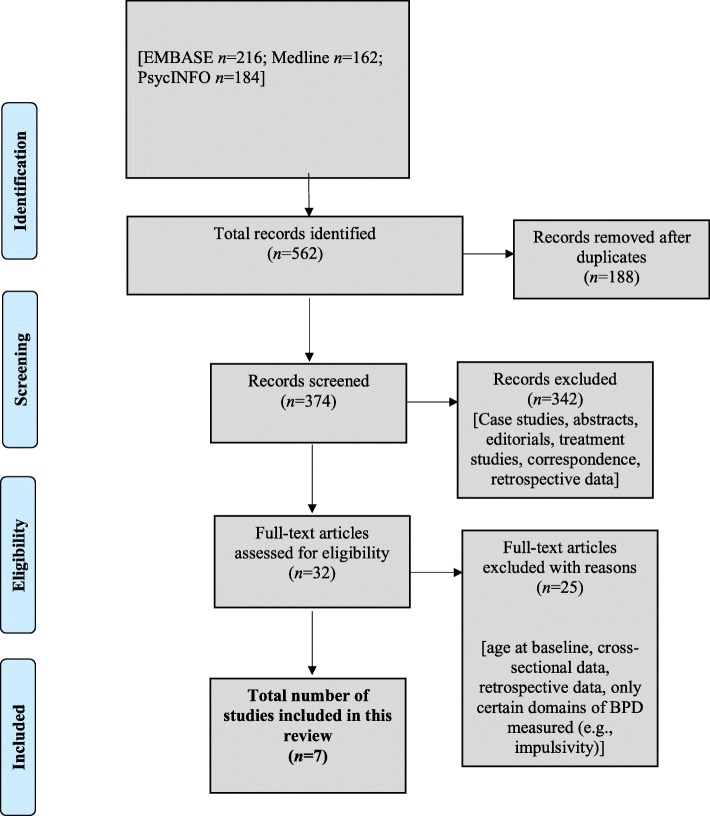
A literature search was conducted using Embase, MEDLINE, and PsycINFO databases and cited reference searches. Criteria included studies of adolescents (age ≤ 18 at baseline) from either epidemiological or clinical samples, incorporating a longitudinal design, with predictors and outcomes of interest, including both NSSI and BPD diagnosis/symptoms/traits.
Six independent samples were identified that matched our search criteria.The articles were grouped and reported on separately by population type (epidemiological vs. clinical), and directionality of relations. We identified two epidemiological and four clinical samples. Five samples examined the longitudinal associations of NSSI preceding BPD, three samples measured BPD in adolescence (baseline age ≤ 18), and two of those samples measured BPD at baseline. Both epidemiological studies revealed significant longitudinal associations between NSSI and later BPD/BPD symptoms; however, they differed notably in their methodologies hindering data synthesis across studies. In the clinical studies, findings of the association or predictive relations were not consistent. This is potentially due to differing methodologies, or differences in treatment effectiveness and responsiveness across the samples.
This review highlights the paucity of data that are available examining the longitudinal association between NSSI and BPD within adolescent samples. Thus, it is not possible to reliably comment on how NSSI and BPD are related over time. Future studies will benefit from the measurement of BPD symptoms in very early adolescence, and concurrent measurement of NSSI as well as other forms of suicidal behaviours across adolescence.
青少年样本中的边缘性人格障碍(BPD)在临床特征方面与成人的BPD相似。一个显著的差异是,患有BPD的青少年——以及一般的青少年——比成年人更有可能出现诸如非自杀性自伤(NSSI)和自杀行为等急性症状。BPD是《精神疾病诊断与统计手册(第5版)》中唯一包含NSSI标准的疾病。此外,在生物社会发展模型下,NSSI被认为是BPD的一个发展先兆。尽管许多横断面数据已经说明了青少年NSSI与BPD之间的紧密关联,但迄今为止,尚无综述总结这些现象之间的纵向关联。这篇文献综述的目的是总结关于青少年NSSI与BPD症状之间纵向关联的已知情况。了解NSSI相对于BPD的发展过程的信息对临床医生会有所帮助,因为青少年群体中NSSI的发生率很高;而且研究表明早期的、可能针对BPD的干预措施势在必行。
使用Embase、MEDLINE和PsycINFO数据库进行文献检索,并进行引用文献检索。纳入标准包括对来自流行病学或临床样本的青少年(基线年龄≤18岁)的研究,采用纵向设计,涉及感兴趣的预测因素和结果,包括NSSI以及BPD诊断/症状/特质。
确定了6个符合我们检索标准的独立样本。这些文章根据人群类型(流行病学样本与临床样本)以及关系的方向性进行分组并分别报告。我们确定了2个流行病学样本和4个临床样本。5个样本研究了NSSI先于BPD的纵向关联,3个样本测量了青少年期(基线年龄≤18岁)的BPD,其中2个样本在基线时测量了BPD。两项流行病学研究均揭示了NSSI与后期BPD/BPD症状之间存在显著的纵向关联;然而,它们的方法存在显著差异,阻碍了跨研究的数据综合。在临床研究中,关于关联或预测关系的结果并不一致。这可能是由于方法不同,或者各样本在治疗效果和反应性方面存在差异。
本综述强调了在青少年样本中研究NSSI与BPD之间纵向关联的数据匮乏。因此,无法可靠地评论NSSI与BPD如何随时间相互关联。未来的研究将受益于在青春期早期对BPD症状的测量,以及在整个青春期对NSSI和其他形式自杀行为的同时测量。
