Department of Medicine, Stanford University School of Medicine, Stanford, CA, USA.
Department of Medicine, Perelman School of Medicine, University of Pennsylvania, Philadelphia, PA, USA.
J Cachexia Sarcopenia Muscle. 2019 Apr;10(2):338-346. doi: 10.1002/jcsm.12396. Epub 2019 Feb 19.
Conventional definitions of sarcopenia based on lean mass may fail to capture low lean mass relative to higher fat mass, that is, relative sarcopenia. The objective of this study is to determine the associations of sarcopenia and relative sarcopenia with mortality independent of co-morbidities, and whether chronic kidney disease (CKD) and adiposity alter these associations.
Dual energy X-ray absorptiometry-derived appendicular lean mass index (ALMI, kg/m ) and fat mass index (FMI, kg/m ) were assessed in 14 850 National Health and Nutrition Examination Survey participants from 1999 to 2006 and were linked to death certificate data in the National Death Index with follow-up through 2011. Sarcopenia was defined using sex-specific and race/ethnicity-specific standard deviation scores compared with young adults (T-scores) as an ALMI T-score < -2 and relative sarcopenia as fat-adjusted ALMI (ALMI ) T-score < -2. Glomerular filtration rate (GFR) was estimated using creatinine-based (eGFR ) and cystatin C-based (eGFR ) regression equations.
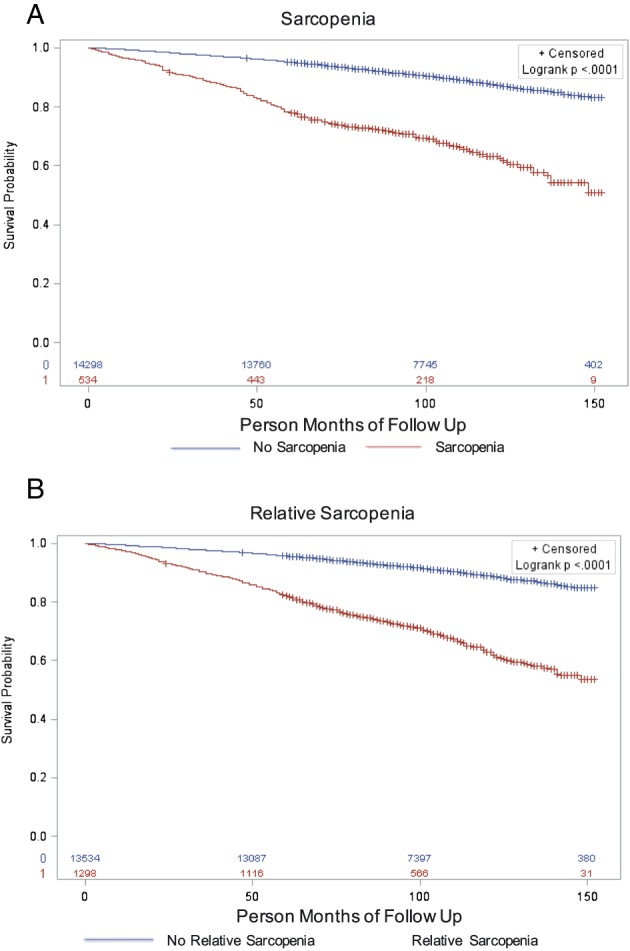
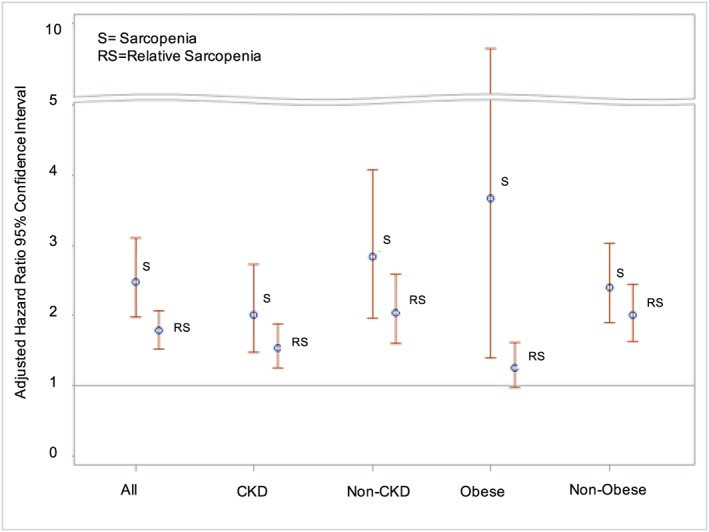
Three (3.0) per cent of National Health and Nutrition Examination Survey participants met criteria for sarcopenia and 8.7% met criteria for relative sarcopenia. Sarcopenia and relative sarcopenia were independently associated with mortality (HR sarcopenia 2.20, 95% CI 1.69 to 2.86; HR relative sarcopenia 1.60, 95% CI 1.31 to 1.96). The corresponding population attributable risks were 5.2% (95% CI 3.4% to 6.4%) and 8.4% (95% CI 4.8% to 11.2%), respectively. Relative sarcopenia remained significantly associated with mortality (HR 1.32, 95% CI 1.08 to 1.61) when limited to the subset who did not meet the criteria for sarcopenia. The risk of mortality associated with relative sarcopenia was attenuated among persons with higher FMI (P for interaction <0.01) and was not affected by CKD status for either sarcopenia or relative sarcopenia.
Sarcopenia and relative sarcopenia are significantly associated with mortality regardless of CKD status. Relative sarcopenia is nearly three-fold more prevalent amplifying its associated mortality risk at the population level. The association between relative sarcopenia and mortality is attenuated in persons with higher FMI.
基于瘦体重的传统肌少症定义可能无法捕捉到相对于较高脂肪量的低瘦体重,即相对肌少症。本研究的目的是确定肌少症和相对肌少症与死亡率的关联,而不考虑合并症,以及慢性肾脏病 (CKD) 和肥胖是否改变这些关联。
从 1999 年至 2006 年的 14850 名全国健康和营养检查调查参与者中评估了双能 X 射线吸收法衍生的四肢瘦体重指数(ALMI,kg/m )和脂肪量指数(FMI,kg/m ),并与国家死亡指数中的死亡证明数据相关联,随访至 2011 年。肌少症的定义是使用与年轻人相比的性别特异性和种族/民族特异性标准偏差评分(T 评分),即 ALMI T 评分<-2 和相对肌少症为脂肪调整后的 ALMI(ALMI )T 评分<-2。肾小球滤过率(GFR)使用基于肌酐的(eGFR )和基于胱抑素 C 的(eGFR )回归方程估算。
三(3.0)%的全国健康和营养检查调查参与者符合肌少症标准,8.7%符合相对肌少症标准。肌少症和相对肌少症与死亡率独立相关(肌少症 HR 2.20,95%CI 1.69 至 2.86;相对肌少症 HR 1.60,95%CI 1.31 至 1.96)。相应的人群归因风险分别为 5.2%(95%CI 3.4%至 6.4%)和 8.4%(95%CI 4.8%至 11.2%)。当仅限于不符合肌少症标准的亚组时,相对肌少症与死亡率仍显著相关(HR 1.32,95%CI 1.08 至 1.61)。在较高 FMI 的人群中,相对肌少症与死亡率相关的风险降低(交互作用 P<0.01),并且 CKD 状态对肌少症或相对肌少症的死亡率均无影响。
肌少症和相对肌少症与死亡率显著相关,无论 CKD 状态如何。相对肌少症的患病率几乎增加了三倍,从而放大了其在人群水平上的相关死亡风险。在较高 FMI 的人群中,相对肌少症与死亡率的关联减弱。