Wang Xiaodong, Li Zhaoliang, Huang Xiaolei, Li Fenghua, Liu Jinbo, Li Zhenzuo, Bai Dongfang
Master, Second Department of Nephrology, Tai'an Central Hospital, China. Technical procedures, critical revision, final approval.
Bachelor, Second Department of Endocrinology, Tai'an Central Hospital, China. Technical procedures, statistical analysis, critical revision, final approval.
Acta Cir Bras. 2019 Feb 14;34(1):e20190010000001. doi: 10.1590/s0102-865020190010000001.
To investigate the effects of exenatide on renal injury in streptozotocin-induced diabetic rats.
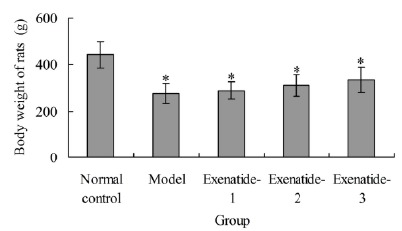
Fifty SD rats were randomly divided into normal control, model, exenatide-1, exenatide-2 and exenatide-3 groups, 10 rats in each group. The diabetic nephropathy model was constructed in later 4 groups. Then, the later 3 groups were treated with 2, 4 and 8 μg/kg exenatide for 8 weeks, respectively. The serum and urine biochemical indexes and oxidative stress and inflammatory indexes in renal tissue were determined.
Compared to the model group, in exenatide-3 group the serum fasting plasma glucose and hemoglobin A1c levels were significantly decreased, the fasting insulin level was significantly increased, the renal index and blood urea nitrogen, serum creatinine and 24 h urine protein levels were significantly decreased, the renal tissue superoxide dismutase and glutathione peroxidase levels were significantly increased, the malondialdehyde level was significantly decreased, and the renal tissue tumor necrosis factor alpha, interleukin 6, hypersensitive C-reactive protein and chemokine (C-C motif) ligand 5 levels were significantly decreased P<0.05).
Exenatide can mitigate the renal injury in diabetic rats. The mechanisms may be related to its resistance of oxidative stress and inflammatory response in renal tissue.
探讨艾塞那肽对链脲佐菌素诱导的糖尿病大鼠肾损伤的影响。
将50只SD大鼠随机分为正常对照组、模型组、艾塞那肽-1组、艾塞那肽-2组和艾塞那肽-3组,每组10只。后4组建立糖尿病肾病模型。然后,后3组分别用2、4和8μg/kg艾塞那肽治疗8周。测定血清和尿液生化指标以及肾组织中的氧化应激和炎症指标。
与模型组相比,艾塞那肽-3组血清空腹血糖和糖化血红蛋白水平显著降低,空腹胰岛素水平显著升高,肾指数以及血尿素氮、血清肌酐和24小时尿蛋白水平显著降低,肾组织超氧化物歧化酶和谷胱甘肽过氧化物酶水平显著升高,丙二醛水平显著降低,肾组织肿瘤坏死因子α、白细胞介素6、超敏C反应蛋白和趋化因子(C-C基序)配体5水平显著降低(P<0.05)。
艾塞那肽可减轻糖尿病大鼠的肾损伤。其机制可能与其抵抗肾组织中的氧化应激和炎症反应有关。