Department of Immunology, Ophthalmology and ERL, Hospital 12 de Octubre Health Research Institute (imas12), School of Medicine, Complutense University, Madrid, Spain.
Manchester Collaborative Centre for Inflammation Research, Lydia Becker Institute of Immunology and Inflammation, University of Manchester, Manchester, United Kingdom.
Front Immunol. 2019 Feb 6;10:156. doi: 10.3389/fimmu.2019.00156. eCollection 2019.
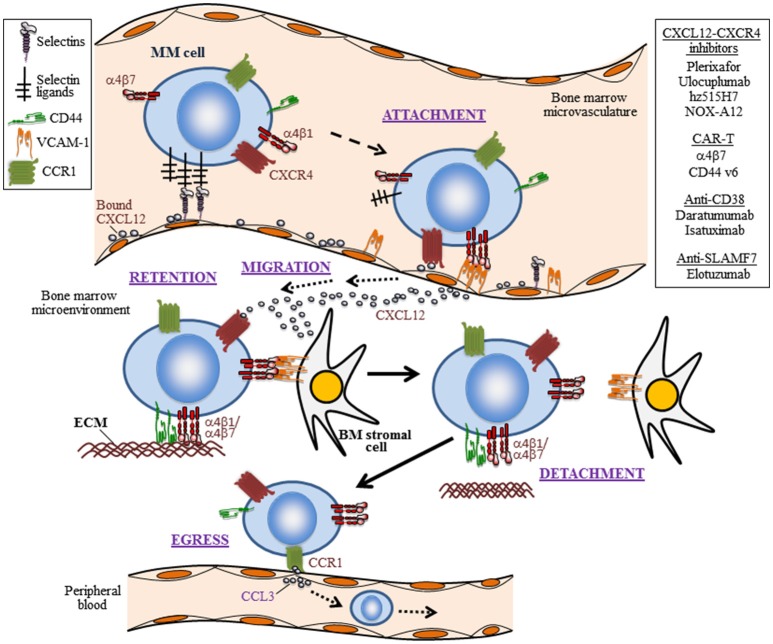
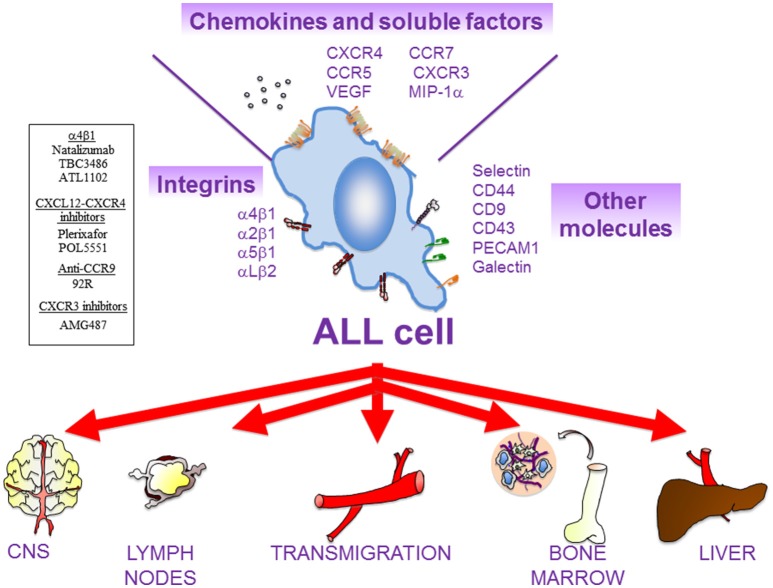
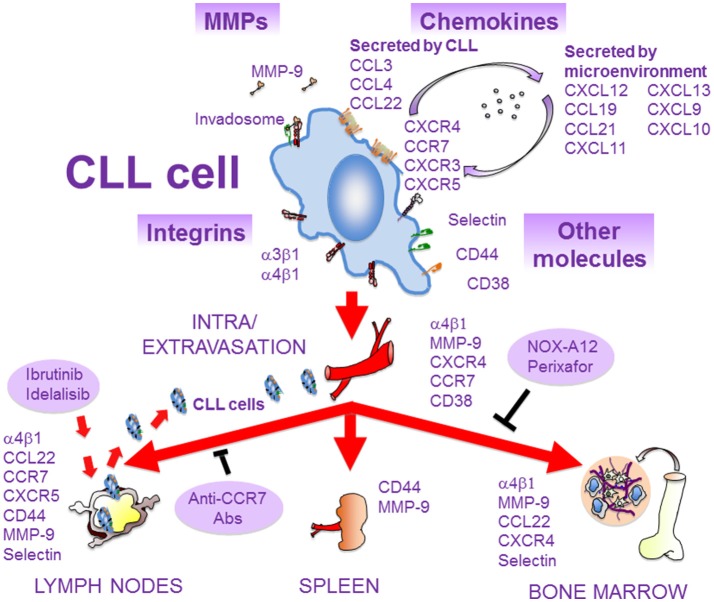
The trafficking of neoplastic cells represents a key process that contributes to progression of hematologic malignancies. Diapedesis of neoplastic cells across endothelium and perivascular cells is facilitated by adhesion molecules and chemokines, which act in concert to tightly regulate directional motility. Intravital microscopy provides spatio-temporal views of neoplastic cell trafficking, and is crucial for testing and developing therapies against hematologic cancers. Multiple myeloma (MM), chronic lymphocytic leukemia (CLL), and acute lymphoblastic leukemia (ALL) are hematologic malignancies characterized by continuous neoplastic cell trafficking during disease progression. A common feature of these neoplasias is the homing and infiltration of blood cancer cells into the bone marrow (BM), which favors growth and survival of the malignant cells. MM cells traffic between different BM niches and egress from BM at late disease stages. Besides the BM, CLL cells commonly home to lymph nodes (LNs) and spleen. Likewise, ALL cells also infiltrate extramedullary organs, such as the central nervous system, spleen, liver, and testicles. The α4β1 integrin and the chemokine receptor CXCR4 are key molecules for MM, ALL, and CLL cell trafficking into and out of the BM. In addition, the chemokine receptor CCR7 controls CLL cell homing to LNs, and CXCR4, CCR7, and CXCR3 contribute to ALL cell migration across endothelia and the blood brain barrier. Some of these receptors are used as diagnostic markers for relapse and survival in ALL patients, and their level of expression allows clinicians to choose the appropriate treatments. In CLL, elevated α4β1 expression is an established adverse prognostic marker, reinforcing its role in the disease expansion. Combining current chemotherapies with inhibitors of malignant cell trafficking could represent a useful therapy against these neoplasias. Moreover, immunotherapy using humanized antibodies, CAR-T cells, or immune check-point inhibitors together with agents targeting the migration of tumor cells could also restrict their survival. In this review, we provide a view of the molecular players that regulate the trafficking of neoplastic cells during development and progression of MM, CLL, and ALL, together with current therapies that target the malignant cells.
肿瘤细胞的转移是促进血液恶性肿瘤进展的关键过程。肿瘤细胞穿过内皮细胞和血管周细胞的黏附是由黏附分子和趋化因子共同作用促进的,它们协同作用以紧密调节定向迁移。活体显微镜提供了肿瘤细胞迁移的时空视图,对于测试和开发针对血液癌症的治疗方法至关重要。多发性骨髓瘤(MM)、慢性淋巴细胞白血病(CLL)和急性淋巴细胞白血病(ALL)是血液恶性肿瘤,其特征是在疾病进展过程中持续发生肿瘤细胞转移。这些肿瘤的一个共同特征是血液癌细胞归巢并浸润骨髓(BM),这有利于恶性细胞的生长和存活。MM 细胞在不同的 BM 龛位之间迁移,并在疾病晚期从 BM 中迁出。除了 BM 之外,CLL 细胞通常归巢到淋巴结(LNs)和脾脏。同样,ALL 细胞也浸润骨髓外器官,如中枢神经系统、脾脏、肝脏和睾丸。α4β1 整合素和趋化因子受体 CXCR4 是 MM、ALL 和 CLL 细胞进出 BM 的关键分子。此外,趋化因子受体 CCR7 控制 CLL 细胞归巢到 LNs,而 CXCR4、CCR7 和 CXCR3 有助于 ALL 细胞穿过内皮细胞和血脑屏障迁移。这些受体中的一些被用作 ALL 患者复发和生存的诊断标志物,其表达水平可让临床医生选择适当的治疗方法。在 CLL 中,升高的 α4β1 表达是一个既定的不良预后标志物,这强化了其在疾病扩张中的作用。将当前的化疗与恶性细胞迁移抑制剂结合使用可能是针对这些肿瘤的有用治疗方法。此外,使用人源化抗体、CAR-T 细胞或免疫检查点抑制剂结合靶向肿瘤细胞迁移的药物进行免疫疗法也可以限制它们的存活。在这篇综述中,我们提供了一个观点,即调节 MM、CLL 和 ALL 发展和进展过程中肿瘤细胞迁移的分子参与者,以及针对恶性细胞的当前治疗方法。