Dandekar Abhaya M, Jacobson Aaron, Ibáñez Ana M, Gouran Hossein, Dolan David L, Agüero Cecilia B, Uratsu Sandie L, Just Robert, Zaini Paulo A
Department of Plant Sciences, University of California, Davis, Davis, CA, United States.
Department of Enology and Viticulture, University of California, Davis, Davis, CA, United States.
Front Plant Sci. 2019 Feb 6;10:84. doi: 10.3389/fpls.2019.00084. eCollection 2019.
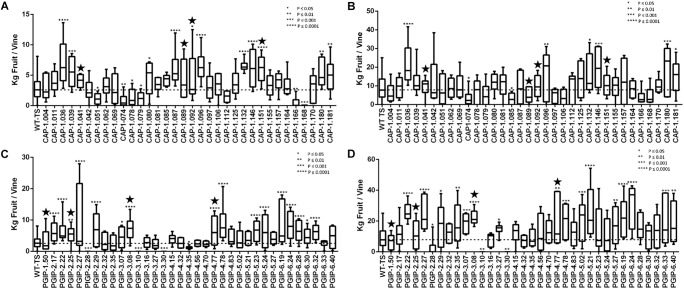
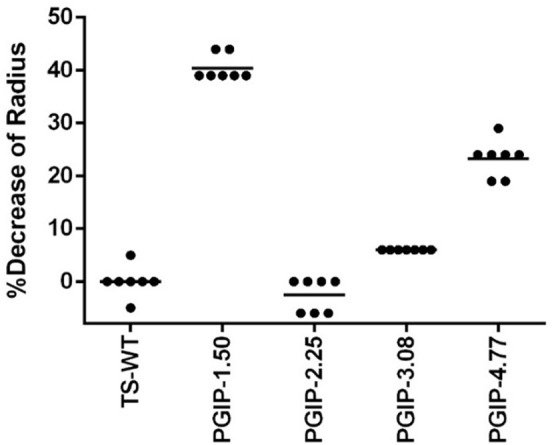
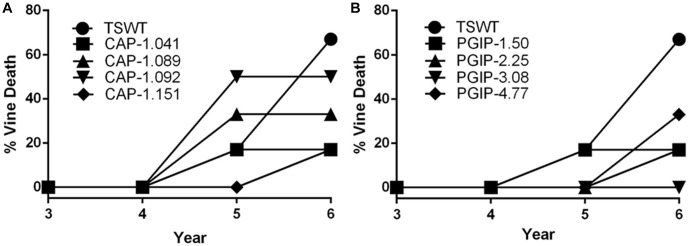
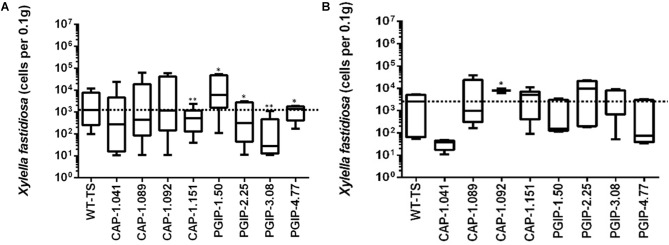
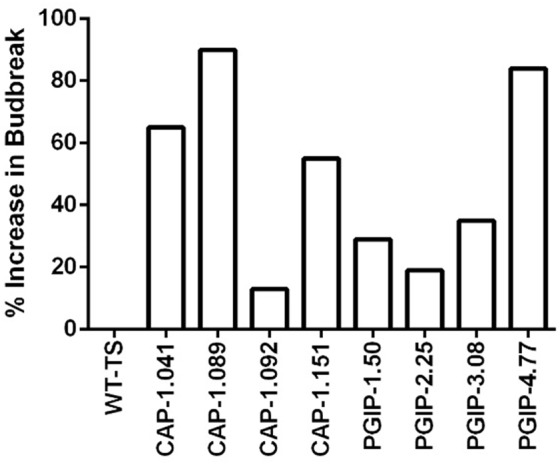
A field study showed that transgenic grapevine rootstocks can provide trans-graft-mediated protection to a wild type scion against Pierce's disease (PD) development. We individually field-tested two distinct strategies. The first expressed a chimeric antimicrobial protein (CAP) that targeted the functionality of the lipopolysaccharide (LPS) surface of (), the causative agent of PD. The second expressed a plant polygalacturonase inhibitory protein (PGIP) that prevents PD by inhibiting breakdown of pectin present in primary cell walls. Both proteins are secreted to the apoplast and then into the xylem, where they migrate past the graft union, transiting into the xylem of the grafted scion. Transgenic cv. Thompson Seedless (TS) expressing ether CAP or PGIP were tested in the greenhouse and those lines that showed resistance to PD were grafted with wild type TS scions. Grafted grapevines were introduced into the field and tested over 7 years. Here we present data on the field evaluation of trans-graft protection using four CAP and four PGIP independent rootstock lines, compared to an untransformed rootstock. There was 30 to 95% reduction in vine mortality among CAP- and PGIP-expressing lines after three successive yearly infections with virulent . Shoot tissues grafted to either CAP or PGIP transgenic rootstocks supported lower pathogen titers and showed fewer disease symptoms. Grafted plants on transgenic rootstocks also had more spring bud break following infection, more shoots, and more vigorous growth compared to those grafted to wild type rootstocks. No yield penalty was observed in the transgenic lines and some PGIP-expressing vines had enhanced yield potential. Trans-graft protection is an efficient way to protect grape scions against PD while preserving their valuable varietal genotypes and clonal properties.
一项田间研究表明,转基因葡萄砧木可以通过转嫁接介导为野生型接穗提供针对皮尔氏病(PD)发展的保护。我们分别在田间测试了两种不同的策略。第一种策略是表达一种嵌合抗菌蛋白(CAP),该蛋白靶向PD病原体()脂多糖(LPS)表面的功能。第二种策略是表达一种植物多聚半乳糖醛酸酶抑制蛋白(PGIP),该蛋白通过抑制存在于初生细胞壁中的果胶分解来预防PD。这两种蛋白都分泌到质外体,然后进入木质部,在木质部中它们迁移通过嫁接结合处,进入嫁接接穗的木质部。在温室中对表达CAP或PGIP的转基因汤普森无核葡萄(TS)品种进行了测试,并将那些对PD表现出抗性的品系与野生型TS接穗进行嫁接。将嫁接的葡萄引入田间并进行了7年的测试。在这里,我们展示了与未转化的砧木相比,使用四个CAP和四个PGIP独立砧木品系进行转嫁接保护的田间评估数据。在用强毒株连续三年感染后,表达CAP和PGIP的品系中葡萄死亡率降低了30%至95%。嫁接到表达CAP或PGIP的转基因砧木上的嫩梢组织支持较低的病原体滴度,并且表现出较少的疾病症状。与嫁接到野生型砧木上的植株相比,嫁接到转基因砧木上的植株在感染后春季萌芽更多、新梢更多且生长更旺盛。在转基因品系中未观察到产量损失,并且一些表达PGIP的葡萄藤产量潜力有所提高。转嫁接保护是保护葡萄接穗免受PD侵害的有效方法,同时保留其有价值的品种基因型和克隆特性。