School of Business Administration, Hohai University, Changzhou 213022, China.
Business School, Hohai University, Nanjing 211100, China.
Int J Environ Res Public Health. 2019 Feb 20;16(4):619. doi: 10.3390/ijerph16040619.
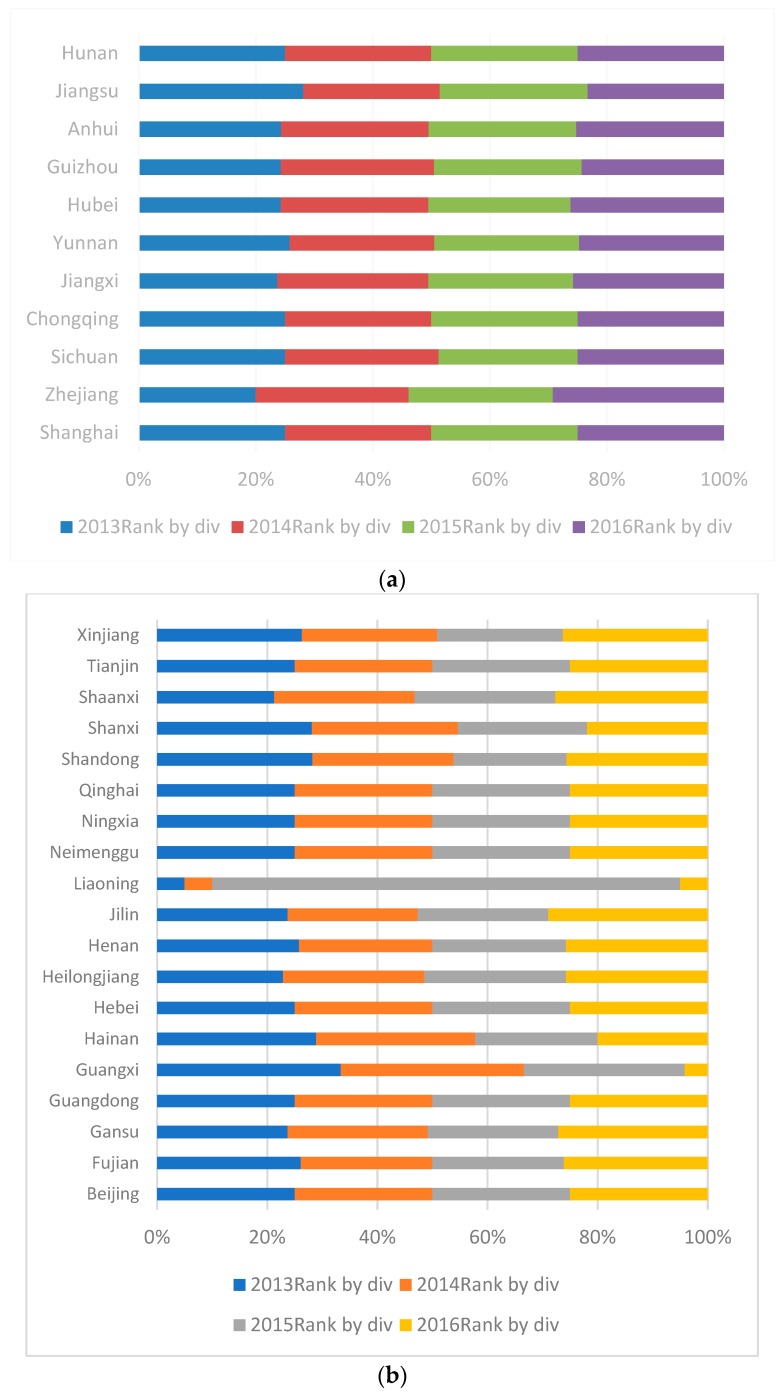
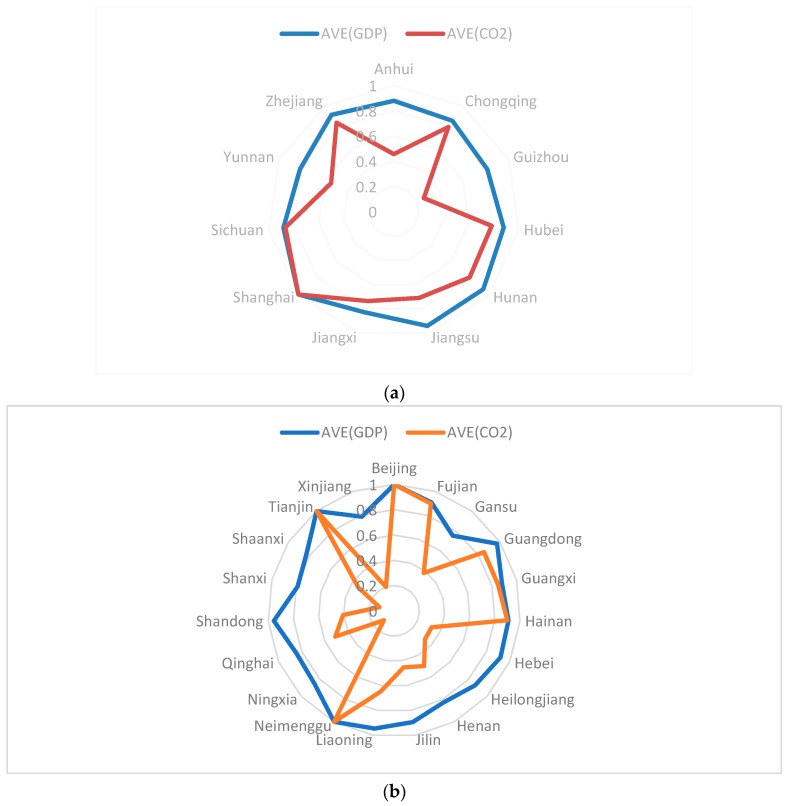
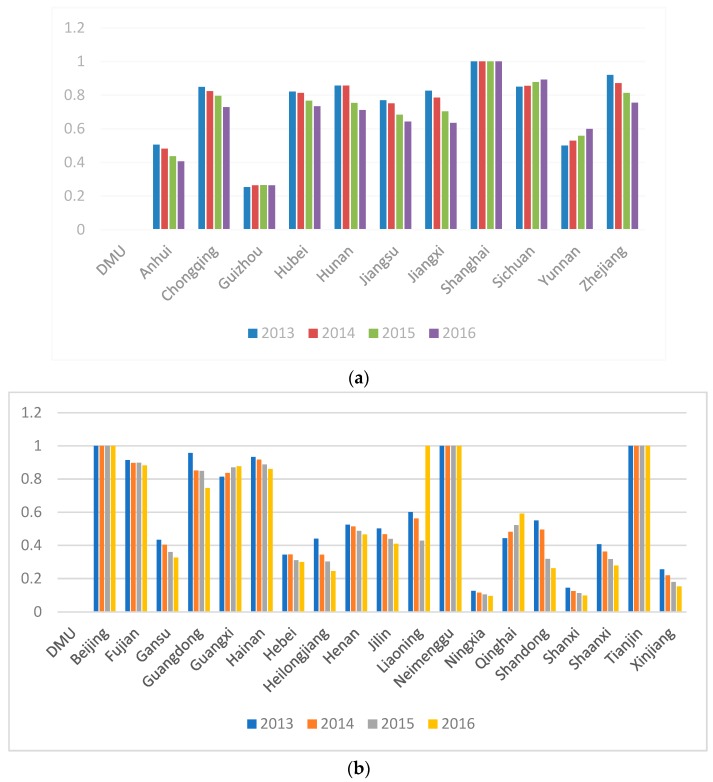
The Yangtze River Economic Belt (YREB) is one of the most important areas for the economic growth of China, but rapid development has caused tremendous damage to the energy and ecological environments of the region. Very few studies have compared the carbon emissions of YREB with that of non-YREB and furthermore, have not considered regional differences and radial or non-radial characteristics in their analysis. This paper thus selects the energy consumption data of 19 provinces and cities in YREB and 19 provinces and cities in non-YREB from 2013 to 2016, constructs the modified meta-frontier Epsilou-based measure (EBM) data envelopment analysis (DEA) model and adds an undesirable factor, energy consumption, and CO₂ emission efficiency of each province and city of the two regions. The results are as follows. (1) China's provinces and cities have different energy efficiency scores in energy consumption, economic growth, and CO₂ emissions. The regional ranks and technology gaps of five provinces and cities in non-YREB and of four provinces and cities in YREB exhibit a decline. Overall, the ranks and technology gaps of the provinces and cities in YREB are significantly lower than those in non-YREB, meaning that there is greater room for efficiency improvement in the latter region. (2) The gross domestic product (GDP) and CO₂ efficiency values of non-YREB provinces present great differences, especially the CO₂ efficiency value that ranges from 0.2 to 1, while their values in YREB are more balanced with little difference between provinces and cities. Thus, YREB is more coordinated in terms of energy savings and air pollutant reduction. (3) Some cities with good economic development such as Beijing, Shanghai, and Tianjin have regional and technology gap values of one, indicating that they not only target economic growth but also address energy savings and air pollutant reduction. The regional rank and technology gap values of some underdeveloped provinces such as Neimenggu, Ningxia, and Qinghai are also one. Finally, this research proposes countermeasures and recommendations to both areas.
长江经济带是中国经济增长的重要区域之一,但快速发展给该地区的能源和生态环境带来了巨大破坏。很少有研究将长江经济带的碳排放与非长江经济带的碳排放进行比较,而且在分析中没有考虑到区域差异和径向或非径向特征。因此,本文选择了 2013 年至 2016 年长江经济带 19 个省市和非长江经济带 19 个省市的能源消费数据,构建了修正的基于超效率 Epsilou 的测度(EBM)数据包络分析(DEA)模型,并加入了一个非期望产出因素,即各省市的能源消费和 CO₂排放效率。结果如下:(1)中国各省市在能源消费、经济增长和 CO₂排放方面的能源效率得分存在差异。非长江经济带的五个省市和长江经济带的四个省市的区域排名和技术差距呈下降趋势。总体而言,长江经济带省市的排名和技术差距明显低于非长江经济带省市,表明后者在提高效率方面有更大的空间。(2)非长江经济带省市的国内生产总值(GDP)和 CO₂效率值差异较大,特别是 CO₂效率值在 0.2 到 1 之间,而长江经济带省市的 GDP 和 CO₂效率值则更为均衡,省市之间的差异较小。因此,长江经济带在节能减排方面更加协调。(3)一些经济发展良好的城市,如北京、上海和天津,其区域和技术差距值为 1,这表明它们不仅以经济增长为目标,还注重节能减排。一些欠发达省份,如内蒙古、宁夏和青海的区域排名和技术差距值也为 1。最后,本文为两个地区提出了对策和建议。