Department of Medicine, Faculty of Medicine, Chulalongkorn University, King Chulalongkorn Memorial Hospital, Bangkok, Thailand.
Research Collaborations in Hematologic Malignancies and Hematopoietic Stem Cell Transplantation, Chulalongkorn University, Bangkok, Thailand.
Blood Adv. 2019 Feb 26;3(4):588-595. doi: 10.1182/bloodadvances.2018028340.
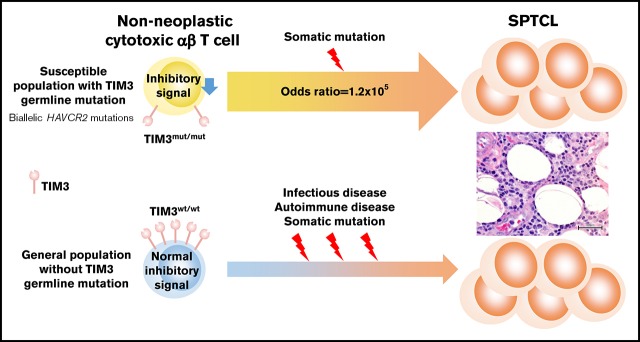
Subcutaneous panniculitis-like T-cell lymphoma (SPTCL) is a rare subtype of peripheral T-cell lymphoma affecting younger patients and associated with hemophagocytic lymphohistiocytosis. To clarify the molecular pathogenesis of SPTCL, we analyzed paired tumor and germline DNAs from 13 patients by whole-exome sequencing. All cases were Asians and were phenotypically sporadic with no family history of SPTCL. Consistent with a recent report, germline mutations in , encoding T-cell immunoglobulin mucin 3 (TIM3), were identified in 11 of 13 (85%) cases. All mutated cases were primary SPTCL, whereas the 2 cases without mutation were secondary SPTCL associated with underlying diseases, including viral infection and autoimmune disease. Ten patients harbored homozygous p.Y82C mutations, and 1 showed compound heterozygous mutations (p.Y82C and p.T101I). Both missense mutations altered highly conserved residues located in the extracellular immunoglobulin variable-like domain. According to the Genome Aggregation Database of >138 500 general individuals, both mutations were documented with minor allele frequencies < 0.007, indicating remarkable enrichment of these alleles in SPTCL. SPTCL cells also harbored somatic mutations (6.2 per patient) that are frequently identified in genes associated with epigenetic regulation and signal transduction. In conclusion, individuals harboring biallelic (TIM3) germline mutations were highly susceptible to sporadic SPTCL, which was also associated with clonal somatic mutations.
皮下脂膜炎样 T 细胞淋巴瘤(SPTCL)是一种罕见的外周 T 细胞淋巴瘤亚型,影响年轻患者,并与噬血细胞性淋巴组织细胞增生症有关。为了阐明 SPTCL 的分子发病机制,我们通过全外显子组测序分析了 13 例患者的配对肿瘤和种系 DNA。所有病例均为亚洲人,表型为散发性,无 SPTCL 家族史。与最近的一项报告一致,在 13 例中的 11 例(85%)中鉴定出编码 T 细胞免疫球蛋白粘蛋白 3(TIM3)的 种系突变。所有突变病例均为原发性 SPTCL,而未发生突变的 2 例为继发于潜在疾病的 SPTCL,包括病毒感染和自身免疫性疾病。10 例患者携带纯合 p.Y82C 突变,1 例显示复合杂合突变(p.Y82C 和 p.T101I)。这两种错义突变改变了位于细胞外免疫球蛋白可变样结构域中的高度保守残基。根据超过 138500 名普通个体的基因组聚合数据库,这两种突变的次要等位基因频率均<0.007,表明这些 等位基因在 SPTCL 中显著富集。SPTCL 细胞还携带体细胞突变(每位患者 6.2 个),这些突变经常在与表观遗传调控和信号转导相关的基因中被发现。总之,携带 种系突变(TIM3)的个体易患散发性 SPTCL,同时也与克隆性体细胞突变相关。