• 文献检索
  • 文档翻译
  • 深度研究
  • 学术资讯
  • Suppr Zotero 插件Zotero 插件
  • 邀请有礼
  • 套餐&价格
  • 历史记录
应用&插件
Suppr Zotero 插件Zotero 插件浏览器插件Mac 客户端Windows 客户端微信小程序
定价
高级版会员购买积分包购买API积分包
服务
文献检索文档翻译深度研究API 文档MCP 服务
关于我们
关于 Suppr公司介绍联系我们用户协议隐私条款
关注我们

Suppr 超能文献

核心技术专利:CN118964589B侵权必究
粤ICP备2023148730 号-1Suppr @ 2026

文献检索

告别复杂PubMed语法,用中文像聊天一样搜索,搜遍4000万医学文献。AI智能推荐,让科研检索更轻松。

立即免费搜索

文件翻译

保留排版,准确专业,支持PDF/Word/PPT等文件格式,支持 12+语言互译。

免费翻译文档

深度研究

AI帮你快速写综述,25分钟生成高质量综述,智能提取关键信息,辅助科研写作。

立即免费体验

免疫检查点TIM-3调节小胶质细胞与阿尔茨海默病。

Immune checkpoint TIM-3 regulates microglia and Alzheimer's disease.

作者信息

Kimura Kimitoshi, Subramanian Ayshwarya, Yin Zhuoran, Khalilnezhad Ahad, Wu Yufan, He Danyang, Dixon Karen O, Chitta Udbhav Kasyap, Ding Xiaokai, Adhikari Niraj, Guzchenko Isabell, Zhang Xiaoming, Tang Ruihan, Pertel Thomas, Myers Samuel A, Aastha Aastha, Nomura Masashi, Eskandari-Sedighi Ghazaleh, Singh Vasundhara, Liu Lei, Lambden Conner, Kleemann Kilian L, Gupta Neha, Barry Jen-Li, Durao Ana, Cheng Yiran, Silveira Sebastian, Zhang Huiyuan, Suhail Aamir, Delorey Toni, Rozenblatt-Rosen Orit, Freeman Gordon J, Selkoe Dennis J, Weiner Howard L, Blurton-Jones Mathew, Cruchaga Carlos, Regev Aviv, Suvà Mario L, Butovsky Oleg, Kuchroo Vijay K

机构信息

The Gene Lay Institute of Immunology and Inflammation, Brigham and Women's Hospital, Massachusetts General Hospital and Harvard Medical School, Boston, MA, USA.

Ann Romney Center for Neurologic Diseases, Brigham and Women's Hospital and Harvard Medical School, Boston, MA, USA.

出版信息

Nature. 2025 May;641(8063):718-731. doi: 10.1038/s41586-025-08852-z. Epub 2025 Apr 9.

DOI:10.1038/s41586-025-08852-z
PMID:40205047
原文链接:https://pmc.ncbi.nlm.nih.gov/articles/PMC12079183/
Abstract

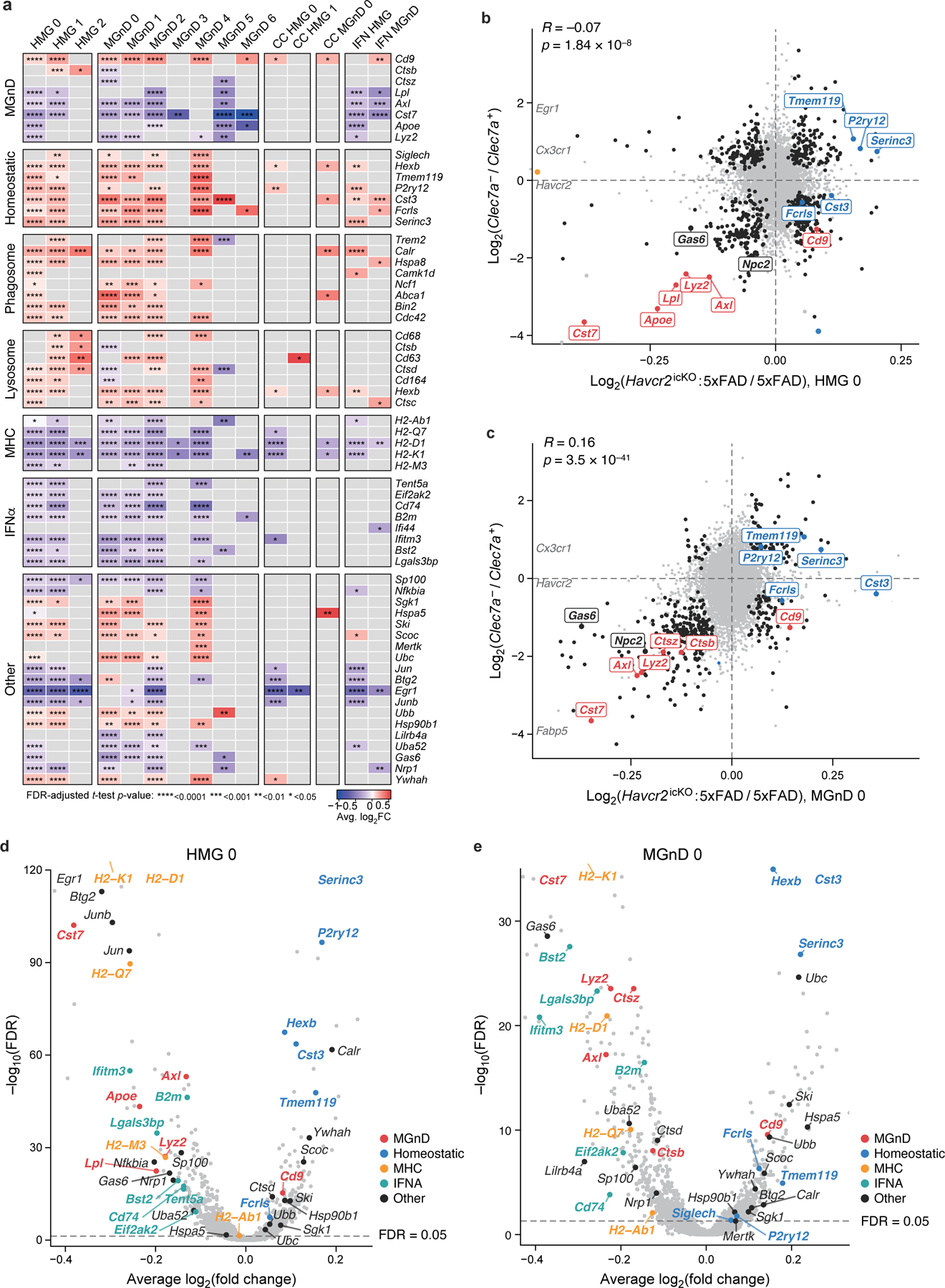
Microglia are the resident immune cells in the brain and have pivotal roles in neurodevelopment and neuroinflammation. This study investigates the function of the immune-checkpoint molecule TIM-3 (encoded by HAVCR2) in microglia. TIM-3 was recently identified as a genetic risk factor for late-onset Alzheimer's disease, and it can induce T cell exhaustion. However, its specific function in brain microglia remains unclear. We demonstrate in mouse models that TGFβ signalling induces TIM-3 expression in microglia. In turn, TIM-3 interacts with SMAD2 and TGFBR2 through its carboxy-terminal tail, which enhances TGFβ signalling by promoting TGFBR-mediated SMAD2 phosphorylation, and this process maintains microglial homeostasis. Genetic deletion of Havcr2 in microglia leads to increased phagocytic activity and a gene-expression profile consistent with the neurodegenerative microglial phenotype (MGnD), also referred to as disease-associated microglia (DAM). Furthermore, microglia-targeted deletion of Havcr2 ameliorates cognitive impairment and reduces amyloid-β pathology in 5×FAD mice (a transgenic model of Alzheimer's disease). Single-nucleus RNA sequencing revealed a subpopulation of MGnD microglia in Havcr2-deficient 5×FAD mice characterized by increased pro-phagocytic and anti-inflammatory gene expression alongside reduced pro-inflammatory gene expression. These transcriptomic changes were corroborated by single-cell RNA sequencing data across most microglial clusters in Havcr2-deficient 5×FAD mice. Our findings reveal that TIM-3 mediates microglia homeostasis through TGFβ signalling and highlight the therapeutic potential of targeting microglial TIM-3 in Alzheimer's disease.

摘要

小胶质细胞是大脑中的常驻免疫细胞,在神经发育和神经炎症中起关键作用。本研究调查了免疫检查点分子TIM-3(由HAVCR2编码)在小胶质细胞中的功能。TIM-3最近被确定为晚发性阿尔茨海默病的遗传风险因素,并且它可以诱导T细胞耗竭。然而,其在脑小胶质细胞中的具体功能仍不清楚。我们在小鼠模型中证明,TGFβ信号传导诱导小胶质细胞中TIM-3的表达。反过来,TIM-3通过其羧基末端尾巴与SMAD2和TGFBR2相互作用,通过促进TGFBR介导的SMAD2磷酸化来增强TGFβ信号传导,并且这个过程维持小胶质细胞的稳态。小胶质细胞中Havcr2的基因缺失导致吞噬活性增加以及与神经退行性小胶质细胞表型(MGnD,也称为疾病相关小胶质细胞(DAM))一致的基因表达谱。此外,小胶质细胞靶向缺失Havcr2可改善5×FAD小鼠(阿尔茨海默病的转基因模型)的认知障碍并减少淀粉样β病理。单核RNA测序揭示了Havcr2缺陷型5×FAD小鼠中MGnD小胶质细胞的一个亚群,其特征是促吞噬和抗炎基因表达增加,同时促炎基因表达减少。这些转录组变化在Havcr2缺陷型5×FAD小鼠的大多数小胶质细胞簇的单细胞RNA测序数据中得到了证实。我们的研究结果表明,TIM-3通过TGFβ信号传导介导小胶质细胞稳态,并突出了靶向小胶质细胞TIM-3在阿尔茨海默病中的治疗潜力。

https://cdn.ncbi.nlm.nih.gov/pmc/blobs/d0d9/12079183/e3ff5c04293b/nihms-2075434-f0005.jpg
https://cdn.ncbi.nlm.nih.gov/pmc/blobs/d0d9/12079183/b7c0faaa3080/nihms-2075434-f0006.jpg
https://cdn.ncbi.nlm.nih.gov/pmc/blobs/d0d9/12079183/2536d9c842ea/nihms-2075434-f0007.jpg
https://cdn.ncbi.nlm.nih.gov/pmc/blobs/d0d9/12079183/20101b8afd70/nihms-2075434-f0008.jpg
https://cdn.ncbi.nlm.nih.gov/pmc/blobs/d0d9/12079183/55363e19722a/nihms-2075434-f0009.jpg
https://cdn.ncbi.nlm.nih.gov/pmc/blobs/d0d9/12079183/62f46a48c764/nihms-2075434-f0010.jpg
https://cdn.ncbi.nlm.nih.gov/pmc/blobs/d0d9/12079183/83690106e0e1/nihms-2075434-f0011.jpg
https://cdn.ncbi.nlm.nih.gov/pmc/blobs/d0d9/12079183/17b7b19526e3/nihms-2075434-f0012.jpg
https://cdn.ncbi.nlm.nih.gov/pmc/blobs/d0d9/12079183/103becbfda0a/nihms-2075434-f0013.jpg
https://cdn.ncbi.nlm.nih.gov/pmc/blobs/d0d9/12079183/73d584dcb415/nihms-2075434-f0014.jpg
https://cdn.ncbi.nlm.nih.gov/pmc/blobs/d0d9/12079183/ef278953a9ac/nihms-2075434-f0015.jpg
https://cdn.ncbi.nlm.nih.gov/pmc/blobs/d0d9/12079183/cc18e2553e73/nihms-2075434-f0016.jpg
https://cdn.ncbi.nlm.nih.gov/pmc/blobs/d0d9/12079183/eda6fe2d17ce/nihms-2075434-f0017.jpg
https://cdn.ncbi.nlm.nih.gov/pmc/blobs/d0d9/12079183/1e7b8039940b/nihms-2075434-f0018.jpg
https://cdn.ncbi.nlm.nih.gov/pmc/blobs/d0d9/12079183/649db9f74f9d/nihms-2075434-f0001.jpg
https://cdn.ncbi.nlm.nih.gov/pmc/blobs/d0d9/12079183/d07573d5b36d/nihms-2075434-f0002.jpg
https://cdn.ncbi.nlm.nih.gov/pmc/blobs/d0d9/12079183/005d836a5d1a/nihms-2075434-f0003.jpg
https://cdn.ncbi.nlm.nih.gov/pmc/blobs/d0d9/12079183/dd18126a26d0/nihms-2075434-f0004.jpg
https://cdn.ncbi.nlm.nih.gov/pmc/blobs/d0d9/12079183/e3ff5c04293b/nihms-2075434-f0005.jpg
https://cdn.ncbi.nlm.nih.gov/pmc/blobs/d0d9/12079183/b7c0faaa3080/nihms-2075434-f0006.jpg
https://cdn.ncbi.nlm.nih.gov/pmc/blobs/d0d9/12079183/2536d9c842ea/nihms-2075434-f0007.jpg
https://cdn.ncbi.nlm.nih.gov/pmc/blobs/d0d9/12079183/20101b8afd70/nihms-2075434-f0008.jpg
https://cdn.ncbi.nlm.nih.gov/pmc/blobs/d0d9/12079183/55363e19722a/nihms-2075434-f0009.jpg
https://cdn.ncbi.nlm.nih.gov/pmc/blobs/d0d9/12079183/62f46a48c764/nihms-2075434-f0010.jpg
https://cdn.ncbi.nlm.nih.gov/pmc/blobs/d0d9/12079183/83690106e0e1/nihms-2075434-f0011.jpg
https://cdn.ncbi.nlm.nih.gov/pmc/blobs/d0d9/12079183/17b7b19526e3/nihms-2075434-f0012.jpg
https://cdn.ncbi.nlm.nih.gov/pmc/blobs/d0d9/12079183/103becbfda0a/nihms-2075434-f0013.jpg
https://cdn.ncbi.nlm.nih.gov/pmc/blobs/d0d9/12079183/73d584dcb415/nihms-2075434-f0014.jpg
https://cdn.ncbi.nlm.nih.gov/pmc/blobs/d0d9/12079183/ef278953a9ac/nihms-2075434-f0015.jpg
https://cdn.ncbi.nlm.nih.gov/pmc/blobs/d0d9/12079183/cc18e2553e73/nihms-2075434-f0016.jpg
https://cdn.ncbi.nlm.nih.gov/pmc/blobs/d0d9/12079183/eda6fe2d17ce/nihms-2075434-f0017.jpg
https://cdn.ncbi.nlm.nih.gov/pmc/blobs/d0d9/12079183/1e7b8039940b/nihms-2075434-f0018.jpg
https://cdn.ncbi.nlm.nih.gov/pmc/blobs/d0d9/12079183/649db9f74f9d/nihms-2075434-f0001.jpg
https://cdn.ncbi.nlm.nih.gov/pmc/blobs/d0d9/12079183/d07573d5b36d/nihms-2075434-f0002.jpg
https://cdn.ncbi.nlm.nih.gov/pmc/blobs/d0d9/12079183/005d836a5d1a/nihms-2075434-f0003.jpg
https://cdn.ncbi.nlm.nih.gov/pmc/blobs/d0d9/12079183/dd18126a26d0/nihms-2075434-f0004.jpg
https://cdn.ncbi.nlm.nih.gov/pmc/blobs/d0d9/12079183/e3ff5c04293b/nihms-2075434-f0005.jpg

相似文献

1
Immune checkpoint TIM-3 regulates microglia and Alzheimer's disease.免疫检查点TIM-3调节小胶质细胞与阿尔茨海默病。
Nature. 2025 May;641(8063):718-731. doi: 10.1038/s41586-025-08852-z. Epub 2025 Apr 9.
2
Microglial TLR4-Lyn kinase is a critical regulator of neuroinflammation, Aβ phagocytosis, neuronal damage, and cell survival in Alzheimer's disease.小胶质细胞Toll样受体4-淋巴细胞特异性酪氨酸蛋白激酶是阿尔茨海默病中神经炎症、β-淀粉样蛋白吞噬作用、神经元损伤和细胞存活的关键调节因子。
Sci Rep. 2025 Apr 3;15(1):11368. doi: 10.1038/s41598-025-96456-y.
3
Asrij/OCIAD1 depletion reduces inflammatory microglial activation and ameliorates Aβ pathology in an Alzheimer's disease mouse model.在阿尔茨海默病小鼠模型中,Asrij/OCIAD1缺失可减少炎症性小胶质细胞激活并改善Aβ病理状态。
J Neuroinflammation. 2025 Mar 20;22(1):89. doi: 10.1186/s12974-025-03415-5.
4
Identification of a protective microglial state mediated by miR-155 and interferon-γ signaling in a mouse model of Alzheimer's disease.阿尔茨海默病小鼠模型中 miR-155 和干扰素-γ 信号介导的保护性小胶质细胞状态的鉴定。
Nat Neurosci. 2023 Jul;26(7):1196-1207. doi: 10.1038/s41593-023-01355-y. Epub 2023 Jun 8.
5
Fatty acid amide hydrolase gene inactivation induces hetero-cellular potentiation of microglial function in the 5xFAD mouse model of Alzheimer's disease.脂肪酸酰胺水解酶基因失活在阿尔茨海默病的5xFAD小鼠模型中诱导小胶质细胞功能的异细胞增强。
Glia. 2025 Feb;73(2):352-367. doi: 10.1002/glia.24638. Epub 2024 Oct 30.
6
Delta-opioid receptor signaling alleviates neuropathology and cognitive impairment in the mouse model of Alzheimer's disease by regulating microglia homeostasis and inhibiting HMGB1 pathway.δ-阿片受体信号传导通过调节小胶质细胞稳态和抑制高迁移率族蛋白B1(HMGB1)通路,减轻阿尔茨海默病小鼠模型的神经病理学变化和认知障碍。
Alzheimers Res Ther. 2025 Feb 1;17(1):35. doi: 10.1186/s13195-025-01682-1.
7
Fibrillar Aβ triggers microglial proteome alterations and dysfunction in Alzheimer mouse models.纤维状 Aβ 在阿尔茨海默病小鼠模型中引发小胶质细胞蛋白质组改变和功能障碍。
Elife. 2020 Jun 8;9:e54083. doi: 10.7554/eLife.54083.
8
APOE4 impairs the microglial response in Alzheimer's disease by inducing TGFβ-mediated checkpoints.载脂蛋白 E4 通过诱导 TGFβ 介导的检查点来损害阿尔茨海默病中的小胶质细胞反应。
Nat Immunol. 2023 Nov;24(11):1839-1853. doi: 10.1038/s41590-023-01627-6. Epub 2023 Sep 25.
9
Identification and therapeutic modulation of a pro-inflammatory subset of disease-associated-microglia in Alzheimer's disease.鉴定和治疗阿尔茨海默病中与疾病相关的小胶质细胞的促炎亚群。
Mol Neurodegener. 2018 May 21;13(1):24. doi: 10.1186/s13024-018-0254-8.
10
Gossypetin ameliorates 5xFAD spatial learning and memory through enhanced phagocytosis against Aβ.棉子低聚糖通过增强对 Aβ 的吞噬作用来改善 5xFAD 空间学习和记忆。
Alzheimers Res Ther. 2022 Oct 21;14(1):158. doi: 10.1186/s13195-022-01096-3.

引用本文的文献

1
Beyond Neuroinflammation: Microglia at the Crossroads of Amyloid, Tau, and Neurodegeneration in Alzheimer's Disease.超越神经炎症:阿尔茨海默病中处于淀粉样蛋白、tau蛋白和神经退行性变交叉点的小胶质细胞
Neurol Sci. 2025 Aug 19. doi: 10.1007/s10072-025-08403-4.
2
Into the Spotlight: Microglia in the Peripheral Nervous System.聚焦:外周神经系统中的小胶质细胞
Neurosci Bull. 2025 Jul 18. doi: 10.1007/s12264-025-01466-5.
3
Commentary on differential impact of TIM-3 ligands on NK cell function.关于TIM-3配体对自然杀伤细胞功能的差异影响的评论

本文引用的文献

1
Sex-dependent APOE4 neutrophil-microglia interactions drive cognitive impairment in Alzheimer's disease.性别依赖的 APOE4 中性粒细胞-小胶质细胞相互作用导致阿尔茨海默病的认知障碍。
Nat Med. 2024 Oct;30(10):2990-3003. doi: 10.1038/s41591-024-03122-3. Epub 2024 Jul 3.
2
Human microglial state dynamics in Alzheimer's disease progression.阿尔茨海默病进展过程中的人类小胶质细胞状态动态变化。
Cell. 2023 Sep 28;186(20):4386-4403.e29. doi: 10.1016/j.cell.2023.08.037.
3
APOE4 impairs the microglial response in Alzheimer's disease by inducing TGFβ-mediated checkpoints.
J Immunother Cancer. 2025 Jul 11;13(7):e012125. doi: 10.1136/jitc-2025-012125.
4
Inflamed Microglia like Macrophages in the Central Nervous System of Prodromal Parkinson's Disease.前驱期帕金森病中枢神经系统中类似巨噬细胞的炎性小胶质细胞。
bioRxiv. 2025 May 21:2025.05.16.654530. doi: 10.1101/2025.05.16.654530.
载脂蛋白 E4 通过诱导 TGFβ 介导的检查点来损害阿尔茨海默病中的小胶质细胞反应。
Nat Immunol. 2023 Nov;24(11):1839-1853. doi: 10.1038/s41590-023-01627-6. Epub 2023 Sep 25.
4
PD-L1 positive astrocytes attenuate inflammatory functions of PD-1 positive microglia in models of autoimmune neuroinflammation.PD-L1 阳性星形胶质细胞可减弱自身免疫性神经炎症模型中 PD-1 阳性小胶质细胞的炎症功能。
Nat Commun. 2023 Sep 9;14(1):5555. doi: 10.1038/s41467-023-40982-8.
5
CXCR6 orchestrates brain CD8 T cell residency and limits mouse Alzheimer's disease pathology.CXCR6 调控大脑 CD8 T 细胞的定居,并限制小鼠阿尔茨海默病的病理。
Nat Immunol. 2023 Oct;24(10):1735-1747. doi: 10.1038/s41590-023-01604-z. Epub 2023 Sep 7.
6
cGAS-STING drives ageing-related inflammation and neurodegeneration.cGAS-STING 驱动与衰老相关的炎症和神经退行性变。
Nature. 2023 Aug;620(7973):374-380. doi: 10.1038/s41586-023-06373-1. Epub 2023 Aug 2.
7
Identification of a protective microglial state mediated by miR-155 and interferon-γ signaling in a mouse model of Alzheimer's disease.阿尔茨海默病小鼠模型中 miR-155 和干扰素-γ 信号介导的保护性小胶质细胞状态的鉴定。
Nat Neurosci. 2023 Jul;26(7):1196-1207. doi: 10.1038/s41593-023-01355-y. Epub 2023 Jun 8.
8
Hypoxia compromises the mitochondrial metabolism of Alzheimer's disease microglia via HIF1.缺氧通过 HIF1 损害阿尔茨海默病小胶质细胞的线粒体代谢。
Nat Aging. 2021 Apr;1(4):385-399. doi: 10.1038/s43587-021-00054-2. Epub 2021 Apr 15.
9
Tau activation of microglial cGAS-IFN reduces MEF2C-mediated cognitive resilience.tau 激活小胶质细胞的 cGAS-IFN 减少 MEF2C 介导的认知弹性。
Nat Neurosci. 2023 May;26(5):737-750. doi: 10.1038/s41593-023-01315-6. Epub 2023 Apr 24.
10
Microglia-mediated T cell infiltration drives neurodegeneration in tauopathy.小胶质细胞介导的 T 细胞浸润驱动神经退行性变在 tau 病中。
Nature. 2023 Mar;615(7953):668-677. doi: 10.1038/s41586-023-05788-0. Epub 2023 Mar 8.