School of Biotechnology and Biomolecular Sciences, University of New South Wales, Sydney, NSW, 2052, Australia.
Department of Molecular Biology, Princeton, NJ, 08544-1014, USA.
Nat Commun. 2019 Feb 21;10(1):888. doi: 10.1038/s41467-019-08866-y.
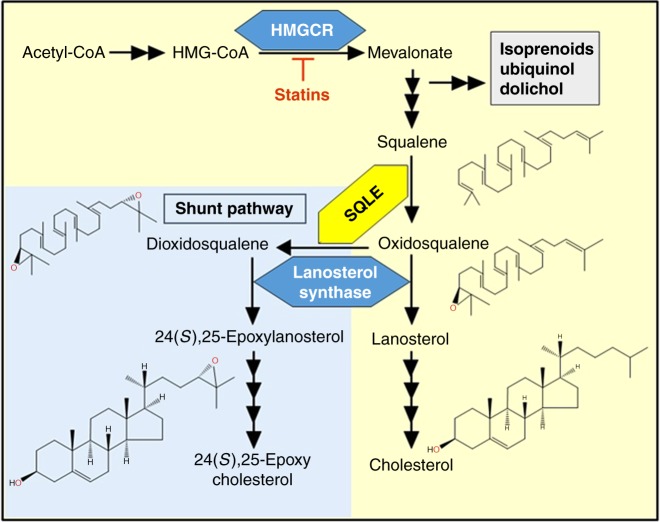
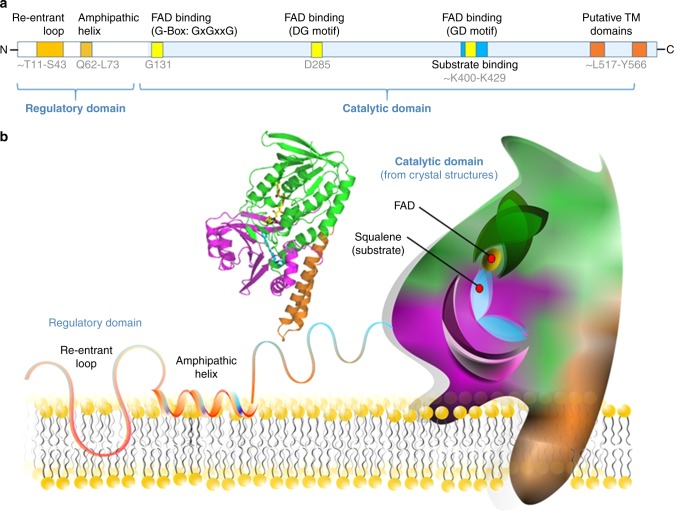
Squalene epoxidase (also known as squalene monooxygenase, EC 1.14.99.7) is a key rate-limiting enzyme in cholesterol biosynthesis. Anil Padyana and colleagues report the long awaited structure of human squalene epoxidase (SQLE). They solved the crystal structure of the catalytic domain of human SQLE alone and in complex with two similar pharmacological inhibitors and elucidate their mechanism of action. SQLE is the target of fungicides and of increasing interest in human health and disease, particularly as a new anti-cancer target. Indeed, in a companion paper, Christopher Mahoney and colleagues performed an inhibitor screen with cancer cell lines and identified SQLE as an unique vulnerability in a subset of neuroendocrine tumours, where SQLE inhibition caused a toxic accumulation of the substrate squalene. The SQLE structure will facilitate the development of improved inhibitors. Here, we comment on these two studies in the wider context of the field and discuss possible future directions.
鲨烯环氧化酶(也称为鲨烯单加氧酶,EC 1.14.99.7)是胆固醇生物合成中的关键限速酶。Anil Padyana 及其同事报告了人们期待已久的人鲨烯环氧化酶(SQLE)的结构。他们分别单独和与两种类似的药理学抑制剂复合物形式解析了人 SQLE 的催化结构域的晶体结构,并阐明了其作用机制。SQLE 是杀菌剂的作用靶点,并且在人类健康和疾病方面的关注度不断增加,特别是作为新的抗癌靶点。事实上,在一篇相关的论文中,Christopher Mahoney 及其同事在癌细胞系中进行了抑制剂筛选,并发现 SQLE 是神经内分泌肿瘤亚群中的一个独特弱点,其中 SQLE 抑制导致底物鲨烯的有毒积累。SQLE 结构将促进更好抑制剂的开发。在这里,我们在更广泛的领域背景下对这两项研究进行了评论,并讨论了可能的未来方向。