• 文献检索
  • 文档翻译
  • 深度研究
  • 学术资讯
  • Suppr Zotero 插件Zotero 插件
  • 邀请有礼
  • 套餐&价格
  • 历史记录
应用&插件
Suppr Zotero 插件Zotero 插件浏览器插件Mac 客户端Windows 客户端微信小程序
定价
高级版会员购买积分包购买API积分包
服务
文献检索文档翻译深度研究API 文档MCP 服务
关于我们
关于 Suppr公司介绍联系我们用户协议隐私条款
关注我们

Suppr 超能文献

核心技术专利:CN118964589B侵权必究
粤ICP备2023148730 号-1Suppr @ 2026

文献检索

告别复杂PubMed语法,用中文像聊天一样搜索,搜遍4000万医学文献。AI智能推荐,让科研检索更轻松。

立即免费搜索

文件翻译

保留排版,准确专业,支持PDF/Word/PPT等文件格式,支持 12+语言互译。

免费翻译文档

深度研究

AI帮你快速写综述,25分钟生成高质量综述,智能提取关键信息,辅助科研写作。

立即免费体验

论人类意识:数学视角

On human consciousness: A mathematical perspective.

作者信息

Grindrod Peter

机构信息

Mathematical Institute, University of Oxford, United Kingdom.

出版信息

Netw Neurosci. 2018 Mar 1;2(1):23-40. doi: 10.1162/NETN_a_00030. eCollection 2018.

DOI:10.1162/NETN_a_00030
PMID:30793070
原文链接:https://pmc.ncbi.nlm.nih.gov/articles/PMC6353040/
Abstract

We consider the implications of the mathematical modeling and analysis of large modular neuron-to-neuron dynamical networks. We explain how the dynamical behavior of relatively small-scale strongly connected networks leads naturally to nonbinary information processing and thus to multiple hypothesis decision-making, even at the very lowest level of the brain's architecture. In turn we build on these ideas to address some aspects of the hard problem of consciousness. These include how feelings might arise within an architecture with a foundational decision-making and classification layer of . We discuss how a proposed "dual hierarchy model," made up from both externally perceived, physical elements of increasing complexity, and internally experienced, mental elements (which we argue are equivalent to feelings), may support aspects of a learning and evolving consciousness. We introduce the idea that a human brain ought to be able to reconjure subjective mental feelings at will, and thus these feelings cannot depend on internal chatter or internal instability-driven activity (patterns). An immediate consequence of this model, grounded in dynamical systems and nonbinary information processing, is that finite human brains must always be learning and forgetting and that any possible subjective internal feeling that might be fully idealized with a countable infinity of facets could never be learned completely a priori by zombies or automata. It may be experienced more and more fully by an evolving human brain (yet never in totality, not even in a lifetime). We argue that, within our model, the mental elements and thus internal modes (feelings) play a role akin to latent variables in processing and decision-making, and thus confer an evolutionary "fast-thinking" advantage.

摘要

我们考虑大型模块化神经元到神经元动态网络的数学建模与分析所带来的影响。我们解释了相对小规模的强连通网络的动态行为如何自然地导致非二进制信息处理,进而导致多假设决策,即使是在大脑结构的最底层。反过来,我们基于这些想法来探讨意识难题的一些方面。这些方面包括在具有基础决策和分类层的架构中感觉是如何产生的。我们讨论了一个提出的“双重层次模型”,它由外部感知的、复杂度不断增加的物理元素以及内部体验的心理元素(我们认为等同于感觉)组成,该模型如何支持学习和进化意识的各个方面。我们提出这样的观点,即人类大脑应该能够随意重新唤起主观心理感觉,因此这些感觉不能依赖于内部闲聊或内部不稳定驱动的活动(模式)。基于动态系统和非二进制信息处理的这个模型的一个直接结果是,有限的人类大脑必须始终处于学习和遗忘状态,并且任何可能具有可数无穷多个方面且能被完全理想化的主观内部感觉,僵尸或自动机永远无法先验地完全学会。进化中的人类大脑可能会越来越充分地体验到这种感觉(但永远无法完全体验,即使一生也不行)。我们认为,在我们的模型中,心理元素以及因此的内部模式(感觉)在处理和决策中起着类似于潜在变量的作用,从而赋予进化上的“快速思考”优势。
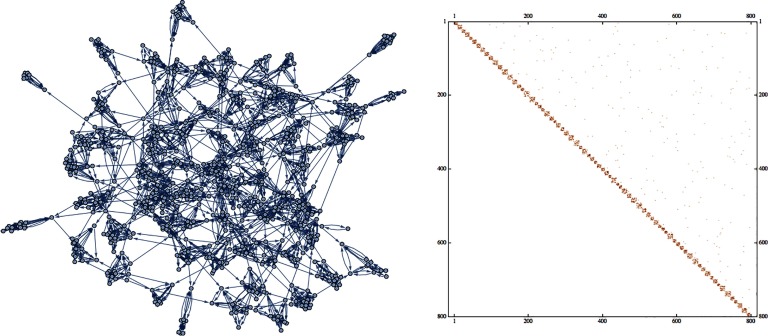
https://cdn.ncbi.nlm.nih.gov/pmc/blobs/7197/6353040/c6f08fd4ca62/netn-02-23-f003.jpg
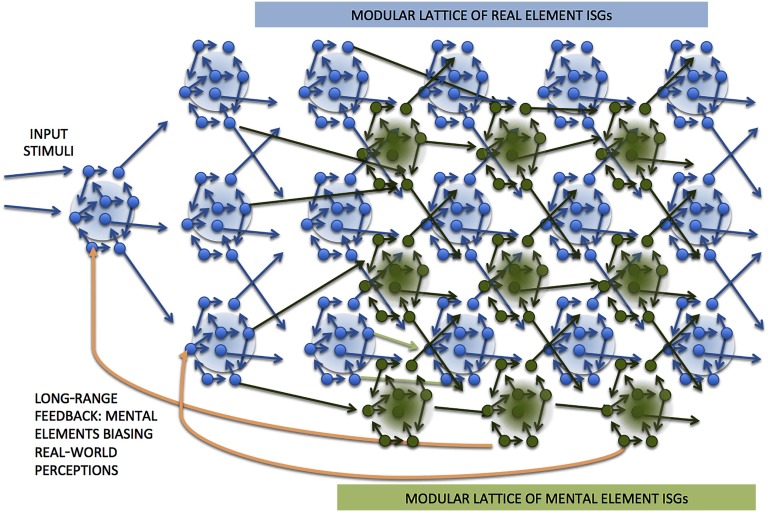
https://cdn.ncbi.nlm.nih.gov/pmc/blobs/7197/6353040/9efff3588485/netn-02-23-f001.jpg
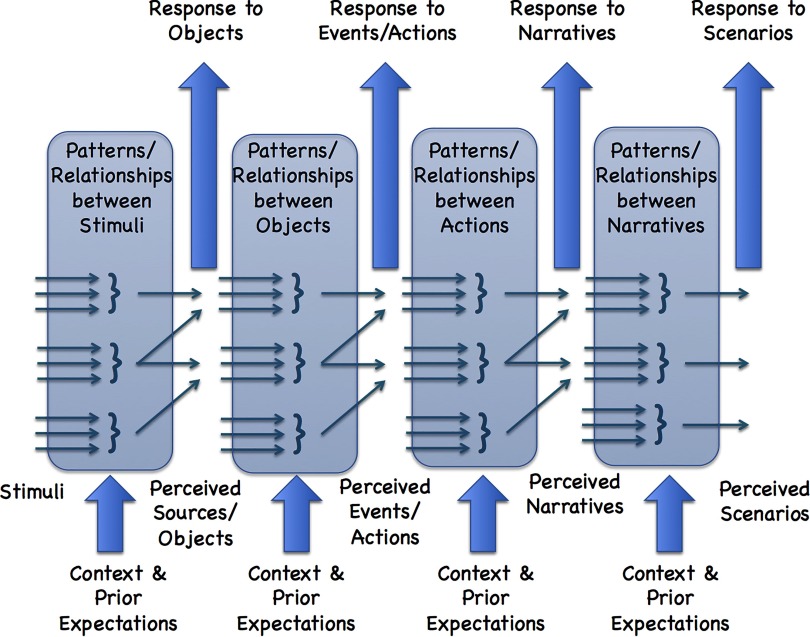
https://cdn.ncbi.nlm.nih.gov/pmc/blobs/7197/6353040/bb8723cdab40/netn-02-23-f002.jpg
https://cdn.ncbi.nlm.nih.gov/pmc/blobs/7197/6353040/c6f08fd4ca62/netn-02-23-f003.jpg
https://cdn.ncbi.nlm.nih.gov/pmc/blobs/7197/6353040/9efff3588485/netn-02-23-f001.jpg
https://cdn.ncbi.nlm.nih.gov/pmc/blobs/7197/6353040/bb8723cdab40/netn-02-23-f002.jpg
https://cdn.ncbi.nlm.nih.gov/pmc/blobs/7197/6353040/c6f08fd4ca62/netn-02-23-f003.jpg

相似文献

1
On human consciousness: A mathematical perspective.论人类意识:数学视角
Netw Neurosci. 2018 Mar 1;2(1):23-40. doi: 10.1162/NETN_a_00030. eCollection 2018.
2
Cognition and Consciousness Entwined.认知与意识相互交织。
Brain Sci. 2023 May 28;13(6):872. doi: 10.3390/brainsci13060872.
3
Risk and Rationality in Adolescent Decision Making: Implications for Theory, Practice, and Public Policy.青少年决策中的风险与理性:对理论、实践和公共政策的启示。
Psychol Sci Public Interest. 2006 Sep;7(1):1-44. doi: 10.1111/j.1529-1006.2006.00026.x. Epub 2006 Sep 1.
4
Networks of conscious experience: computational neuroscience in understanding life, death, and consciousness.意识体验网络:理解生命、死亡和意识的计算神经科学。
Rev Neurosci. 2009;20(3-4):151-76. doi: 10.1515/revneuro.2009.20.3-4.151.
5
Consciousness: a neural capacity for objectivity, especially pronounced in humans.意识:一种具有客观性的神经能力,在人类中尤为明显。
Front Psychol. 2014 Mar 17;5:223. doi: 10.3389/fpsyg.2014.00223. eCollection 2014.
6
Affective consciousness: Core emotional feelings in animals and humans.情感意识:动物和人类的核心情感感受。
Conscious Cogn. 2005 Mar;14(1):30-80. doi: 10.1016/j.concog.2004.10.004.
7
Consciousness, biology and quantum hypotheses.意识、生物学与量子假说。
Phys Life Rev. 2012 Sep;9(3):285-94. doi: 10.1016/j.plrev.2012.07.001. Epub 2012 Jul 10.
8
A systematic approach to brain dynamics: cognitive evolution theory of consciousness.一种研究大脑动力学的系统方法:意识的认知进化理论。
Cogn Neurodyn. 2023 Jun;17(3):575-603. doi: 10.1007/s11571-022-09863-6. Epub 2022 Aug 10.
9
Visual anticipation biases conscious decision making but not bottom-up visual processing.视觉预期会影响有意识的决策,但不会影响自下而上的视觉加工。
Front Psychol. 2015 Jan 30;5:1443. doi: 10.3389/fpsyg.2014.01443. eCollection 2014.
10
Performance of a Computational Model of the Mammalian Olfactory System哺乳动物嗅觉系统计算模型的性能

引用本文的文献

1
Dynamical Systems on Generalised Klein Bottles.广义克莱因瓶上的动力系统
Entropy (Basel). 2025 Jan 24;27(2):119. doi: 10.3390/e27020119.
2
Interior Operators and Their Relationship to Autocatalytic Networks.内部操作子及其与自动催化网络的关系。
Acta Biotheor. 2023 Oct 27;71(4):21. doi: 10.1007/s10441-023-09472-8.
3
Cognition and Consciousness Entwined.认知与意识相互交织。

本文引用的文献

1
On strongly connected networks with excitable-refractory dynamics and delayed coupling.关于具有可激发-不应期动力学和延迟耦合的强连通网络。
R Soc Open Sci. 2017 Apr 5;4(4):160912. doi: 10.1098/rsos.160912. eCollection 2017 Apr.
2
Life as we know it.我们所了解的生命。
J R Soc Interface. 2013 Jul 3;10(86):20130475. doi: 10.1098/rsif.2013.0475. Print 2013 Sep 6.
3
Modular and hierarchically modular organization of brain networks.大脑网络的模块化和层次模块化组织。
Brain Sci. 2023 May 28;13(6):872. doi: 10.3390/brainsci13060872.
4
Mathematical Models of Consciousness.意识的数学模型
Entropy (Basel). 2020 May 30;22(6):609. doi: 10.3390/e22060609.
5
From Learning to Consciousness: An Example Using Expected Float Entropy Minimisation.从学习到意识:一个使用预期浮动熵最小化的例子。
Entropy (Basel). 2019 Jan 13;21(1):60. doi: 10.3390/e21010060.
Front Neurosci. 2010 Dec 8;4:200. doi: 10.3389/fnins.2010.00200. eCollection 2010.